1. In the magnificent and spacious Grecian
city of Ephesus an antient law was made by the ancestors of the
inhabitants, hard indeed in its nature, but nevertheless equitable. When an
architect was entrusted with the execution of a public work, an estimate thereof
being lodged in the hands of a magistrate, his property was held, as security,
until the work was finished. If, when finished, the expense did not exceed the
estimate, he was complimented with decrees and honours. So when the excess did
not amount to more than a fourth part of the original estimate, it was defrayed
by the public, and no punishment was inflicted. But when more than one-fourth of
the estimate was exceeded, he was required to pay the excess out of his own
pocket.
law was made by the ancestors of the
inhabitants, hard indeed in its nature, but nevertheless equitable. When an
architect was entrusted with the execution of a public work, an estimate thereof
being lodged in the hands of a magistrate, his property was held, as security,
until the work was finished. If, when finished, the expense did not exceed the
estimate, he was complimented with decrees and honours. So when the excess did
not amount to more than a fourth part of the original estimate, it was defrayed
by the public, and no punishment was inflicted. But when more than one-fourth of
the estimate was exceeded, he was required to pay the excess out of his own
pocket.
2. Would to God that such a law existed among
the Roman people, not only in respect of their public, but also of their private
buildings, for then the unskilful could not commit their depredations with
impunity, and those who were the most skilful in the intricacies of the art
would follow the profession. Proprietors would not be led into an extravagant
expenditure so as to cause ruin; architects themselves, from the dread of
punishment, would be more careful in their calculations, and the proprietor
would complete his building for that sum, or a little more, which he could
afford to expend. Those who can conveniently expend a given sum on any work,
with the pleasing expectation of seeing it completed would cheerfully add
one-fourth more; but when they find themselves burdened with the addition of
half or even more than half of the expense originally contemplated, losing their
spirits, and sacrificing what has already been laid out, they incline to desist
from its completion.
3. Nor is this an evil which occurs in
buildings alone, but also in the shows of gladiators in
the Forum, and in the scenes of plays
exhibited by the magistrates, in which neither delay nor hindrance is admitted,
since there is a necessity for their being completed by a certain time. Thus the
seats for viewing the shows, the machinery for drawing the Vela, and the contrivances for shifting
the scenes, must all be prepared by a given day, that the people may not be
disappointed. And in the preparation of all these much readiness and profound
thought must be exercised, because they cannot be executed without machinery,
and the application of varied and extensive studies.
and in the scenes of plays
exhibited by the magistrates, in which neither delay nor hindrance is admitted,
since there is a necessity for their being completed by a certain time. Thus the
seats for viewing the shows, the machinery for drawing the Vela, and the contrivances for shifting
the scenes, must all be prepared by a given day, that the people may not be
disappointed. And in the preparation of all these much readiness and profound
thought must be exercised, because they cannot be executed without machinery,
and the application of varied and extensive studies.
4. Since, therefore, this is the case, it does
not seem foreign to our purpose, carefully and diligently to explain those
principles on which a work should be formed previous to commencing it. But as
neither the law nor custom compels the adoption of such a practice, and the
prætors and ædiles are bound every year to provide the machinery for the sports,
it appeared to me, O Emperor, highly expedient, as in the foregoing books I have
treated on buildings, to explain in this which closes the treatise, the
principles upon which such machines are constructed.
Chapter 1
1. A machine is a combination of materials capable
of moving great weights. It derives its power from that circular application of
motion which the Greeks call kuklikh\ ki/nhsij. The
first species is for scaling (scansoria), which the Greeks call a)krobatiko\j. The second, wherein the wind is the moving
power, is, by the Greeks, called pneumatiko\j. The
third sort of machine is for draft, and they call it ba/nausoj. The scaling machine is constructed for the purpose
of ascending, without danger, to view works of considerable altitude, and is
formed of long pieces of timber connected together by transverse pieces. The
pneumatic machine is for the purpose of imitating the sounds of stringed and
wind instruments, by means of a rush of air organically introduced.
2. Machines of draft are constructed for the
purpose of removing or raising great weights. The scaling machine is one more of
boldness than of art, being a combination of longitudinal timbers connected
together by cross pieces, the splicings well lashed together, and the whole
supported by shores or props. But the machine which, by the action of wind,
produces very pleasing effect, requires great ingenuity in its construction. The
machines for draft perform much greater and more important operations, in their
application to different purposes, and, when skilfully managed, are of great
utility.
3. Of these some act mechanically, others
organically. The different between machines and organs is this, that the former
are composed of many subordinate parts, or propelled by a great power, as balistæ for instance, and wine-presses; whereas, the latter,
by an ingenious application of the moving power, can be set in motion by a
single person, as in turning the axis of the scorpion or anisocyli. Thus organs, as well as machines, are extremely
useful and necessary, inasmuch as, without them, no works could be carried into
execution.
4. The laws of mechanics are founded on those of
nature, and are illustrated by studying the master-movements of the universe
itself. For if we consider the sun, the moon and the five planets, we shall
perceive, that if they were not duly poised in their orbits, we should neither
have light on the earth, nor heat to mature its fruits. Our ancestors reasoned
so on these motions, that they adopted nature as their model; and, led to an
imitation of the divine institutions, invented machines necessary for the
purposes of life. That these might be suitable to their different purposes, some
were constructed with wheels, and were called machines; others were denominated
organs. Those which were found most useful were gradually improved, by repeated
experiments, by art, and by the laws which they instituted.
5. Let us, for an instant, reflect on an
invention, necessarily of an early period, that of clothing; wherein, by the
organic arrangement of the loom, the connexion of the warp to the woof not only
defends our bodies by the covering it affords, but is likewise an ornament to
them. Again; how should we be supplied with food, but for the yokes and ploughs
to which oxen and other animals are harnessed? Without the aid of wheels and
axles, of presses and levers, we could enjoy neither the comforts of good oil,
nor of the fruit of the vine. Without the aid of carts and waggons on land, and
ships on the sea, we should be unable to transport any of our commodities. How
necessary also, is the use of scales and weights in our dealings, to protect us
from fraud. Not less so are innumerable different machines, which it is
unnecessary here to discuss, since they are so well known from our daily use of
them, such as wheels generally, the blacksmith's bellows, chariots, calêches,
lathes, and other things which our habits constantly require. We will,
therefore, proceed to explain, in the first place, those which are more rarely
wanted.
Chapter 2
1. We will begin by describing those engines which
are chiefly used in the erection of sacred buildings, and other public works.
They are made as follows: three pieces of timber are prepared suitable to the
greatness of weights to be lifted, connected at the top by a pin, but spreading
extensively at their feet. These are raised by means of ropes made fast to the
top, and when raised, are thereby kept steady. To the top is then made fast a
block, by some called rechamus. In this block are two
pulleys, turning on axles; over the upper pulley passes the leading rope, which,
let fall and drawn through under the lower pulley of the bottom block is
returned thence over the lower pulley of the upper block: the rope again
descends to the lower block, and its end is made fast to the eye of it. We refer
the other end of the rope to the description of the lower part of the machine.
2. On the back faces of the pieces of timber,
where they diverge, are fixed socket-pieces (chelonia),
for the gudgeons of the axles to work, so that they may revolve freely. The
axles at the ends near the gudgeons, are pierced with two holes, so adjusted as
to fit and receive the levers. Iron shears are then made fast to the under part
of the lower block, whose teeth are received in holes cut in the piece of stone,
for the purpose. The loose end of the rope being now attached to the axle, and
that turned round by means of the levers, the rope, in winding round the axle,
raises the weight to its height and place in the work.
3. A block containing three pulleys is denominated
Trispastos; when the lower system has two pulleys, and the upper one
three, Pentaspastos. A machine for raising heavier
weights requires longer and stouter beams, and the pins for joining them at the
top, as well as the axle below, must be increased in proportion. Having premised
this, the raising ropes lying loose, are first distributed; then to the
shoulders of the machine are made fast the guys, which, if there be no place to
which they can be otherwise firmly fixed, must be attached to sloping piles
driven into the ground, and steadied by ramming the ground about them.
4. A block is to be now slung to the head of the
machine, and, passing over its pulley, must be returned to that on the top of
the machine, round which the rope passes and descends to the axle at bottom, to
which it is lashed. The axle is now turned round by means of the levers, and the
machine is put in motion without danger. Thus the ropes being disposed around,
and the guys firmly fastened to the stakes, a machine is stationed for use. The
pulleys and leading ropes are applied as described in the foregoing chapter.
5. If exceedingly large weights are to be raised,
they must not be trusted to a mere axle; but the axle being retained by the
gudgeons, a large drum should be fixed on it, which some call a drum-wheel (tympanum):
the Greeks name it a)mfi/reusij, or peri/troxoj.
6. In these machines the blocks are constructed
differently from those already described. Having, at top and bottom, two ranks
of pulleys, the rope passes through a hole in the lower block, so that each end
of the rope is equal in length when extended. It is there bound and made fast to
the lower block, and both parts of the ropes so retained, that neither of them
may swerve either to the right or the left. The ends of the rope are then
returned to the outside of the upper block, and carried over its lower pulleys;
whence they descend to the lower block, and passing round its pulleys on the
inner side, are carried up right and left over the tops of the higher pulleys of
the upper block;
7. whence descending on the outer sides, they are
secured to the axle on the right and left of the drum-wheel, about which another
rope is now wound, and carried to the capstan. On the turning of the capstan,
the drum-wheel and axle, and consequently the ropes fastened to it, are set in
action, and raise the weights gently and without danger. But if a larger
drum-wheel be affixed, either in the middle or on one of the sides, of such
dimensions that men may walk therein, a more effectual power is obtained than
the capstan will afford.
8. There is another species of machine, ingenious
in respect of its contrivance, and of ready application in practice; but it
should not be used except by experienced persons. A pole or log of timber is
raised, and kept in its situation by means of four guy ropes in opposite
directions. Under the place where the guy ropes at top are made fast to the
pole, two cheeks are fixed, above which the block is tied with ropes. Under the
block, a piece of timber
 about two feet long, six inches
wide, and four inches thick, is placed. The blocks have three ranks of pulleys
latitudinally, so that it is necessary to conduct three leading ropes from the
upper part of the machine; these are brought down to the lower block, passing
from the outer sides of the lower pulleys to the inner sides of the lower
pulleys of the upper block.
about two feet long, six inches
wide, and four inches thick, is placed. The blocks have three ranks of pulleys
latitudinally, so that it is necessary to conduct three leading ropes from the
upper part of the machine; these are brought down to the lower block, passing
from the outer sides of the lower pulleys to the inner sides of the lower
pulleys of the upper block.
9. Descending once more to the inferior block,
they pass round the second rank of pulleys from the inner to the outer side, and
are then returned to the second rank of pulleys in the higher block, over which
they pass and return to the lowest, whence they are again carried upwards, and
passing round the uppermost pulley, return to the lower part of the machine.
A third block is fixed near the bottom of the pole, whose Greek name is
e)pa/gwn, but with us it is called Artemo. This block, which is made fast to the pole at a small
distance from the ground, has three pulleys through which the ropes are passed,
for the men to work them. Thus, three sets of men, working without the
intervention of a capstan, quickly raise the weight to its required height.
10. This species of machine is called Polyspaston, because the facility and dispatch in working it,
is obtained by means of many pulleys. One convenience in using a single pole is,
that the situation of the weight in relation to the pole, whether before it or
to the right or left of it, is of no consequence. All the machines above
described, are not only adapted to the purposes mentioned, but are also useful
in loading and unloading ships, some upright, others horizontal, with a rotatory
motion. On the ground, however, without the aid of the poles, ships are drawn on
shore by the mere application of blocks and ropes.
11. It will be useful to explain the ingenious
contrivance of Chersiphron. When he removed from the quarry the
shafts of the columns which he had prepared for the temple of Diana at Ephesus,
not thinking it prudent to trust them on carriages, lest their weight should
sink the wheels in the soft roads over which they would have to pass, he devised
the following scheme. He made a frame of four pieces of timber, two of which
were equal in length to the shafts of the columns, and were held together by the
two transverse pieces. In each end of the shaft he inserted iron pivots, whose
ends were dovetailed thereinto, and run with lead. The pivots worked in gudgeons
fastened to the timber frame, whereto were attached oaken shafts. The pivots
having a free revolution in the gudgeons, when the oxen were attached and drew
the frame, the shafts rolled round, and might have been conveyed to any
distance.
When he removed from the quarry the
shafts of the columns which he had prepared for the temple of Diana at Ephesus,
not thinking it prudent to trust them on carriages, lest their weight should
sink the wheels in the soft roads over which they would have to pass, he devised
the following scheme. He made a frame of four pieces of timber, two of which
were equal in length to the shafts of the columns, and were held together by the
two transverse pieces. In each end of the shaft he inserted iron pivots, whose
ends were dovetailed thereinto, and run with lead. The pivots worked in gudgeons
fastened to the timber frame, whereto were attached oaken shafts. The pivots
having a free revolution in the gudgeons, when the oxen were attached and drew
the frame, the shafts rolled round, and might have been conveyed to any
distance.
12. The shafts having been thus transported, the
entablatures were to be removed, when Metagenes the son of Chersiphron, applied
the principle upon which the shafts had been conveyed to the removal of those
also. He constructed wheels about twelve feet diameter, and fixed the ends of
the blocks of stone whereof the entablature was composed into them; pivots and
gudgeons were then prepared to receive them in the manner just described, so
that when the oxen drew the machine, the pivots turning in the gudgeons, caused
the wheels to revolve, and thus the blocks, being enclosed like axles in the
wheels, were brought to the work without delay, as were the shafts of the
columns. An example of this species of machine may be seen in the rolling stone
used for smoothing the walks in palæstræ. But the
method would not have been practicable for any considerable distance. From the
quarries to the temple is a length of not more than
eight thousand feet, and the
interval is a plain without any declivity.
13. Within our own times, when the base of the
colossal statue of Apollo in the temple of that god, was decayed through age, to
prevent the fall and destruction of it, a contract for a base from the same
quarry was made with Pæonius. It was
twelve feet long, eight feet wide,
and six feet high. Pæonius, driven to an expedient, did not use the same as
Metagenes did, but constructed a machine for the purpose, by a different
application of the same principle.
14. He made two wheels
about fifteen feet in diameter, and
fitted the ends of the stone into these wheels. To connect the two wheels he
framed into them, round their circumference, small pieces of
two inches square not more than one
foot apart, each extending from one wheel to the other, and thus enclosing the
stone. Round these bars a rope was coiled, to which the traces of the oxen were
made fast, and as it was drawn out, the stone rolled on by means of the wheels,
but the machine by its constantly swerving from a direct straightforward path,
stood in need of constant rectification, so that Pæonius was at last without
money for the completion of his contract.
15. I must digress a little, and relate how the
quarries of Ephesus were discovered. A shepherd, of the name of Pixodarus, dwelt
in these parts at the period in which the Ephesians had decreed a temple to
Diana, to be built of marble from Paros, Proconnesus, or Thasos. Pixodarus on a
certain occasion tending his flock at this place, saw two rams fighting. In
their attacks, missing each other, one fell, and glancing against the rock with
his horns, broke off a splinter, which appeared to him so delicately white, that
he left his flock and instantly ran with it into Ephesus, where marble was then
in much demand. The Ephesians forthwith decreed him honours, and changed his
name to Evangelus. Even to this day the chief magistrate
of the city proceeds every month to the spot, and sacrifices to him; the
omission of which ceremony would, on the magistrate's part, be attended with
penal consequences to him.
Chapter 3
1. I have briefly explained the principles of
machines of draught, in which, as the powers and nature of the motion are
different, so they generate two effects, one direct, which the Greeks call eu)qei=a, the other circular, which they call kuklwth\; but it must be confessed, that rectilinear without
circular motion, and, on the other hand, circular without rectilinear motion can
neither without the other be of much assistance in raising weights.
2. I will proceed to the explanation of this. The
pulleys revolve on axles which go across the blocks, and are acted upon by
straight ropes which coil round the axle of the windlass when that is put in
motion by the levers, thus causing the weight to ascend. The pivots of the
windlass axle are received into, or play in the gudgeons of the cheeks, and the
levers being inserted in the holes provided for them in the axle, are moved in a
circular direction, and thus cause the ascent of the weight. Thus also, an iron
lever being applied to a weight which many hands could not remove; if a fulcrum,
which the Greeks call u(pomo/xlion, be placed under it,
and the tongue of the lever be under the weight, one man's strength at the end
will raise the weight.
3. This is accounted for by the fore part of the
lever being under the weight, and at a shorter distance from the fulcrum or
centre of motion; whilst the longest part, which is from the centre of motion to
the head being brought into circular motion, the application of few hands to it
will raise a great weight. So if the tongue of the lever be placed under the
weight, and instead of the end being pressed downward it be lifted up, the
tongue then having the ground for a fulcrum, will act on that as in the first
instance it did on the weight, and the tongue will press against the side
thereof as it did on the fulcrum: though by this means the weight will not be so
easily raised, yet it may thus be moved. If the tongue of the lever lying on the
fulcrum be placed too far under the weight, and the end be too near the centre
of pressure, it will be without effect; so, as hath been already mentioned, will
it be, unless the distance from the fulcrum to the end of the lever be greater
than from the fulcrum to the tongue thereof.
4. Any one will perceive the application of this
principle in the instruments called steelyards (stateræ); for when the handle of suspension, on which as a
centre the beam turns, is placed nearer the end from which the scale hangs, and,
on the other side of the centre, the weight be shifted to the different
divisions on the beam, the further it is from the centre, the greater will be
the load in the scale which it is capable of raising, and that through the
equilibration of the beam. Thus, a small weight, which, placed near the centre,
would have but a feeble effect, may in a moment acquire power, and raise with
ease a very heavy load.
5. Thus also the steersman of a merchant ship,
holding the tiller which the Greeks call oi1ac with
only one hand, by the situation of the centre moves it in a moment as the nature
of the case requires, and turns the ship though ever so deeply laden. The sails
also, if only half mast high, will cause the vessel to sail slower than when the
yards are hoisted up to the top of the mast, because not then being near the
foot of the mast, which is as it were the centre, but at a distance therefrom,
they are acted on by the wind with greater force.
6. For as, if the fulcrum be placed under the
middle of a lever, it is but with difficulty that the weight is moved, and that
only when the power is applied at the extremity of the lever, so when the sails
are no higher than the middle of the mast, they have less effect on the motion
of the vessel: when, however, raised to the top of the mast, the impulse they
received from an equal wind higher up, causes a quicker motion in the ship. For
the same reason the oars, which are made fast with rope to the thowls, when
plunged into the water and drawn back by the hand, impel the vessel with great
force, and cause the prow thereof to cleave the waves, if their blades are at a
considerable distance from the centre, which is the thowl.
7. Also, when loads of great weight are carried by
porters in gangs of four or six, the levers are so adjusted in the middle that
each porter may be loaded with a proper proportion of the burden. The middle
parts of the levers for four persons over which the tackle passes, are provided
with pins to prevent it sliding out of its place, for if it shift from the
centre, the weight will press more on the shoulders of him to whom it is
nearest, just as in the steelyard the weight is shifted towards the end of the
beam.
8. Thus also oxen have an equal draft when the
piece which suspends the pole hangs exactly from the middle of the yoke. But
when oxen are not equally strong, the method of apportioning to each his due
labour is by shifting the suspending piece so that one side of the yoke shall be
longer than the other, and thus relieve the weaker animal. It is the same in the
porters' levers as in yokes, when the suspending tackle is not in the centre,
and one arm of the lever is longer than the other, namely that towards which the
tackle has shifted; for in this case if the lever turn upon the points to which
the tackle has slid, which now becomes its centre, the longer arm will describe
a portion of a larger circle, and the shorter a smaller circle.
9. Now as small wheels revolve with more
difficulty than larger ones, so levers and yokes press most on the side which is
the least distance from the fulcrum, and on the contrary they ease those who
bear that arm which is at the greatest distance from the fulcrum. Inasmuch as
all these machines regulate either rectilinear or circular motion by means of
the centre or fulcrum, so also waggons, chariots, drumwheels, wheels of
carriages, screws, scorpions, balistæ, presses, and
other instruments, for the same reasons produce their effects by means of
rectilinear and circular motions.
Chapter 4
1. I shall now explain the machines for raising
water, and their various sorts. And first the tympanum, which, though it raise not the water to a great
height, yet lifts a large quantity in a small period of time. An axis is
prepared in the lathe, or at least made circular by hand, hooped with iron at
the ends; round the middle whereof the tympanum, formed
of planks fitted together, is adjusted. This axis rests on posts also cased with
iron where the axis touches them. In the hollow part of the tympanum are distributed eight diagonal pieces, going from
the axis to the circumference of the tympanum, which
are equidistant.
2. The horizontal face of the wheel or tympanum is close boarded, with apertures therein half a foot
in size to admit the water. On the axis also channels are cut for each bay. This
machine, when moored like a ship, is turned round by mean walking a wheel
attached to it, and, by receiving the water in the apertures which are in front
of the wheel, brings it up through the channels on the axle into a trough,
whence it is conducted in abundance to water gardens, and dilute salt in pits.
3. If it be necessary to raise the water to a
higher level, it must be differently adjusted. The wheel, in that case, applied
to the axis must be of such diameter that it shall correspond with the requisite
height. Round the circumference of the wheel buckets, made tight with pitch and
wax, are fixed; thus when the wheel is made to revolve by means of the persons
treading in it, the buckets being carried to the top full of water, as they
return downwards, discharge the water they bring up into a conduit. But if water
is to be supplied to still higher places, a double chain of iron is made to
revolve on the axis of the wheel, long enough to reach to the lower level; this
is furnished with brazen buckets, each holding about a gallon. Then by turning
the wheel, the chain also turns on the axis, and brings the buckets to the top
thereof, on passing which they are inverted, and pour into the conduits the
water they have raised.
Chapter 5
1. Wheels on rivers are constructed upon the same
principles as those just described. Round their circumference are fixed paddles,
which, when acted upon by the force of the current, drive the wheel round,
receive the water in the buckets, and carry it to the top with the aid of
treading; thus by the mere impulse of the stream supplying what is required.
2. Water mills are turned on the same principle,
and are in all respects similar, except that at one end of the axis they are
provided with a drum-wheel, toothed and framed fast to the said axis; this being
placed vertically on the edge turns round with the wheel. Corresponding with the
drum-wheel a larger horizontal toothed wheel is placed, working on an axis whose
upper head is in the form of a dovetail, and is inserted into the mill-stone.
Thus the teeth of the drum-wheel which is made fast to the axis acting on the
teeth of the horizontal wheel, produce the revolution of the mill-stones, and in
the engine a suspended hopper supplying them with grain, in the same revolution
the flour is produced.
Chapter 6
1. There is a machine, on the principle of the
screw, which raises water with considerable power, but not so high as the wheel.
It is contrived as follows. A beam is procured whose thickness, in inches, is
equal to its length in feet; this is rounded. Its ends, circular,
are then divided by compasses, on their circumference, into four or eight parts,
by diameters drawn thereon. These lines must be so drawn, that when the beam is
placed in an horizontal direction, they may respectively and horizontally
correspond with each other. The whole length of the beam must be divided into
spaces equal to one eighth part of the circumference thereof. Thus the circular
and longitudinal divisions will be equal, and the latter intersecting lines
drawn from one end to the other, will be marked by points.
2. These lines being accurately drawn, a small
flexible ruler of willow or withy, smeared with liquid pitch, is attached at the
first point of intersection, and made to pass obliquely through the remaining
intersections of the longitudinal and circular divisions; whence progressing and
winding through each point of intersection it arrives and stops in the same line
from which it started, receding from the first to the eighth point, to which it
was at first attached. In this manner, as it progresses through the eight points
of the circumference, so it proceeds to the eighth point lengthwise. Thus, also,
fastening similar rules obliquely through the circumferential and longitudinal
intersections, they will form eight channels round the shaft, in the form of a
screw.
3. To these rules or slips others are attached,
also smeared with liquid pitch, and of these still others, till the thickness of
the whole be equal to one eighth part of the length. On the slips or rules
planks are fastened all round, saturated with pitch, and bound with iron hoops,
that the water may not injure them. The ends of the shaft are also strengthened
with iron nails and hoops, and have iron pivots inserted into them. On the right
and left of the screw are beams, with a cross piece at top and bottom, each of
which is provided with an iron gudgeon, for the pivots of the shaft to turn in,
and then, by the treading of men, the screw is made to revolve.
4. The inclination at which the screw is to be
worked, is equal to that of the right angled triangle of Pythagoras: that is, if
the length be divided into five parts, three of these will give the height that
the head is to be raised; thus four parts will be the perpendicular to the lower
mouth. The method of constructing it may be seen in the diagram at end of the
book. I have now described, as accurately as possible, the engines which are
made of wood, for raising water, the manner of constructing them, and the powers
that are applied to put them in motion, together with the great advantages to be
derived from the use of them.
Chapter 7
1. It is now necessary to explain the machine of
Ctesibius, which raises water to a height. It is made of brass, and at the
bottom are two buckets near each other, having pipes annexed in the shape of a
fork, which meet at a basin in the middle. In the basin are valves nicely fitted
to the apertures of the pipes, which, closing the holes, prevent the return of
the liquid which has been forced into the basin by the pressure of the air.
2. Above the basin is a cover like an inverted
funnel, fitted and fastened to it with a rivet, that the force of the water may
not blow it off. On this a pipe, called a trumpet, is fixed upright. Below the
lower orifices of the pipes the buckets are furnished with valves over the holes
in their bottoms.
3. Pistons made round and smooth, and well oiled,
are now fastened to the buckets, and worked from above with bars and levers,
which, by their alternate action, frequently repeated, press the air in the
pipes, and the water being prevented from returning by the closing of the
valves, is forced and conducted into the basin through the mouths of the pipes;
whence the force of the air, which presses it against the cover, drives it
upwards through the pipe: thus water on a lower level may be raised to a
reservoir, for the supply of fountains.
4. Nor is this the only machine which Ctesibius
has invented. There are many others, of different sorts, which prove that
liquids, in a state of pressure from the air, produce many natural effects, as
those which imitate the voices of singing birds, and the engibita, which move figures that seem to drink, and perform
other actions pleasing to the senses of sight and hearing.
5. From these inventions I have selected those
which are most pleasing and necessary, and described them in my treatise on
dialling: in this place I confine myself to those which act by the impulse of
water. The others, which are more for pleasure than utility, may be seen by the
curious in the writings of Ctesibius.
Chapter 8
1. I cannot here omit a brief explanation, as
clearly as I can give it, of the principles on which hydraulic organs are
constructed. A base of framed wood-work is
prepared, on which is placed a brazen box. On the base, right and left, uprights
are fixed, with cross pieces like those of a ladder, to keep them together;
between which are enclosed brass barrels with moveable bottoms, perfectly round,
having iron rods fixed in their centres, and covered with leather and woollen,
attached by pins to the levers. There are also, on the upper surface, holes
about three inches diameter, in
which, near the pin-joint, are brazen dolphins with chains hanging from their
mouths, which sustain the valves that descend below the holes of the barrels.
2. Within the box, where the water is deposited,
there is a species of inverted funnel, under which two collars,
about three inches high, answer the
purpose of keeping it level, and preserving the assigned distance between the
lips of the wind-chest and the bottom of the box. On the neck a chest, framed
together, sustains the head of the instrument, which in Greek is called kanw=n mousiko\j (canon musicus);
upon which, lengthwise, are channels, four in number, if the instrument be
tetrachordal, six if hexachordal, and eight if octachordal.
3. In each channel are fixed stops, that are
connected with iron finger-boards; on pressing down which, the communication
between the chest and the channels is opened. Along the channels is a range of
holes corresponding with others on an upper table, called pi/nac in Greek. Between this table and the canon, rules are
interposed, with corresponding holes well oiled, so that they may be easily
pushed and return; they are called pleuritides, and are
for the purpose of stopping and opening the holes along the channels, which they
do by passing backwards and forwards.
4. These rules have iron jacks attached to them,
and being united to the keys, when those are touched they move the rules. Over
the table there are holes through which the wind passes into the pipes. Rings
are fixed in the rules, for the reception of the feet of the organ-pipes. From
the barrels run pipes joined to the neck of the wind-chest, which communicate
with the holes in the chest, in which pipes are closely fitted valves; these,
when the chest supplied with wind, serve to close their orifices, and prevent
its escape.
5. Thus, when the levers are raised, the
piston-rods are depressed to the bottom of the barrel, and the dolphins turning
on their pivots, suffer the valves attached to them to descend, thus filling
with air the cavities of the barrels. Lastly; the pistons in the barrels being
alternately raised and depressed with a quick motion, cause the valves to stop
the upper holes: the air, therefore, which is pent, excapes into the pipes,
through which it passes into the wind-chest, and thence, by its neck, into the
box.
6. By the quick motion of the levers still
compressing the air, it finds its way through the apertures of the stops, and
fills the channels with wind. Hence, when the keys are touched by hand, they
propel and repel the rules, alternately stopping and opening the holes, and
producing a varied melody founded upon the rules of music. I have done my utmost
to give a clear explanation of a complex machine. This has been no easy task,
nor, perhaps, shall I be understood, except by those who are experienced in
matters of this nature. Such, however, as comprehend but a little of what I have
written, would, if they saw the instrument, be compelled to acknowledge the
skill exhibited in its contrivance.
Chapter 9
1. Let us now consider an invention by no means
useless, and delivered to us by the antients as of ingenuity, by means of which,
when on a journey by land or sea, one may ascertain the distance travelled. It
is as follows. The wheels of the chariot must be
four feet diameter; so that, marking
a certain point thereon, whence it begins its revolution on the ground, when it
has completed that revolution, it will have gone on the road over a space equal
to
twelve feet and a half.
2. This being adjusted on the inner side of the
nave of the wheel, let a drum-wheel be securely fixed, having one small tooth
projecting beyond the face of its circumference; and in the body of the chariot
let a small box be fastened, with a drum-wheel placed to revolve
perpendicularly, and fastened to an axle. The latter wheel is to be equally
divided, on its edge, into four hundred teeth, corresponding with the teeth of
the lower drum-wheel: besides the above the upper drum-wheel has on its side one
tooth projecting out before the others.
3. Above, in another enclosure, is a third
horizontal wheel toothed similarly, and so that the teeth correspond with that
tooth which is fixed to the side of the second wheel. In the third wheel just
described are as many holes as are equal to the number of miles in an usual
day's journey. It does not, however, signify, if they be more or less. In all
the holes let small balls be placed, and in the box or lining let a hole be
made, having a channel, through which each ball may fall into the box of the
chariot, and the brazen vessel placed under it.
4. Thus, as the wheel proceeds, it acts on the
first drum-wheel, the tooth of which, in every revolution, striking the tooth of
the upper wheel, causes it to move on; so that when the lower wheel as revolved
four hundred times, the upper wheel has revolved only once, and its tooth, which
is on the side, will have acted on only one tooth of the horizontal wheel. Now
as in four hundred revolutions of the lower wheel, the upper wheel will only
have turned round once, the length of the journey will be
five thousand feet, or one thousand
paces. Thus, by the dropping of the balls, and of the noise they make, we know
every mile passed over; and each day one may ascertain, by the number of balls
collected in the bottom, the number of miles in the day's journey.
5. In navigation, with very little change in the
machinery, the same thing may be done. An axis is fixed across the vessel, whose
ends project beyond the sides, to which are attached wheels four feet diameter,
with paddles to them touching the water. That part of the axis within the vessel
has a wheel with a single tooth standing out beyond its face; at which place a
box is fixed with a wheel inside it having four hundred teeth, equal and
correspondent to the tooth of the first wheel fixed on the axis. On the side of
this, also, projecting from its face, is another tooth.
6. Above, in another box, is enclosed another
horizontal wheel, also toothed, to correspond with the tooth that is fastened to
the side of the vertical wheel, and which, in every revolution, working in the
teeth of the horizontal wheel, and striking one each time, causes it to turn
round. In this horizontal wheel holes are made, wherein the round balls are
placed; and in the box of the wheel is a hole with a channel to it, through
which the ball descending without obstruction, falls into the brazen vase, and
makes it ring.
7. Thus, when the vessel is on its way, whether
impelled by oars or by the wind, the paddles of the wheels, driving back the
water which comes against them with violence, cause the wheels to revolve,
whereby the axle is also turned round, and consequently with it the drum-wheel,
whose tooth, in every revolution, acts on the tooth in the second wheel, and
produces moderate revolutions thereof. Wherefore, when the wheels are carried
round by the paddles four hundred times, the horizontal wheel will only have
made one revolution, by the striking of that tooth on the side of the vertical
wheel, and thus, in the turning caused by the horizontal wheel every time it
brings a ball to the hole it falls through the channel. In this way, by sound
and number, the number of miles navigated will be ascertained. It appears to me,
that I completed the description in such a manner that it will be easy to
comprehend the structure of the machine, which will afford both utility and
amusement in times of peace and safety.
Chapter 10
1. I shall now proceed to an explanation of those
instruments which have been invented for defence from danger, and for the
purposes of self-preservation; I mean the construction of scorpions, catapultæ, and balistæ, and their
proportions. And first of catapultæ and scorpions.
Their proportions depend on the length of the arrow which instrument is to
throw, a ninth part of whose length is assigned for the sizes of the holes in
the capitals through which the cords are stretched, that retain the arms of the
catapultæ.
2. The height and width of the holes in the
capital are thus fashioned. The plates (tabulæ) which
are at the top and bottom of the capital, and which are called parallels (paralleli) are equal in thickness to one hole, in width one
and three quarters, and at their extremities to one hole and a half. The side
posts (parastatæ) right and left, exclusive of the
tenons four holes high and five thick, the tenons three quarters of a hole. From
the hole to the middle post also three quarters of a hole, the width of the
middle post one hole and a quarter, its thickness one hole.
3. The space wherein the arrow is placed in the
middle of the post, the fourth part of a hole. The four angle pieces which
appear on the sides and front, are strengthened with iron hoops fastened with
copper or iron nails. The length of the channel which is called stri\c in Greek, is nineteen holes. That of the slips (regulæ) which lie on the right and left of the channel, and
which some persons call bucculæ, is also nineteen
holes, their height and width half a hole. Two other slips are fixed for
attaching the windlass, three holes long and half a hole wide. The thickness of
a slip is called camillum, or according to others the
dove-tailed box, and is of the dimension of one hole, its height half a hole.
The length of the windlass is eight holes and an eighth. The roller nine holes
wide.
4. The length of the epitoxis is three quarters of a hole, and its thickness one
quarter. The chelo or manucla
is three holes long, its length and thickness three quarters of a hole. The
length of the bottom of the channel sixteen holes, its width and thickness each
three quarters of a hole. The small column (columella)
with its base near the ground eight holes, the breadth of the plinth in which
the small column is fixed three quarters of a hole, its thickness three
twelfths. The length of the small column up to the tenon twelve holes; three
quarters of a hole wide, and five-sixths of a hole thick. The three braces are
nine holes long, half a hole wide, and five-sixths of a hole thick. The length
of the head of the small column is one hole and three quarters. The width of the
fore-piece (antefixa) is three eighths of a hole, its
thickness one hole.
5. The smaller back column, which in Greek is
called a)nti/basij, is eight holes long, one hole and a
half wide, and three twelfths of a hole thick. The base (subjectio) is twelve holes, and its breadth and thickness the
same as that of the smaller column. The chelonium or
pillow as it is called, over the smaller column, two holes and a half; also two
holes and a half high, and one hole and three quarters wide. The mortices (carchesia) in the axles are two holes and a half; their
thickness also two holes and a half, and their width one hole and a half. The
length of the transverse pieces with the tenons is ten holes, their width one
hole and a half, their thickness ten holes. The length of the arm is seven
holes, its thickness at bottom three twelfths, and at top half a hole. The curve
part eight holes.
6. All these proportions are appropriate; some,
however, add to them, and some diminish them; for if the capitals are higher
than the width, in which case they are called anatona,
the arms are shortened: so that the tone being weakened by the height of the
capital, the shortness of the arm may make the stroke more powerful. If the
height of the capital be less, in which case it is called catatonum, the arms must be longer, that they may be the more
easily drawn to, on account of the greater purchase; for as a lever four feet
long raises a weight by the assistance of four men, if it be eight feet long,
two men will raise the weight; in like manner arms that are longer are more
easily drawn to than those that are shorter.
Chapter 11
1. I have explained the structure of catapultæ, their parts and proportions. The constructions of
balistæ are various and different, though contrived to
produce similar effects. Some of these are worked by windlasses, others by
systems of pulleys, others by capstans, and others by wheels: no balista, however, is made without regard to the weight of the
stones it is intended to throw. Hence the rules will only be understood by those
who are acquainted with arithmetical numbers and their powers.
2. For instance, holes are made in the capitals,
and through them are brought the cords, made either of woman's hair, or of gut,
which are proportioned to the weight of the stone that the balista is to throw, as in the catapultæ the proportions are derived from the length of the
arrow. But that those who are not masters of geometry and arithmetic, may be
prepared against delay on the occasions of war, I shall here state the results
of my own experience as well as what I have learnt from masters, and shall
explain them, by reducing the Greek measures to their correspondent terms in our
own.
3. A balista capable of
throwing a stone of
two pounds should have the hole (foramen) in the capital
five digits wide; for
a stone of four pounds, six digits;
for
a stone of six pounds, seven digits;
for
a stone of ten pounds, eight digits;
fora stone of twenty pounds, ten
digits; for
a stone of forty pounds, twelve
digits and nine sixteenths; for
a stone of sixty pounds, thirteen
digits and one eighth; for
one of eighty pounds, fifteen
digits; for
one of one hundred and twenty
pounds, one foot and a half and a digit and a half; for
one of a hundred and sixty pounds,
two feet; for
one of a hundred and eighty pounds,
two feet and five digits; for
one of two hundred pounds, two feet
and six digits; for
one of two hundred and ten pounds,
two feet and seven digits: and lastly, for
one of two hundred and
fifty pounds, eleven feet and a half.
4. Having thus determined the size of the hole,
which in Greek is called peri/trhtoj, a sight hole (cutula)
is described two holes and a quarter in length, and two holes and one sixth
wide. Let this line described be bisected, and when so bisected, let the figure
be obliquely turned till its length be equal to one sixth part, and its width on
which it turns that of the fourth part of a hole. In the part where the
curvature is, at which the points of the angles project, and the holes are
turned, the contractions of the breadth return inwardly, a sixth part. The hole
must be as much longer as the epizygis is thick. When it has been described, the extremity
is to be divided that it may have a gentle curvature.
5. Its thickness must be nine sixteenths of a
hole. The stocks are made equal to two holes and a quarter, the width to one
hole and three quarters, the thickness, exclusive of that part which is inserted
into the hole, one hole and a half; the width at the extremity, one hole and a
sixteenth; the length of the side posts, five holes and nine sixteenths; the
curvature one half of a hole, the thickness four ninths; in the middle the
breadth is increased as it was near the hole above described; its breadth and
thickness are each five holes; its height one quarter of a hole.
6. The length of the slip on the table is eight
holes, and it is to be half a hole wide and thick. The length of the tenon two
holes and a sixth, and its thickness one hole: the curvature of the slip is to
be one sixteenth and five quarters of a sixteenth; the breadth and thickness of
the exterior slip the same: its left will be found by the turning, and the width
of the side post and its curvature one sixteenth: the upper are equal to the
lower slips, that is one sixteenth: the transverse pieces of the table two
thirds and one sixteenth of a hole:
7. the length of shaft of the small ladder (climacis) thirteen holes, its thickness three sixteenths: the
breadth of the middle interval is a quarter of a hole, its thickness five
thirty-seconds of a hole: the length of the upper part of the climacis near the arms, where it is joined to the table, is
to be divided into five parts; of these, two are given to that part which the
Greeks call xhlo\j (the chest), the width one
sixteenth, the thickness one quarter, the length three holes and an eighth, the
projecting part of the chest half a hole. The pteregoma
(or wing), one twelfth of a hole and one sicilicus. The
large axis, which is called the cross front, is three holes;
8. the width of the interior slips, one sixteenth
of a hole; its thickness five forty-eighths of a hole: the cheek of the chest
serves to cover the dove-tail, and is a quarter of a hole: the shaft of the
climacis five sixths of a hole and twelve holes and a
quarter thick: the thickness of the square piece which reaches to the climacis is five twelfths, at its ends one sixteenth: the
diameter of the round axis must be equal to the chêlos,
but near its turning points three sixteenths less.
9. The length of the spur is one twelfth and
three quarters; its width at bottom one sixteenth, and its width at top a
quarter and one sixteenth. The base, which is called esxa/ra, is a ninth of a hole long; the piece in front of the
base (antibasis) four holes and one ninth; the width
and thickness of each are to be the ninth of a hole. The half column is a
quarter of a hole high, and its weight and thickness half a hole; as to its
height, that need not be proportioned to the hole, but made, however, of such
size as may be fit for the purpose. Of the arm the length will be six holes, its
thickness at bottom half a hole; at the bottom one twelfth of a hole. I have now
given those proportions of the catapultæ and balistæ, which
I consider most useful; I shall not, however, omit to describe, as well as I can
by writing, the manner of preparing them with cords twisted of guts and hair.
Chapter 12
1. Beams of considerable length must be procured,
upon which are fixed cheeks in which the axles are retained; in the middle of
those beams holes are made, into which are received the capitals of the catapultæ, well tightened with wedges, so that the strain
will not move them. Then brazen stocks are fixed for the reception of the
capitals, in which are the small iron pins which the Greeks call e)pisxi/dej.
2. The ends of the ropes pass through the holes
of the capitals, and brought through on the other side, they are then passed
round the axle of the windlass, which is turned by the aid of levers, till the
ropes, both drawn tight, give the same tone when struck by the hand. Then they
are confined at the holes with wedges, to prevent their slipping. Being passed
through to the other side, they are in a similar way tightened by the levers and
axles till the tones are similar. Thus by the use of the wedges, catapultæ are adjusted, according to the effect of musical
tones on the ear.
Chapter 13
1. I have said as much as I could on these
matters; it now remains for me to treat of those things relating to attacks,
namely, of those machines with which generals take and defend cities.
The first engine for attack was the
ram, whose origin is said to have been as follows. The Carthaginians encamped in
order to besiege Cadiz, and having first got possession of one of the towers,
they endeavoured to demolish it, but having no machines fit for the purpose,
they took a beam, and suspending it in their hands, repeatedly battered the top
of the wall with the end of it, and having first thrown down the upper courses,
by degrees they destroyed the whole fortress.
2. After that, a certain workman of Tyre, of the
name of Pephasmenos, turning his attention to the subject, fixed up a pole and
suspended a cross piece therefrom after the method of a steelyard, and thus
swinging it backwards and forwards, levelled with heavy blows the walls of
Cadiz. Cetras the Chalcedonian, was the first who added a base to it of timber
moveable on wheels, and covered it with a roof on upright and cross pieces: on
this he suspended the ram, covering it with bulls' hides, so that those who were
employed therein battering the walls might be secure from danger. And inasmuch
as the machine moved but slowly, they called it the tortoise of the ram. Such
was the origin of this species of machines.
3. But afterwards, when Philip, the son of
Amintas, besieged Byzantium, Polydus the Thessalian used it in many and simple
forms, and by him were instructed Diades and Chæreas who fought under Alexander.
Diades has shewn in his writings that he was the inventor of ambulatory towers,
which he caused to be carried from one place to another by the army, in pieces,
as also of the auger and the scaling machine, by which one may step on to a
wall; as also the grappling hook, which some call the crane (grus).
4. He also used a ram on wheels, of which he has
left a description in writing. He says that no tower should be built less than
sixty cubits high, nor than seventeen wide, and that its diminution at top
should be one fifth of the width of the base: that the upright pieces of the
tower should be
one foot and three quarters at
bottom, and half a foot at top: that it should contain ten floors, with windows
on each side.
5. That the greatest tower that is constructed
may be
one hundred and twenty cubits high,
and twenty-three and a half wide, diminishing at the top one fifth of its base;
the upright piece
one foot at bottom, and half a foot
at top. The large tower is made with twenty floors, and to each floor there is a
parapet of
three cubits, covered with raw hides
to protect it from the arrows.
6. The construction of the tortoise ram is
similar: it was
thirty cubits wide, and, exclusive
of the roof, sixteen high. The height of the roof from the eaves to the ridge,
seven cubits. On the top thereof in
the centre rose a small tower, not less than
twelve cubits wide: it was raised
with four stories, on the upper of which the scorpions and catapultæ were placed, and in those below was kept a large
store of water, to extinguish the flames in case it should be fired. In it was
placed the machine for the ram, which the Greeks called kriodo/kh, wherein was the round smooth roller on which the
ram worked backwards and forwards by means of ropes, and produced great effect.
This, like the tower, was covered with raw hides.
7. He describes the auger (terebra) thus: the machine is made like a tortoise, as in
those for the reception of the catapultæ and balistæ, and in the middle thereof is a channel on the
pilasters
fifty cubits long, one high, and
across it an axle. In front, on the right and left, are two pulleys, by means of
which is moved a beam with an iron point at its end, which works in the channel.
Under the channel are rollers, which give it an easier and stronger motion.
Above the beam an arch is turned to cover the channel, and receive the raw hides
with which the machine is covered.
8. I do not describe the grappling machine,
because I consider it of very little use. I perceive that he only promises to
explain, which however he does not do, the construction of the ladder called
e)piba/qra by the Greeks, and the other marine machines for boarding
ships. Having described the construction of the machines as Diades directs,
I shall now explain it in a way that I think will be useful, and as taught me by
my masters.
Chapter 14
1. The tortoise contrived for filling up ditches,
which also affords an access to the walls, is thus made. A base, called by the
Greeks esxa/ra, is prepared
twenty-five feet square, with four
cross pieces. These are tied in by two other pieces, one twelfth high, and one
half wide, distant from each other
about a foot and a half, and under
each of their intervals are placed the naves of wheels, called in Greek a(maco/podej, within which the axles of the wheels turn in
iron hoops. The naves are so made that they have holes in their heads, in which
the handspikes being received, are made to turn them. The naves thus revolving,
it may be moved forward or backward, to the right or left, or diagonally, as
wanted.
2. Above the base are placed two beams,
projecting
six feet on each side; round the
projections of which two other beams are fixed in front,
seven feet long, and their width and
thickness as described for the base. Upon this frame which is to be morticed,
posts are placed,
nine feet high, exclusive of their
tenons,
one foot and a palm square, and a
foot and a half distant from each other. These are tied in at top by means of
morticed beams. Above these beams are braces, with tenons, the end of one being
let into the next to the height of nine feet, and over the braces is a square
piece of timber, by which they are connected.
3. They also are kept together by side pieces,
and are covered with planks of palm, in preference to other wood: if those are
not to be procured, by other wood of a strong nature, pine and ash, however,
excepted; for they are weak and easily ignited. About the planking are placed
gratings, made of slender twigs recently cut, and closely interwoven; and then
the whole machine is covered with raw hides, as fresh as can be procured,
doubled and stuffed with seaweed or straw steeped in vinegar, in order that it
may resist the strokes of the balistæ and the attacks
of fire.
Chapter 15
1. There is another species of tortoise, which is
just the same as that above described, except in respect of the braces. This has
a parapet and battlements of boarding, and above, an inclined pent-house round
it, tied in at top with planks and hides firmly fastened. Over these is a layer
of clay with hair, of such thickness as to prevent the machine taking fire.
These machines may be made with eight wheels, if need be, and if the nature of
the place require it. The tortoises made for undermining, called by the Greeks
o!rugej, are similar to those already described; but
their fonts are formed on a triangular plan, so that the weapons from the wall
may not fall direct on the faces, but gliding off from them, the excavators
within may be secure from danger.
2. It does not appear to me foreign to our
purpose to explain the proportions and constructions of the tortoise made by
Agetor the Byzantine. Its base was sixty feet long, its width eighteen. The
upright pieces which rose above the framing, were four in number; they were in
two lengths, joined, each
thirty-six feet high, one foot and
one palm in thickness, and in width one foot and a half. The base had eight
wheels, on which it was moved; their height was six feet and three quarters,
their thickness three feet, composed of three pieces of wood dove-tailed
together, and tied with plates of cold wrought iron.
3. These turned on naves, or hamaxopodes, as they are called. Above the surface of the
cross pieces which were on the base, upright posts were erected,
eighteen feet and a quarter high,
three quarters wide, and three-twelfths thick, and one and three quarters apart.
Above them were beams all round, which tied the machine together, they were one
foot and a quarter wide, and three quarters thick. Over these the braces were
placed, and were
twelve feet high. Above the braces
was a beam which united the framing. They had also side pieces fixed
transversely, on which a floor, running round them, covered the parts below.
4. There was also a middle floor above the small
beams, where the scorpions and catapultæ were placed.
Two upright pieces were also raised, joined together,
thirty-five feet long, a foot and a
half thick, and two feet wide, united at their heads, dove-tailed into a cross
beam, and by another in the middle, morticed between two shafts and tied with
iron hooping, above which were alternate beams between the uprights and the
cross piece, firmly held in by the cheeks and angle pieces. Into the framing
were fixed two round and smooth axles, to which were fastened the ropes that
held the ram.
5. Over the heads of those who worked the ram was
a pent-house, formed after the manner of a turret, where two soldiers could
stand secure from danger, and give directions for annoying the enemy. The ram
was
one hundred and six feet long, a
foot and a palm wide at the butt, a foot thick, tapering towards the head to a
foot in width, and five-eighths in thickness.
6. It was furnished with a hard iron beak like
those fixed on galleys, from which went out four iron prongs
about fifteen feet long, to fix it
to the beam. Moreover, distributed between the foot and the head of the beam,
four stout ropes were stretched
eight inches thick, made fast like
those which retain the mast of a ship between the poop and the prow. To these
were slung others diagonally, which suspended the ram at the distance of
a palm and a foot from each other.
The whole of the ram was covered with raw hides. At the further end of the
ropes, towards the head, were four iron chains, also covered with raw hides,
7. and it had a projection from each floor,
framed with much skill, which was kept in its place by means of large stretched
ropes, the roughness of which preventing the feet from slipping, made it easy to
get thence on to the wall. The machine could be moved in six directions,
straight forward, to the right and left, and from its extent it could be used on
the ascending and descending slope of a hill. It could, moreover, be so raised
as to throw down a wall
one hundred feet in height: so,
also, when moved to the right and left, it reached not less than one hundred
feet. It was worked by one hundred men, and its weight was
four thousand talents, or four
hundred and eighty thousand pounds.
Chapter 16
1. I have explained what I thought most requisite
respecting scorpions, catapultæ, balistæ, no less than tortoises and towers, who invented
them, and in what manner they ought to be made. It did not seem necessary to
write on ladders, cranes, and other things of simpler construction; these the
soldiers of themselves easily make. Neither are they useful in all places, nor
of the same proportions, inasmuch as the defences and fortifications of
different cities are not similar: for machines constructed to assault the bold
and impetuous, should be differently contrived to those for attacking the
crafty, and still dissimilar, where the parties are timid.
2. Whoever, therefore, attends to these precepts,
will be able to select from the variety mentioned, and design safely, without
further aid, such new schemes as the nature of the places and other
circumstances may require. For the defence of a place or army, one cannot give
precepts in writing, since the machines which the enemy prepares may not be in
consonance with our rules; whence oftentimes their contrivances are foiled by
some ready ingenious plan, without the assistance of machines, as was the case
with the Rhodians.
3. Diognetus was a Rhodian architect, who, to his
honour, on account of his great skill, had an annual fixed salary. At that
period, an architect of Aradus, whose name was Callias, came to Rhodes, obtained
an audience, and exhibited a model of a wall, whereon was a revolving crane, by
means whereof he could suspend an
Helepolis near the spot, and swing it within the walls. The wondering
Rhodians, when they saw it, took away the salary from Diognetus, and conferred
it on Callias.
4. Immediately after this, king Demetrius, who,
from his resolution, was sirnamed Poliorcetes, prepared to wage war
against the Rhodians, and brought in his train Epimachus, a celebrated architect
of Athens. This person prepared an helepolis of
prodigious expense and of ingenious and laborious construction,
whose height was one hundred and
twenty-five feet, and its width sixty feet: he secured it, moreover, with
hair-cloths and raw hides, so that it might securely withstand the shock of a
stone of
three hundred and sixty pounds
weight, thrown from a balista. The whole machine
weighed
three hundred and sixty thousand
pounds. Callias being now requested by the Rhodians to prepare his machine
against the helepolis, and to swing it within the wall, as had promised,
confessed he was unable.
5. For the same principles do not answer in all
cases. In some machines the principles are of equal effect on a large and on a
small scale; others cannot be judged of by models. Some there are whose effects
in models seem to approach the truth, but vanish when executed on a larger
scale, as we have just seen. With an auger, a hole of
half an inch, of an inch, or even an
inch and a half, may be easily bored; but by the same instrument it would be
impossible to bore one of a palm in diameter; and no one would think of
attempting in this way to bore one of half a foot, or larger.
6. Thus that which may be effected on a small or
a moderately large scale, cannot be executed beyond certain limits of size. When
the Rhodians perceived their error, and how shamefully they had wronged
Diognetus; when, also, they perceived the enemy was determined to invest them,
and the machine approaching to assault the city, fearing the miseries of slavery
and the sacking of the city, they humbled themselves before Diognetus, and
requested his aid in behalf of his country.
7. He at first refused to listen to their
entreaties; but when afterwards the comely virgins and youths, accompanied by
the priests, came to solicit his aid, he consented, on condition that if he
succeeded in taking the machine, it should be his own property. This being
agreed to, he ordered a hole to be made in that part of the wall opposite to the
machine, and gave general as well as particular notices to the inhabitants, to
throw on the other side of the hole, through channels made for the purpose, all
the water, filth, and mud, that could be procured. These being, during the
night, discharged through the hole in great abundance, on the following day,
when the helepolis was advanced towards the wall, it
sunk in the quagmire thus created: and Demetrius, finding himself overreached by
the sagacity of Diognetus, drew off his army.
8. The Rhodians, freed from war by the ingenuity
of Diognetus, gave him thanks publicly, and loaded him with honours and
ornaments of distinction. Diognetus afterwards removed the helepolis within the walls, placed it in a public situation,
and inscribed it thus: "DIOGNETUS PRESENTED THIS TO THE PEOPLE
OUT OF THE SPOILS OF WAR." Hence, in defensive operations, ingenuity is
of more avail than machines.
9. A similar circumstance occurred at Chios,
where the enemy had got ready sambucæ on board their
ships; the Chians, during the night, threw into the sea, at the foot of their
wall, earth, sand, and stones; so that when the enemy, on the following day,
endeavoured to approach it, the ships got aground on the heaps thus created
under water, without being able to approach the wall or to recede; in which
situation they were assailed with lighted missiles, and burnt. When, also, the
city of Apollonia was besieged, and the enemy was in hopes, by undermining, to
penetrate the fortress unperceived; the spies communicated this intelligence to
the Apollonians, who were dismayed, and, through fear, knew not how to act,
because they were not aware at what time, nor in what precise spot, the enemy
would make his appearance.
10. Trypho, of Alexandria, who was the architect
to the city, made several excavations within the wall, and, digging through,
advanced an arrow's flight beyond the walls. In these excavations he suspended
brazen vessels. In one of them, near the place where the enemy was forming his
mine, the brazen vessels began to ring, from the blows of the mining tools which
were working. From this he found the direction in which they were endeavouring
to penetrate, and then prepared vessels of boiling water and pitch, human dung,
and heated sand, for the purpose of pouring on their heads. In the night he
bored a great many holes, through which he suddenly poured the mixture, and
destroyed those of the enemy that were engaged in this operation.
11. Similarly when Marseilles was besieged, and
the enemy had made more than thirty mines; the Marseillois suspecting it,
lowered the depth of the ditch which encompassed the wall, so that the apertures
of all the mines were discovered. In those places, however, where there is not a
ditch, they excavate a large space within the walls, of great length and
breadth, opposite to the direction of the mine, which they fill with water from
wells and from the sea; so that when the mouths of the mine open to the city,
the water rushes in with great violence, and throws down the struts,
overwhelming all those within it with the quantity of water introduced, and the
falling in of the mine.
12. When a rampart composed of the trunks of
trees is raised opposite to a wall, it may be consumed by discharging red hot
iron bars against it from the balistæ. When, also, a
tortoise is brought up to batter a wall with a ram, a rope with a noose in it
may be lowered to lay hold of the ram, which being then raised by means of a
wheel and axle above, keeps the head suspended, so that it cannot be worked
against the wall: lastly, with burning arrows, and with discharges from the
balistæ, the whole machine may be destroyed. Thus all
these cities are saved and preserve their freedom, not by machines, but by
expedients which are suggested through the ready ingenuity of their architects.
I have, in this book, to the best of my ability, described the construction of
those machines most useful in peace and war. In the preceding nine I treated of
the other branches of Architecture, so that the whole subject is contained in
ten books.
Thayer's Notes:
 a brief explanation, as clearly as I can give it, of the
principles on which hydraulic organs are constructed: See also the good
text and diagrams on each of these three sites:
a brief explanation, as clearly as I can give it, of the
principles on which hydraulic organs are constructed: See also the good
text and diagrams on each of these three sites:
and a
late 16c water organ in Rome.
 the upper drum-wheel has on its side one tooth:
Vitruvius is very careful not to tell us he invented this machine himself,
saying in 9.1 that it was "delivered to us by the antients". In at least one place (8.3.27)
he actually tells us who it was that he read for the given subject: all Greeks,
too. Indeed, he mentions the Greeks over a hundred times, and laments that
Romans haven't written much, although — patriotically — they're just as good as
the Greeks.
the upper drum-wheel has on its side one tooth:
Vitruvius is very careful not to tell us he invented this machine himself,
saying in 9.1 that it was "delivered to us by the antients". In at least one place (8.3.27)
he actually tells us who it was that he read for the given subject: all Greeks,
too. Indeed, he mentions the Greeks over a hundred times, and laments that
Romans haven't written much, although — patriotically — they're just as good as
the Greeks.
Here unfortunately he has not told us his
source, and it has spawned controversy. (If you are a student just learning to
write papers, prick up your ears and take note.) Does his minute description of
this Rube Goldberg device mean he at least built one, or is he just transcribing
someone else's report? The note that follows, explaining the difficulties, was
kindly contributed by David M. MacMillan of the
Rolling Ball Web:
Vitruvius' machine is better known in the study
of the history of technology for a controversy involving its "one-tooth gear"
("having one small tooth projecting beyond the face of its circumference"). The
problem isn't with the single tooth per se, but rather with getting a
single tooth to mesh effectively enough with a 400-tooth gear to transmit
sufficient power. There's a popular treatment of this in:
Sleeswyk, Andre Wegener. "Vitruvius' Odometer: A Machine for Measuring Mileage
that the Roman Engineer Described but may never have Seen Proved Puzzling to
Leonardo 1,500 Years Later. It may have been Invented by Archimedes during the
First Punic War." Scientific American 245.4 (October, 1981): 188-200.
The formal presentation of Sleeswyk's argument
appears in a paper that I have not yet read:
Sleeswyk,
Andre W. "Vitruvius' Waywiser", Archives internationales d'histoire des
sciences Vol. 29 (1979): 11-22.
Sleeswyk cites historical objections to the practicality of
meshing a single-tooth gear with a 400-tooth gear (e.g., Claude Perrault, in an
unspecified commentary of 1673) as well as proposed alternatives by Leonardo da Vinci
which, while perhaps workable, don't seem to match Vitruvius' text. Sleeswyk
then proposes a version which seems both to work (or at least which worked in a
1/4 scale model) and to conform to Vitruvius' text.
Sleeswyk goes on to point out the possibility of a connection between the
ball-release mechanism of this device and the ball-release mechanisms proposed
in a treatise on water clock making traditionally attributed to Archimedes. This
treatise has been translated by Donald R. Hill, and has been published as:
Hill, D. R., On the Construction of Water Clocks: Kitâb
Arshimídas fi`amal al-binkamât London: Turner & Devereux, 1976. [Turner &
Devereux Occasional Paper No. 4]
Hill discusses in detail the difficulties of the attribution of
this text and the devices it describes to particular individuals; most of it
clearly postdates Archimedes. However, Hill opts for an attribution of the basic
"water-machinery and the release of balls" (Hill p. 9) to Archimedes.
Sleeswyk cites Hills attribution and goes on to argue
that Archimedes may have actually invented the Vitruvian odometer for the
measuring of the early, expanding system of Roman roads.
I would like, as a historian of rolling ball devices, to cite
the Vitruvian / Archimedean odometer as an extremely early example of a rolling
ball mechanism. I'll be the first to admit that doing this is stretching the
point - it's really a "dropping ball" device. But if one credits possible links
with it to Archimedes, and then possible links of Archimedes to early and
medieval Islamic "dropping ball" clocks (which used dropped balls, channels, and
bells, as in Vitruvius X.9.6),
there is an interesting, if highly conjectural, thread in the history of
technology.
(Notwithstanding all these difficulties, someone has
a little webpage
making it appear that this odometer was
a common device; with a small video showing how it worked. . .)
 twelve digits and nine sixteenths: Notice that the
Gwilt text has been reading: ". . .a stone of ten pounds, eight
digits; for a stone of twenty pounds, ten digits" and suddenly shifts to "a
stone of forty pounds, twelve digits and nine sixteenths; for a stone of sixty
pounds, thirteen digits and one eighth. . ." with exaggeratedly
precise figures for the width of the holes.
twelve digits and nine sixteenths: Notice that the
Gwilt text has been reading: ". . .a stone of ten pounds, eight
digits; for a stone of twenty pounds, ten digits" and suddenly shifts to "a
stone of forty pounds, twelve digits and nine sixteenths; for a stone of sixty
pounds, thirteen digits and one eighth. . ." with exaggeratedly
precise figures for the width of the holes.
That the
widths of the holes should be specified in fractions of digits (a digit is
almost exactly 2 millimeters) might have been expected for the
smaller weights, but hardly for the larger, where less fine calibration
would not be required. I don't think Vitruvius wrote these numbers, and
I attribute them to manuscript corruption. A sixteenth of a digit,
after all, is about 100 microns!
To conclude the series
a
bit further on, an absurd figure jumps into our text with both feet: we've
had "for one of two hundred pounds, two feet and six digits; for one of two
hundred and ten pounds, two feet and seven digits" and suddenly the series
concludes with "for one of two hundred and fifty pounds, eleven feet and a
half": that last figure is shown in blue
on the semi-logarithmic graph below.









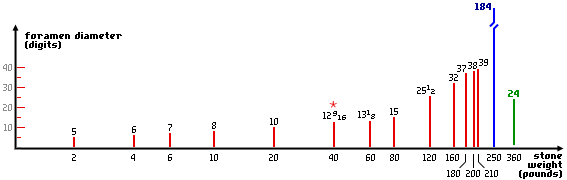
 those machines with which generals take and defend cities:
