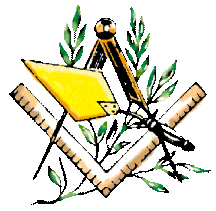
"By square conduct, level steps, and upright actions we may hope to
ascend to those ethereal mansions whence all goodness emanates."
All through the ages the square has been regarded as the emblem of
justice. In ancient Egypt when the gods appear as judges they are depicted
as seated on chairs in which a square is carefully portrayed, and even in
the ordinary speech of the outside world a square deal is the generally
recognised term for a fair and just transaction. It is not surprising
therefore to find that this implement plays a prominent part in our
Masonic symbolism, in fact it is one of the very first tools to which the
attention of the apprentice is directed after he has received the light.
It should be noticed, however, that the three working tools of a F.C.
are also the characteristic jewels of the principal officers of the lodge,
and since in every degree the candidate passes, as it were, in review
before each of them, we immediately obtain a valuable symbolic lesson,
namely, that we cannot make progress towards the light save by square
conduct, level steps and upright actions.
There is not much difficulty in understanding the significance of the
first and last phrases of the above sentences but sometimes there appears
to be a little uncertainty as to the exact significance of the phrase,
"level steps." This implies that our feet are planted firmly on the ground
and therefore that we feel no uncertainty as to the direction in which we
are moving, neither will the winds of adversity divert us from our path.
We know also that the level implies that there is a natural equality
between brethren, and so in the phrase, "level steps," we are taught that
we should go forward side by side with our fellow members, not trying to
push the weaker to the wall, in order to achieve our goal irrespective of
the claims of others. This fact is more significant than appears at first
sight. In real life some men are more spiritually evolved or more
intellectual than others, but we are taught hereby that instead of
selfishly has tening on, such men should stay and help the weaker
brethren, lending to them something of their intellectual ability or their
spiritual insight so that they may keep pace with those more richly
endowed. This is peculiarly brought out in the way that Officers work in a
team for the good of the whole lodge and are promoted in rotation. It is,
indeed, a valuable lesson! The spirit of esprit de corps is a high virtue
and one which should particularly distinguish a Masonic lodge, and the
spirit which will lea d a more evolved brother to pause on his journey to
help a weaker one is deserving of cultivation. Moreover, it brings its own
reward, for such an action is in the highest sense unselfish, and thus
further increases the spiritual evolution of the man himself and brings
him yet another step along the path which leads to the goal towards which
we are all striving.
When we look round the outside world and see how commercial competition
has produced a spirit wherein the weakest are thrust to the wall and men
say, "Let the devil take the hindermost," we see, that this little phrase
conveys, perhaps, one of the most important and salutary lessons needed by
the present generation, and gives another example of the truly exalted
moral teaching contained in every word and line of our craft rituals.
Indeed, this willingness to slow down one's own spiritual progress to
help another is the essence of self-sacrifice, and has been the guiding
principle which has inspired all the great spiritual teachers of the world
in their efforts to advance the well-being of struggling humanity.
Now it is important to realise that this spirit of self-sacrifice
succeeds to "square conduct." In other words, it is only when a man has
learnt to be just to his fellow men that he can realise the next lesson,
which is that he must be more than just, he must give up his own rights to
help others. There would be nothing unjust in his outpacing his
companions, but it would be selfish, or at any rate self-centred. For all
that, it should be remembered that the square in some measure represents
the letter G. , which stands for God, the Grand Geometrician of the
Universe, the Just Judge. There are other aspects of the Deity which are
perhaps more lofty, but, as the old Jewish teachers perceived, you must
first make man realise that God is Just before you can convince him that
He is something even greater than this, namely, a loving father.
Once, however, we have realised that God is just and that we are all
partakers of the same nature, all equally His children, we shall perceive
that we shall hardly be acting justly to our fellow men if we leave them
behind in the race, and do not help and assist them so that all humanity
may achieve the same goal.
The above facts also help us to understand the significance of the
plumb line, itself an emblem of God's unerring justice, for they cause us
to perceive that we must show forth the lessons we have learnt by upright
actions. Unless we show by our actions in life that we have assimilated
these important teachings, our knowledge is but vain, and herein it is
interesting to note that the level and plumb rule, or, rather, the plumb
line, will themselves form a square, thus showing that these three,
symbols are a trinity and may-be refer to the triune nature of the Supreme
Being.
We may at any rate feel sure that the brother who acts up to the
principle of the square, level and plumb rule will not have laboured in
vain in the terrestrial lodge, and on quitting it may reasonably hope that
he will be permitted to enter that Temple not built with hands, eternal in
the skies.