|
28°- KNIGHT OF THE
SUN, OR PRINCE ADEPT
Morals and Dogma
Albert Pike
GOD is the author of everything that existeth; the Eternal,
the Supreme, the Living, and Awful Being; from Whom nothing in the Universe is
hidden. Make of Him no idols and visible images; but rather worship Him in the
deep solitudes of sequestered forests; for He is invisible, and fills the
Universe as its soul, and liveth not in any Temple!
Light and Darkness are the World's Eternal ways. God is the
principle of everything that exists, and the Father of all Beings. He is
eternal, immovable, and Self-Existent. There are no bounds to His power. At one
glance He sees the Past, the Present, and the Future; and the procession of the
builders of the Pyramids, with us and our remotest Descendants, is now passing
before Him. He reads our thoughts before they are known to ourselves. He rules
the movements of the Universe, and all events and revolutions are the creatures
of His will. For He is the Infinite Mind and Supreme Intelligence.
In the beginning Man had the WORD, and that WORD was from
God: and out of the living power which, in and by that WORD, was communicated to
man, came the LIGHT of his existence. Let no man speak the WORD, for by it THE
FATHER made light and darkness, the world and living creatures!
The Chaldean upon his plains worshipped me, and the
sea-loving Phœnician. They builded me temples and towers, and burned sacrifices
to me upon a thousand altars. Light was divine to them, and they thought me a
God. But I am nothing--nothing; and LIGHT is the creature of the unseen
GOD that taught the true religion to the Ancient Patriarchs: AWFUL, MYSTERIOUS,
THE ABSOLUTE.
Man was created pure; and God gave him TRUTH, as He gave him
LIGHT. He has lost the truth and found error. He has wandered far
into darkness; and round him Sin and Shame hover evermore. The Soul that is
impure, and sinful, and defiled with earthly stains, cannot again unite with
God, until, by long trials and many purifications, it is finally delivered from
the old calamity; and Light overcomes Darkness and dethrones it, in the Soul.
God is the First; indestructible, eternal, UNCREATED,
INDIVISIBLE. Wisdom, Justice, Truth, and Mercy, with
Harmony and Love, are of His essence, and Eternity and
Infinitude of Extension. He is silent, and consents with MIND, and is known
to Souls through MIND alone. In Him were all things originally contained, and
from Him all things were evolved. For out of His Divine SILENCE and REST, after
an infinitude of time, was unfolded the WORD, or the Divine POWER; and then in
turn the Mighty, ever-acting, measureless INTELLECT; and from the WORD were
evolved the myriads of suns and systems that make the Universe; and fire,
and light, and the electric HARMONY, which is the harmony of spheres and
numbers: and from the INTELLECT all Souls and intellects of men.
In the Beginning, the Universe was but ONE SOUL. HE was THE
ALL, alone with TIME and SPACE, and Infinite as they.
------ HE HAD THIS THOUGHT: "I Create Worlds:" and lo!
the Universe, and the laws of harmony and motion that rule
it. the expression of a thought of God; and bird and beast, and every living
thing but Man: and light and air, and the mysterious cur-rents, and the dominion
of mysterious numbers!
------ HE HAD THIS THOUGHT: "I Create Man, whose Soul
shall be my image, and he shall rule." And lo! Man, with senses, instinct,
and a reasoning mind!
------ And yet not MAN! but an animal that breathed,
and saw, and thought: until an immaterial spark from God's own Infinite Being
penetrated the brain, and became the Soul: and lo, MAN THE IMMORTAL! Thus,
threefold, fruit of God's thought, is Man; that sees and hears and feels; that
thinks and reasons; that loves and is in harmony with the Universe.
Before the world grew old, the primitive Truth faded out from
men's Souls. Then man asked himself, "What am I? and how and whence am I? and
whither do I go?" And the Soul, looking inward upon itself, strove to learn
whether that "I" were mere matter; its thought and reason and its passions and
affections mere results of material combination; or a material Being enveloping
an immaterial Spirit: . . and further it strove, by self-examination, to learn
whether that Spirit were an individual essence, with a separate immortal
existence, or an infinitesimal portion of a Great First Principle,
inter-penetrating the Universe and the infinitude of space, and undulating like
light and heat: . . and so they wandered further amid the mazes of error; and
imagined vain philosophies; wallowing in the sloughs of materialism and
sensualism, of beating their wings vainly in the vacuum of abstractions and
idealities.
While yet the first oaks still put forth their leaves, man
lost the perfect knowledge of the One True God, the Ancient Absolute Existence,
the Infinite Mind and Supreme Intelligence; and floated helplessly out upon the
shoreless ocean of conjecture. Then the soul vexed itself with seeking to learn
whether the material Universe was a mere chance combination of atoms, or the
work of Infinite, Uncreated Wisdom: . . whether the Deity was a concentrated,
and the Universe an extended immateriality; or whether He was a personal
existence, an Omnipotent, Eternal, Supreme Essence, regulating matter at will;
or subjecting it to unchangeable laws throughout eternity; and to Whom, Himself
Infinite and Eternal, Space and Time are unknown. With their finite limited
vision they sought to learn the source and explain the existence of Evil, and
Pain, and Sorrow; and so they wandered ever deeper into the darkness, and were
lost; and there was for them no longer any God; but only a great, dumb, soulless
Universe, full of mere emblems and symbols.
You have heretofore, in some of the Degrees through which you
have passed, heard much of the ancient worship of the Sun, the Moon, and the
other bright luminaries of Heaven, and of the Elements and Powers of Universal
Nature. You have been made, to
some extent, familiar with their personifications as Heroes suffering or
triumphant, or as personal Gods or Goddesses, with human characteristics and
passions, and with the multitude of legends and fables that do but allegorically
represent their risings and settings, their courses, their conjunctions and
oppositions, their domiciles and places of exaltation.
Perhaps you have supposed that we, like many who have written
on these subjects, have intended to represent this worship to you as the most
ancient and original worship of the first men that lived. To undeceive you, if
such was your conclusion, we have caused the Personifications of the Great
Luminary of Heaven, under the names by which he was known to the most ancient
nations, to proclaim the old primitive truths that were known to the Fathers of
our race, before men came to worship the visible manifestations of the Supreme
Power and Magnificence and the Supposed Attributes of the Universal Deity in the
Elements and in the glittering armies that Night regularly marshals and arrays
upon the blue field of the firmament.
We ask now your attention to a still further development of
these truths, after we shall have added something to what we have already said
in regard to the Chief Luminary of Heaven, in explanation of the names and
characteristics of the several imaginary Deities that represented him among the
ancient races of men.
ATHOM or ATHOM-RE, was the Chief and Oldest Supreme God of
Upper Egypt, worshipped at Thebes; the same as the OM or AUM of the Hindūs,
whose name was unpronounceable, and who, like the BREHM of the latter People,
was "The Being that was, and is, and is to come; the Great God, the Great
Omnipotent, Omniscient, and Omnipresent One, the Greatest in the Universe, the
Lord;" whose emblem was a perfect sphere, showing that He was first, last,
midst, and without end; superior to all Nature-Gods, and all personifications of
Powers, Elements, and Luminaries; symbolized by Light, the Principle of Life.
AMUN was the Nature-God, or Spirit of Nature, called by that
name or AMUN-RE, and worshipped at Memphis in Lower Egypt, and in Libya, as well
as in Upper Egypt. He was the Libyan Jupiter, and represented the intelligent
and organizing force that develops itself in Nature, when the intellectual types
or forms of bodies are revealed to the senses in the world's order, by their
union with matter, whereby the generation of bodies is effected. He
was the same with Kneph, from whose mouth issued the Orphic egg out of which
came the Universe.
DIONUSOS was the Nature-God of the Greeks, as AMUN was of the
Egyptians. In the popular legend, Dionusos, as well as Hercules, was a Theban
Hero, born of a mortal mother. Both were sons of Zeus, both persecuted by Here.
But in Hercules the God is subordinate to the Hero; while Dionusos, even in
poetry, retains his divine character, and is identical with Iacchus, the
presiding genius of the Mysteries. Personification of the Sun in Taurus, as his
ox-hoofs showed, the delivered earth from the harsh dominion of Winter,
conducted the mighty chorus of the Stars, and the celestial revolution of the
year, changed with the seasons, and underwent their periodical decay. He was the
Sun as invoked by the Eleans, Πυριγενης, ushered into the world amidst lightning
and thunder, the Mighty Hunter of the Zodiac, Zagreus the Golden or ruddy-faced.
The Mysteries taught the doctrine of Divine Unity; and that Power Whose Oneness
is a seeming mystery, but really a truism, was Dionusos, the God of Nature, or
of that moisture, which is the life of Nature, who prepares in darkness, in
Hades or Iasion, the return of life and vegetation, or is himself the light and
change evolving their varieties. In the Egean Islands he was Butes, Dardanus,
Himeros or Imbros; in Crete he appears as Iasius or even Zeus, whose orgiastic
worship, remaining unveiled by the usual forms of mystery, betrayed to profane
curiosity the symbols which, if irreverently contemplated, were sure to be
misunderstood.
He was the same with the dismembered Zagreus, the son of
Persephoné, an Ancient Subterranean Dionusos, the horned progeny of Zeus in the
Constellation of the Serpent, entrusted by his father with the thunderbolt, and
encircled with the protecting dance of Curetes. Through the envious artifices of
Here, the Titans eluded the vigilance of his guardians and tore him to pieces;
but Pallas restored the still palpitating heart to his father, who commanded
Apollo to bury the dismembered remains upon Parnassus.
Dionusos, as well as Apollo, was leader of the Muses; the
tomb of one accompanied the worship of the other; they were the same, yet
different, contrasted, yet only as filling separate parts in the same drama; and
the mystic and heroic personifications, the God of Nature and of Art, seem, at
some remote period, to have proceeded from a common source. Their separation was
one of form rather than of
substance: and from the time when Hercules obtained initiation from Triptolemus,
or Pythagoras received Orphic tenets, the two conceptions were tending to
re-combine. It was said that Dionusos or Poseidon had preceded Apollo in the
Oracular office; and Dionusos continued to be esteemed in Greek Theology as
Healer and Saviour, Author of Life and Immortality. The dispersed Pythagoreans,
"Sons of Apollo," immediately betook themselves to the Orphic Service of
Dionusos, and there are indications that there was always something Dionysiac in
the worship of Apollo.
Dionusos is the Sun, that liberator of the elements; and his
spiritual meditation was suggested by the same imagery which made the Zodiac the
supposed path of the Spirits in their descent and their return. His second
birth, as offspring of the highest, is a type of the spiritual regeneration of
man. He, as well as Apollo, was precepter of the Muses and source of
inspiration. His rule prescribed no unnatural mortification: its yoke was easy,
and its mirthful choruses, combining the gay with the severe, did but
commemorate that golden age when earth enjoyed eternal spring, and when
fountains of honey, milk, and wine burst forth out of its bosom at the touch of
the thyrsus. He is the "Liberator." Like Osiris, he frees the soul, and guides
it in its migrations beyond the grave, preserving it from the risk of again
falling under the slavery of matter or of some inferior animal form. All soul is
part of the Universal Soul, whose totality is Dionusos; and he leads back the
vagrant spirit to its home, and accompanies it through the purifying processes,
both real and symbolical, of its earthly transit. He died and descended to the
Shades; and his suffering was the great secret of the Mysteries, as death is the
grand mystery of existence. He is the immortal suitor of Psyche (the Soul), the
Divine influence which physically called the world into being, and which,
awakening the soul from its Stygian trance, restores it from earth to Heaven.
Of HERMES, the Mercury of the Greeks, the Thoth of the
Egyptians, and the Taaut of the Phœnicians, we have heretofore spoken
sufficiently at length. He was the inventor of letters and of Oratory, the
winged messenger of the Gods, bearing the Caduceus wreathed with serpents; and
in our Council he is represented by the ORATOR.
The Hindūs called the Sun SURYA; the Persians,
MITHRAS; the Egyptians,
OSIRIS; the Assyrians and Chaldæans, BEL; the Scythians and
Etruscans and the ancient Pelasgi, ARKALEUS or HERCULES; the
Phœnicians, ADONAI or ADON; and the Scandinavians, ODIN.
From the name SURYA, given by the Hindūs to the Sun, the Sect
who paid him particular adoration were called Souras. Their painters
describe his car as drawn by seven green horses. In the Temple of Visweswara, at
Benares, there is an ancient piece of sculpture, well executed in stone,
representing him sitting in a car drawn by a horse with twelve heads. His
charioteer, by whom he is preceded, is ARUN [from אור, AUR the Crepusculum?],
or the Dawn; and among his many titles are twelve that denote his distinct
powers in each of the twelve months. Those powers are called Adityas, each of
whom has a particular name. Surya is supposed frequently to have descended upon
earth, in a human shape, and to have left a race on earth, equally renowned in
Indian story with the Heliades of Greece. He is often styled King of the Stars
and Planets, and thus reminds us of the Adon-Tsbauth (Lord of the Starry Hosts)
of the Hebrew writings.
MITHRAS was the Sun-God of the Persians; and was fabled to
have been born in a grotto or cave, at the Winter Solstice. His feasts were
celebrated at that period, at the moment when the sun commenced to return
Northward, and to increase the length of the days. This was the great Feast of
the Magian religion. The Roman Calendar, published in the time of Constantine,
at which period his worship began to gain ground in the Occident, fixed his
feast-day on the 25th of December. His statues and images were inscribed,
Deo-Soli invicto Mithræ--to the invincible Sun-God Mithras. Nomen
invictum Sol Mithra. . . . Soli Omnipotenti Mithræ. To him, gold, incense,
and myrrh were consecrated. "Thee," says Martianus Capella, in his hymn to the
Sun, "the dwellers on the Nile adore as Serapis, and Memphis worships as Osiris;
in the sacred rites of Persia thou art Mithras, in Phrygia, Atys, and Libya bows
down to thee as Ammon, and Phœnician Byblos as Adonis; and thus the whole world
adores thee under different names."
OSIRIS was the son of Helios (Phra), the "divine offspring
con-generate with the dawn," and at the same time an incarnation of Kneph or
Agathodæmon, the Good Spirit, including all his possible manifestations, either
physical or moral. He represented in a familiar form the beneficent aspect of
all higher emanations and in
him was developed the conception of a Being purely good, so that it became
necessary to set up another power as his adversary, called Seth, Babys or Typhon,
to account for the injurious influences of Nature.
With the phenomena of agriculture, supposed to be the
invention of Osiris, the Egyptians connected the highest truths of their
religion. The soul of man was as the seed hidden in the ground, and the mortal
framework, similarly consigned to its dark resting-place, awaited its
restoration to life's unfailing source. Osiris was not only benefactor of the
living; he was also Hades, Serapis, and Rhadamanthus, the monarch of the dead.
Death, therefore, in Egyptian opinion, was only another name for renovation,
since its God is the same power who incessantly renews vitality in Nature. Every
corpse duly embalmed was called "Osiris," and in the grave was supposed to be
united, or at least brought into approximation, to the Divinity. For when God
became incarnate for man's benefit, it was implied that, in analogy with His
assumed character, He should submit to all the conditions of visible existence.
In death, as in life, Isis and Osiris were patterns and precursors of mankind;
their sepulchres stood within the temples of the Superior Gods; yet though their
remains might be entombed at Memphis or Abydus, their divinity was unimpeached,
and they either shone as luminaries in the heavens, or in the unseen world
presided over the futurity of the disembodied spirits whom death had brought
nearer to them.
The notion of a dying God, so frequent in Oriental legend,
and of which we have already said much in former Degrees, was the natural
inference from a literal interpretation of nature-worship; since nature, which
in the vicissitudes of the seasons seems to undergo a dissolution, was to the
earliest religionists the express image of the Deity, and at a remote period one
and the same with the "varied God," whose attributes were seen not only in its
vitality, but in its changes. The unseen Mover of the Universe was rashly
identified with its obvious fluctuations. The speculative Deity suggested by the
drama of nature, was worshipped with imitative and sympathetic rites. A period
of mourning about the Autumnal Equinox, and of joy at the return of Spring, was
almost universal. Phrygians and Paphlagonians, Bœotians, and even Athenians,
were all more or less attached to such observances; the Syrian damsels sat
weeping for Thammuz or Adoni, mortally
wounded by the tooth of Winter, symbolized by the boar, its very
general emblem: and these rites, and those of Atys and Osiris, were evidently
suggested by the arrest of vegetation, when the Sun, descending from his
altitude, seems deprived of his generating power.
Osiris is a being analogous to the Syrian ADONI; and the
fable of his history, which we need not here repeat, is a narrative form of the
popular religion of Egypt, of which the Sun is the Hero, and the agricultural
calendar the moral. The moist valley of the Nile, owing its fertility to the
annual inundation, appeared, in contrast with the surrounding desert, like life
in the midst of death. The inundation was in evident dependence on the Sun, and
Egypt, environed with arid deserts, like a heart within a burning censer, was
the female power, dependent on the influences personified in its God. Typhon his
brother, the type of darkness, drought, and sterility, threw his body into the
Nile; and thus Osiris, the "good," the "Saviour," perished, in the 28th year of
his life or reign, and on the 17th day of the month Athor, or the 13th of
November. He is also made to die during the heats of the early Summer, when,
from March to July, the earth was parched with intolerable heat, vegetation was
scorched, and the languid Nile exhausted. From that death he rises when the
Solstitial Sun brings the inundation, and Egypt is filled with mirth and
acclamation anticipatory of the second harvest. From his Wintry death he rises
with the early flowers of Spring, and then the joyful festival of Osiris found
was celebrated.
So the pride of Jemsheed, one of the Persian Sun-heroes, or
the solar year personified, was abruptly cut off by Zohak, the tyrant of the
West. He was sawn asunder by a fish-bone, and immediately the brightness of Iran
changed to gloom. Ganymede and Adonis, like Osiris, were hurried off in all
their strength and beauty; the premature death of Linus, the burthen of the
ancient lament of Greece, was like that of the Persian Siamek, the Bithynian
Hylas, and the Egyptian Maneros, Son of Menes or the Eternal. The elegy called
Maneros was sung at Egyptian banquets, and an effigy enclosed within a
diminutive Sarcophagus was handed round to remind the guests of their brief
tenure of existence. The beautiful Memnon, also, perished in his prime; and
Enoch, whose early death was lamented at Iconium, lived 365 years, the number of
days of the solar year; a brief space when compared with the
longevity of his patriarchal kindred.
The story of Osiris is reflected in those of Orpheus and
Dionusos Zagreus, and perhaps in the legends of Absyrtus and Pelias, of Æson,
Thyestes, Melicertes, Itys, and Pelops. Io is the disconsolate Isis or Niobe:
and Rhea mourns her dismembered Lord, Hyperion, and the death of her son Helios,
drowned in the Eridanus; and if Apollo and Dionusos are immortal, they had died
under other names, as Orpheus, Linus, or Hyacinthus. The sepulchre of Zeus was
shown in Crete. Hippolytus was associated in divine honors with Apollo, and
after he had been torn to pieces like Osiris, was restored to life by the
Pæonian herbs of Diana, and kept darkling in the secret grove of Egeria. Zeus
deserted Olympus to visit the Ethiopians; Apollo underwent servitude to Admetus;
Theseus, Peirithous, Hercules, and other heroes, descended for a time to Hades;
a dying Nature-God was exhibited in the Mysteries, the Attic women fasted,
sitting on the ground, during the Thesmophoria, and the Bœotians lamented the
descent of Cora-Proserpine to the Shades.
But the death of the Deity, as understood by the Orientals,
was not inconsistent with His immortality. The temporary decline of the Sons of
Light is but an episode in their endless continuity; and as the day and year are
more convenient subdivisions of the Infinite, so the fiery deaths of Phaëthon or
Hercules are but breaks in the same Phœnix process of perpetual regeneration, by
which the spirit of Osiris lives forever in the succession of the Memphian Apis.
Every year witnesses the revival of Adonis; and the amber tears shed by the
Heliades for the premature death of their brother, are the golden shower full of
prolific hope, in which Zeus descends from the brazen vault of Heaven into the
bosom of the parched ground.
BAL, representative or personification of the sun, was one of
the Great Gods of Syria, Assyria, and Chaldea, and his name is found upon the
monuments of Nimroud, and frequently occurs in the Hebrew writings. He was the
Great Nature-God of Babylonia, the Power of heat, life, and generation. His
symbol was the Sun, and he was figured seated on a bull. All the accessories of
his great temple at Babylon, described by Herodotus, are repeated with singular
fidelity, but on a smaller scale, in the Hebrew tabernacle and temple. The
golden statue alone is wanted to complete
the resemblance. The word Bal or Baal, like the word
Adon, signifies Lord and Master. He was also the Supreme Deity of the
Moabites, Amonites, and Carthaginians, and of the Sabeans in general; the Gauls
worshipped the Sun under the name of Belin or Belinus: and Bela is found among
the Celtic Deities upon the ancient monuments.
The Northern ancestors of the Greeks maintained with hardier
habits a more manly style of religious symbolism than the effeminate enthusiasts
of the South, and had embodied in their Perseus, HERCULES and MITHRAS,
the consummation of the qualities they esteemed and exercised.
Almost every nation will be found to have had a mythical
being, whose strength or weakness, virtues or defects, more or less nearly
describe the Sun's career through the seasons. There was a Celtic, a Teutonic, a
Scythian, an Etruscan, a Lydian Hercules, all whose legends became tributary to
those of the Greek hero. The name of Hercules was found by Herodotus to have
been long familiar in Egypt and the East, and to have originally belonged to a
much higher personage than the comparatively modern hero known in Greece as the
Son of Alcmena. The temple of the Hercules of Tyre was reported to have been
built 2300 years before the time of Herodotus; and Hercules, whose Greek name
has been sometimes supposed to be of Phœnician origin, in the sense of Circuitor,
i.e. "rover" and "perambulator" of earth, as well as "Hyperion" of the
sky, was the patron and model of those famous navigators who spread his altars
from coast to coast through the Mediterranean, to the extremities of the West,
where "ARKALEUS" built the City of Gades, and where a perpetual fire burned in
his service. He was the lineal descendant of Perseus, the luminous child of
darkness, conceived within a subterranean vault of brass; and he a
representation of the Persian Mithras, rearing his emblematic lions above the
gates of Mycenæ, and bringing the sword of Jemsheed to battle against the
Gorgons of the West. Mithras is similarly described in the Zend-Avesta as the
"mighty hero, the rapid runner, whose piercing eye embraces all, whose arm bears
the club for the destruction of the Darood."
Hercules Ingeniculus, who, bending on one knee, uplifts his
club and tramples on the Serpent's head, was, like Prometheus and Tantalus, one
of the varying aspects of the struggling and declining Sun. The victories of
Hercules are but exhibitions of Solar power which have ever to be repeated. It
was in the far North, among the Hyperboreans, that, divested of his Lion's skin,
he lay down to sleep, and for a time lost the horses of his chariot. Henceforth
that Northern region of gloom, called the "place of the death and revival of
Adonis," that Caucasus whose summit was so lofty, that, like the Indian Meru, it
seemed to be both the goal and commencement of the Sun's career, became to Greek
imaginations the final bourne of all things, the abode of Winter and desolation,
the pinnacle of the arch connecting the upper and lower world, and consequently
the appropriate place for the banishment .of Prometheus. The daughters of
Israel, weeping for Thammuz, mentioned by Ezekiel, sat looking to the North, and
waiting for his return from that region. It was while Cybele with the Sun-God
was absent among the Hyperboreans, that Phrygia, abandoned by her, suffered the
horrors of famine. Delos and Delphi awaited the return of Apollo from the
Hyperboreans, and Hercules brought thence to Olympia the olive. To all Masons,
the North has immemorially been the place of darkness; and of the great lights
of the Lodge, none is in the North.
Mithras, the rock-born hero (Πετρογενης), heralded the Sun's
return in Spring, as Prometheus, chained in his cavern, betokened the
continuance of Winter. The Persian beacon on the mountain-top represented the
Rock-born Divinity enshrined in his worthiest temple; and the funeral
conflagration of Hercules was the sun dying in glory behind the Western hills.
But though the transitory manifestation suffers or dies, the abiding and eternal
power liberates and saves. It was an essential attribute of a Titan, that he
should arise again after his fall; for the revival of Nature is as certain as
its decline, and its alternations are subject to the appointment of a power
which controls them both.
"God," says Maximus Tyrius, "did not spare His own Son
[Hercules], or exempt Him from the calamities incidental to humanity. The Theban
progeny of Jove had his share of pain and trial. By vanquishing earthly
difficulties he proved his affinity with Heaven. His life was a continuous
struggle. He fainted before Typhon in the desert; and in the commencement of the
Autumnal season (cum longæ redit hora noctis), descended under the guidance of
Minerva to Hades. He died; but first applied for initiation to Eumolpus, in
order to foreshadow that state of religious preparation which should precede the
momentous change. Even in Hades he
rescued Theseus and removed the stone of Ascalaphus, reanimated the
bloodless spirits, and dragged into the light of day the monster Cerberus,
justly reputed invincible because an emblem of Time itself; he burst the chains
of the grave (for Busiris is the grave personified), and triumphant at the close
as in the dawn of his career, was received after his labors into the repose of
the heavenly mansions, living forever with Zeus in the arms of Eternal Youth.
ODIN is said to have borne twelve names among the old
Germans, and to have had 114 names besides. He was the Apollo of the
Scandinavians, and is represented in the Voluspa as destined to slay the
monstrous snake. Then the Sun will be extinguished, the earth be dissolved in
the ocean, the stars lose their brightness, and all Nature be destroyed in order
that it may be renewed again. From the bosom of the waters a new world will
emerge clad in verdure; harvests will be seen to ripen where no seed was sown,
and evil will disappear.
The free fancy of the ancients, which wove the web of their
myths and legends, was consecrated by faith. It had not, like the modern mind,
set apart a petty sanctuary of borrowed beliefs, beyond which all the rest was
common and unclean. Imagination, reason, and religion circled round the same
symbol; and in all their symbols there was serious meaning, if we could but find
it out. They did not devise fictions in the same vapid spirit in which we,
cramped by conventionalities, read them. In endeavoring to interpret creations
of fancy, fancy as well as reason must guide: and much of modern controversy
arises out of heavy misapprehensions off ancient symbolism.
To those ancient peoples, this earth was the centre of the
Universe. To them there were no other worlds, peopled with living beings, to
divide the care and attention of the Deity. To them the world was a great plain,
of unknown, perhaps inconceivable limits, and the Sun, the Moon, and the Stars
journeyed above it, to give them light. The worship of the Sun became the basis
of all the religions of antiquity. To them light and heat were mysteries; as
indeed they still are to us. As the Sun caused the day, and his absence the
night; as, when he journeyed Northward, Spring and Summer followed him; and when
he again turned to the South, Autumn and inclement Winter, and cold and long
dark nights ruled the earth; . . . as his influence produced the leaves and
flowers, and ripened the harvests, and brought regular inundation,
he necessarily became to them the most interesting object of the
material Universe. To them he was the innate fire of bodies, the fire of nature.
Author of Life, heat, and ignition, he was to them the efficient cause of all
generation, for without him there was no movement, no existence, no form. He was
to them immense, indivisible, imperishable, and everywhere present. It was their
need of light, and of his creative energy, that was felt by all men; and nothing
was more fearful to them than his absence. His beneficent influences caused his
identification with the Principle of Good; and the BRAHMA of the Hindūs, the
MITHRAS of the Persians, and ATHOM, AMUN, PHTHA, and OSIRIS, of the Egyptians,
the BEL of the Chaldæans, the ADONAI of the Phœnicians, the ADONIS and APOLLO of
the Greeks became but personifications of the Sun, the regenerating Principle,
image of that fecundity which perpetuates and rejuvenates the world's existence.
So too the struggle between the Good and Evil Principles was
personified, as was that between life and death, destruction and re-creation; in
allegories and fables which poetically represented the apparent course of the
Sun; who, descending toward the Southern Hemisphere, was figuratively said to be
conquered and put to death by darkness, or the genius of Evil; but, returning
again toward the Northern Hemisphere, he seemed to be victorious, and to arise
from the tomb. This death and resurrection were also figurative of the
succession of day and night, of death, which is a necessity of life, and of life
which is born of death; and everywhere the ancients still saw the combat between
the two Principles that ruled the world. Everywhere this contest was embodied in
allegories and fictitious histories: into which were ingeniously woven all the
astronomical phenomena that accompanied, preceded, or followed the different
movements of the Sun, and the changes of Seasons, the approach or withdrawal of
inundation. And thus grew into stature and strange proportions the histories of
the contests between Typhon and Osiris, Hercules and Juno, the Titans and
Jupiter, Ormuzd and Ahriman, the rebellious Angels and the Deity, the Evil Genii
and the Good; and the other like fables, found not only in Asia, but in the
North of Europe, and even among the Mexicans and Peruvians of the New World;
carried thither, in all probability, by those Phœnician voyagers who bore
thither civilization and the arts. The Scythians lamented the death of Acmon,
the Persians that of Zohak conquered
by Pheridoun, the Hindus that of Soura-Parama slain by Soupra-Muni,
as the Scandinavians did that of Balder, torn to pieces by the blind Hother.
The primitive idea of infinite space existed in the first
men, as it exists in us. It and the idea of infinite time are the first two
innate ideas. Man cannot conceive how thing can be added to thing, or event
follow event, forever. The idea will ever return, that no matter how long bulk
is added to bulk, there must be, still beyond, an empty void without
limit; in which is nothing. In the same way the idea of time without
beginning or end forces itself on him. Time, without events, is also a
void, and nothing.
In that empty void space the primitive men knew there was no
light nor warmth. They felt, what we know scientifically, that there must
be a thick darkness there, and an intensity of cold of which we have no
conception. Into that void they thought the Sun, the Planets, and the Stars went
down when they set under the Western Horizon. Darkness was to them an enemy, a
harm, a vague dread and terror. It was the very embodiment of the evil
principle; and out of it they said that he was formed. As the Sun bent Southward
toward that void, they shuddered with dread: and when, at the Winter Solstice,
he again commenced his Northward march, they rejoiced and feasted; as they did
at the Summer Solstice, when most he appeared to smile upon them in his pride of
place. These days have been celebrated by all civilized nations ever since. The
Christian has made them feast-days of the church, and appropriated them to the
two Saints John; and Masonry has done the same.
We, to whom the vast Universe has become but a great
machine, not instinct with a great SOUL, but a clockwork of
proportions unimaginable, but still infinitely less than infinite; and part at
least of which we with our orreries can imitate; we, who have measured the
distances and dimensions, and learned the specific gravity and determined the
orbits of the moon and the planets; we, who know the distance to the sun, and
his size; have measured the orbits of the flashing comets, and the distances of
the fixed stars; and know the latter to be suns like our sun, each with his
retinue of worlds, and all governed by the same unerring, mechanical laws and
outwardly imposed forces, centripetal and centrifugal; we, who with our
telescopes have separated the galaxy and the nebula into other stars and groups
of stars; discovered new
planets, by first discovering their disturbing forces upon those already known;
and learned that they all, Jupiter, Venus, and the fiery Mars, and Saturn and
the others, as well as the bright, mild, and ever-changing Moon, are mere dark,
dull, opaque clods like our earth, and not living orbs of brilliant fire and
heavenly light; we, who have counted the mountains and chasms in the moon, with
glasses that could distinctly reveal to us the temple of Solomon, if it stood
there in its old original glory; we, who no longer imagine that the stars
control our destinies, and who can calculate the eclipses of the sun and moon,
backward and forward, for ten thousand years; we, with our vastly increased
conceptions of the powers of the Grand Architect of the Universe, but our wholly
material and mechanical view of that Universe itself; we cannot, even in the
remotest degree, feel, though we may partially and imperfectly imagine,
how those great, primitive, simple-hearted children of Nature felt in regard to
the Starry Hosts, there upon the slopes of the Himalayas, on the Chaldæan
plains, in the Persian and Median deserts, and upon the banks of that great,
strange River, the Nile. To them the Universe was alive--instinct with
forces and powers, mysterious and beyond their comprehension. To them it was no
machine, no great system of clockwork; but a great live creature, an army of
creatures, in sympathy with or inimical to man. To them, all was a mystery and a
miracle, and the stars flashing overhead spoke to their hearts almost in an
audible language. Jupiter, with his kingly splendors, was the Emperor of the
starry legions. Venus looked lovingly on the earth and blessed it; Mars, with
his crimson fires, threatened war and misfortune; and Saturn, cold and grave,
chilled and repelled them. The ever-changing Moon, faithful companion of the
Sun, was a constant miracle and wander; the Sun himself the visible emblem of
the creative and generative power. To them the earth was a great plain, over
which the sun, the moon, and the planets revolved, its servants, framed to give
it light. Of the stars, some were beneficent existences that brought with them
Spring-time and fruits and flowers,--some, faithful sentinels, advising them of
coming inundation, of the season of storm and of deadly winds; some heralds of
evil, which, steadily foretelling, they seemed to cause. To them the eclipses
were portents of evil, and their causes hidden in mystery, and supernatural. The
regular returns of the stars, the comings of Arcturus, Orion, Sirius, the
Pleiades, and Aldebarán, and the journeyings of the Sun, were voluntary and not
mechanical to them. What wonder that astronomy became to them the most important
of sciences; that those who learned it became rulers; and that vast edifices,
the Pyramids, the tower or temple of Bel, and other like erections everywhere in
the East, were builded for astronomical purposes?--and what wonder that, in
their great child-like simplicity, they worshipped Light, the Sun, the Planets,
and the Stars, and personified them, and eagerly believed in the histories
invented for them; in that age when the capacity for belief was infinite; as
indeed, if we but reflect, it still is and ever will be?
If we adhered to the literally historic sense, antiquity
would be a mere inexplicable, hideous chaos, and all the Sages deranged: and so
it would be with Masonry and those who instituted it. But when these allegories
are explained, they cease to be absurd fables, or facts purely local; and become
lessons of wisdom for entire humanity. No one can doubt, who studies them, that
they all came from a common source.
And he greatly errs who imagines that, because the
mythological legends and fables of antiquity are referable to and have their
foundation in the phenomena of the Heavens, and all the Heathen Gods are but
mere names given to the Sun, the Stars, the Planets, the Zodiacal Signs, the
Elements, the Powers of Nature, and Universal Nature herself, therefore the
first men worshipped the Stars, and whatever things, animate and inanimate,
seemed to them to possess and exercise a power or influence, evident or
imagined, over human, fortunes and human destiny.
For ever, in all the nations, ascending to the remotest
antiquity to which the light of History or the glimmerings of tradition reach,
we find, seated above all the gods which represent the luminaries and the
elements, and those which personify the innate Powers of universal nature, a
still higher Deity, silent, undefined, incomprehensible, the Supreme, one God,
from Whom all the rest flow or emanate, or by Him are created. Above the
Time-God Horus, the Moon-Goddess or Earth-Goddess Isis, and the Sun-God Osiris,
of the Egyptians, was Amun, the Nature-God; and above him, again, the Infinite,
Incomprehensible Deity, ATHOM. BREHM, the silent, self-contemplative, one
original God, was the Source, to the Hindūs, of Brahma, Vishnu, and Siva. Above
Zeus, or before him, were Kronos and Ouranos. Over the Alohayim was the great
Nature-God AL, and still beyond him, Abstract Existence, IHUH--He that IS, WAS,
and SHALL BE. Above all the Persian Deities was the Unlimited Time,
ZERUANE-AKHERENE; and over Odin and Thor was the Great Scandinavian Deity
ALFADIR.
The worship of Universal Nature as a God was too near akin to
the worship of a Universal Soul, to have been the instinctive creed of any
savage people or rude race of men. To imagine all nature, with all its
apparently independent parts, as forming one consistent whole, and as itself a
unit, required an amount of experience and a faculty of generalization not
possessed by the rude uncivilized mind, and is but a step below the idea of a
universal Soul.
In the beginning man had the WORD; and that WORD was from
God; and out of the living POWER communicated to man in and by that WORD, came
THE LIGHT of His Existence.
God made man in His own likeness. When, by a long succession
of geological changes, He had prepared the earth to be his habitation, He
created him, and placed him in that part of Asia which all the old nations
agreed in calling the cradle of the human race, and whence afterward the stream
of human life flowed forth to India, China, Egypt, Persia, Arabia, and Phœnicia.
HE communicated to him a knowledge of the nature of his Creator, and of the
pure, primitive, undefiled religion. The peculiar and distinctive excellence and
real essence of the primitive man, and his true nature and destiny, consisted in
his likeness to God. HE stamped His own image upon man's soul. That image has
been, in the breast of every individual man and of mankind in general, greatly
altered, impaired, and defaced; but its old, half-obliterated characters are
still to be found on all the pages of primitive history; and the impress, not
entirely effaced, every reflecting mind may discover in its own interior.
Of the original revelation to mankind, of the primitive WORD
of Divine TRUTH, we find clear indications and scattered traces in the sacred
traditions of all the primitive Nations; traces which, when separately examined,
appear like the broken remnants, the mysterious and hieroglyphic characters, of
a mighty edifice that has been destroyed; and its fragments, like those of the
old Temples and Palaces of Nimroud, wrought incongruously into edifices many
centuries younger. And, although amid the ever-growing degeneracy of mankind,
this primeval word of revelation was
falsified by the admixture of various errors, and overlaid and
obscured by numberless and manifold fictions, inextricably confused, and
disfigured almost beyond the power of recognition, still a profound inquiry will
discover in heathenism many luminous vestiges of primitive Truth.
For the old Heathenism had everywhere a foundation in Truth;
and if we could separate that pure intuition into nature and into the simple
symbols of nature, that constituted the basis of all Heathenism, from the alloy
of error and the additions of fiction, those first hieroglyphic traits of the
instinctive science of the first men, would be found to agree with truth and a
true knowledge of nature, and to afford an image of a free, pure, comprehensive,
and finished philosophy of life.
The struggle, thenceforward to be eternal, between the Divine
will and the natural will in the souls of men, commenced immediately after the
creation. Cain slew his brother Abel, and went forth to people parts of the
earth with an impious race, forgetters and defiers of the true God. The other
Descendants of the Common Father of the race intermarried with the daughters of
Cain's Descendants: and all nations preserved the remembrance of that division
of the human family into the righteous and impious, in their distorted legends
of the wars between the Gods, and the Giants and Titans. When, afterward,
another similar division occurred, the Descendants of Seth alone preserved the
true primitive religion and science, and transmitted them to posterity in the
ancient symbolical character, on monuments of stone: and many nations preserved
in their legendary traditions the memory of the columns of Enoch and Seth.
Then the world declined from its original happy condition and
fortunate estate, into idolatry and barbarism: but all nations retained the
memory of that old estate; and the poets, in those early days the only
historians, commemorated the succession of the ages of gold, silver, brass, and
iron.
In the lapse of those ages, the sacred tradition followed
various courses among each of the most ancient nations; and from its original
source, as from a common centre, its various streams flowed downward; some
diffusing through favored regions of the world fertility and life; but others
soon losing themselves, and being dried up in the sterile sands of human error.
After the internal and Divine WORD originally communicated
by God to man, had become obscured; after man's connection with his
Creator had been broken, even outward language necessarily fell into disorder
and confusion. The simple and Divine Truth was overlaid with various and sensual
fictions, buried under illusive symbols, and at last perverted into horrible
phantoms.
For in the progress of idolatry it needs came to pass, that
what was originally revered as the symbol of a higher principle, became
gradually confounded or identified with the object itself, and was worshipped;
until this error led to a more degraded form of idolatry. The early nations
received much from the primeval source of sacred tradition; but that haughty
pride which seems an inherent part of human nature led each to represent these
fragmentary relics of original truth as a possession peculiar to themselves;
thus exaggerating their value, and their own importance, as peculiar favorites
of the Deity, who had chosen them as the favored people to whom to commit these
truths. To make these fragments, as far as possible, their private property,
they reproduced them under peculiar forms, wrapped them up in symbols, concealed
them in allegories, and invented fables to account for their own special
possession of them. So that, instead of preserving in their primitive simplicity
and purity these blessings of original revelation, they overlaid them with
poetical ornament; and the whole wears a fabulous aspect, until by close and
severe examination we discover the truth which the apparent fable contains.
These being the conflicting elements in the breast of man;
the old inheritance or original dowry of truth, imparted to him by God in the
primitive revelation; and error, or the foundation for error, in his degraded
sense and spirit now turned from God to nature, false faiths easily sprung up
and grew rank and luxuriant, when the Divine Truth was no longer guarded with
jealous care, nor preserved in its pristine purity. This soon happened among
most Eastern nations, and especially the Indians, the Chaldæans, the Arabians,
the Persians, and the Egyptians; with whom imagination, and a very deep but
still sensual feeling for nature, were very predominant. The Northern firmament,
visible to their eyes, possesses by far the largest and most brilliant
constellations; and they were more alive to the impressions made by such
objects, than are the men of the present day.
With the Chinese, a patriarchal, simple, and secluded people,
idolatry long made but little progress. They invented writing within
three or four generations after the flood; and they long preserved the memory of
much of the primitive revelation; less overlaid with fiction than those
fragments which other nations have remembered. They were among those who stood
nearest to the source of sacred tradition; and many passages in their old
writings contain remarkable vestiges of eternal truth, and of the WORD of
primitive revelation, the heritage of old thought, which attest to us their
original eminence.
But among the other early nations, a wild enthusiasm and a
sensual idolatry of nature soon superseded the simple worship of the Almighty
God, and set aside or disfigured the pure belief in the Eternal Uncreated
Spirit. The great powers and elements of nature, and the vital principle of
production and procreation through all generations; then the celestial spirits
or heavenly Host, the luminous armies of the Stars, and the great Sun, and
mysterious, ever-changing Moon (all of which the whole ancient world regarded
not as mere globes of light or bodies of fire, but as animated living
substances, potent over man's fate and destinies); next the genii and tutelar
spirits, and even the souls of the dead, received divine worship. The animals,
representing the starry constellations, first reverenced as symbols merely, came
to be worshipped as gods; the heavens, earth, and the operations of nature were
personified; and fictitious personages invented to account for the introduction
of science and arts, and the fragments of the old religious truths; and the good
and bad principles personified, became also objects of worship; while, through
all, still shone the silver threads .of the old primitive revelation.
Increasing familiarity with early oriental records seems more
and more to confirm the probability that they all originally emanated from one
source. The eastern and southern slopes of the Paropismus, or Hindukusch, appear
to have been inhabited by kindred Iranian races, similar in habits, language,
and religion. The earliest Indian and Persian Deities are for the most part
symbols of celestial light, their agency being regarded as an eternal warfare
with the powers of Winter, storm, and darkness. The religion of both was
originally a worship of outward nature, especially the manifestations of fire
and light; the coincidences being too marked to be merely accidental. Deva, God,
is derived from the root div, to shine. Indra, like Ormuzd or Ahura-Mazda,
is the bright firmament; Sura or Surya, the Heavenly, a name of the
Sun, recurs in the Zend word Huare, the Sun, whence Khur and Khorshid or Corasch.
Uschas and Mitra are Medic as well as Zend Deities and the Amschaspands or
"immortal Holy Ones" of the Zend-Avesta may be compared with the seven Rishis or
Vedic Star-God, of the constellation of the Bear. Zoroastrianism, like Buddhism,
was an innovation in regard to an older religion; and between the Parsee and
Brahmin may be found traces of disruption as well as of coincidence. The
original Nature-worship, in which were combined the conceptions both of a
Universal Presence and perpetuity of action, took different directions of
development, according to the difference between the Indian and Persian mind.
The early shepherds of the Punjaub, then called the country
of the Seven Rivers, to whose intuitional or inspired wisdom (Veda) we owe what
are perhaps the most ancient religious effusions extant in any language,
apostrophized as living beings the physical objects of their worship. First in
this order of Deities stands Indra, the God of the "blue" or "glittering"
firmament, called Devaspiti, Father of the Devas or Elemental Powers, who
measured out the circle of the sky, and made fast the foundations of the Earth;
the ideal domain of Varouna, "the All-encompasser," is almost equally extensive,
including air, water, night, the expanse between Heaven and Earth; Agni, who
lives on the fire of the sacrifice, on the domestic hearth, and in the
lightnings of the sky, is the great Mediator between God and Man; Uschas, or the
Dawn, leads forth the Gods in the morning to make their daily repast in the
intoxicating Soma of Nature's offertory, of which the Priest could only compound
from simples a symbolical imitation. Then came the various Sun-Gods, Adityas or
Solar Attributes, Surya the Heavenly, Savitri the Progenitor, Pashan the
Nourisher, Bagha the Felicitous, and Mitra the Friend.
The coming forth of the Eternal Being to the work of creation
was represented as a marriage, his first emanation being a universal mother,
supposed to have potentially existed with him from Eternity, or, in metaphorical
language, to have been "his sister and his spouse." She became eventually
promoted to be the Mother of the Indian Trinity, of the Deity under His three
Attributes, of Creation, Preservation, and Change or Regeneration.
The most popular forms or manifestations of Vishnu the
Pre-server, were his successive avataras or historic impersonations,
which represented the Deity coming forth out of the incomprehensible
mystery of His nature, and revealing Himself at those critical epochs which
either in the physical or moral world seemed to mark a new commencement of
prosperity and order. Combating the power of Evil in the various departments of
Nature, and in successive periods of time, the Divinity, though varying in form,
is ever in reality the same, whether seen in useful agricultural or social
inventions, in traditional victories over rival creeds, or in physical changes
faintly discovered through tradition, or suggested by cosmogonical theory. As
Rama, the Epic hero armed with sword, club, and arrows, the prototype of
Hercules and Mithras, he wrestles like the Hebrew Patriarch with the Powers of
Darkness; as Chrishna-Govinda, the Divine Shepherd, he is the Messenger of
Peace, overmastering the world by music and love. Under the human form he never
ceases to be the Supreme Being. "The foolish" (he says, in Bhagavad Ghita),
"unacquainted with my Supreme Nature, despise me in this human form, while men
of great minds, enlightened by the Divine principle within them, acknowledge me
as incorruptible and before all things, and serve me with undivided hearts." "I
am not recognized by all," he says again, "because concealed by the supernatural
power which is in me; yet to me are known all things past, present, and to come;
I existed before Vaivaswata and Menou. I am the Most High God, the Creator of
the World, the Eternal Poorooscha (Man-World or Genius of the World). And
although in my own nature I am exempt from liability to birth or death, and am
Lord of all created things, yet as often as in the world virtue is enfeebled,
and vice and injustice prevail, so often do I become manifest and am revealed
from age to age, to save the just, to destroy the guilty, and to reassure the
faltering steps of virtue. He who acknowledgeth me as even so, doth not on
quitting this mortal frame enter into another, for he entereth into me; and many
who have trusted in me have already entered into me, being purified by the power
of wisdom. I help those who walk in my path, even as they serve me."
Brahma, the creating agent, sacrificed himself, when, by
descending into material forms, he became incorporated with his work; and his
mythological history was interwoven with that of the Universe. Thus, although
spiritually allied to the Supreme, and Lord of all creatures (Prajapati), he
shared the imperfection and
corruption of an inferior nature, and, steeped in manifold and perishable forms,
might be said, like the Greek Uranus, to be mutilated and fallen. He thus
combined two characters, formless form, immortal and mortal, being and
non-being, motion and rest. As Incarnate Intelligence, or THE WORD, he
communicated to man what had been revealed to himself by the Eternal, since he
is creation's Soul as well as Body, within which the Divine Word is written in
those living letters which it is the prerogative of the self-conscious spirit to
interpret.
The fundamental principles of the religion of the Hindi's
consisted in the belief in the existence of One Being only, of the immortality
of the soul, and of a future state of rewards and punishments. Their precepts of
morality inculcate the practice of virtue as necessary for procuring happiness
even in this transient life; and their religious doctrines make their felicity
in a future state to depend upon it.
Besides their doctrine of the transmigration of souls, their
dogmas may be epitomized under the following heads: 1st. The existence of one
God, from Whom all things proceed, and to Whom all must return. To him they
constantly apply these expressions--The Universal and Eternal Essence; that
which has ever been and will ever continue; that which vivifies and pervades all
things; He who is everywhere present, and causes the celestial bodies to revolve
in the course He has prescribed to them. 2d. A tripartite division of the Good
Principle, for the purposes of Creation, Preservation, and Renovation by change
and death. 3d. The necessary existence of an Evil Principle, occupied in
counteracting the benevolent purposes of the first, in their execution by the
Devata or Subordinate Genii, to whom is entrusted the control over the various
operations of nature.
And this was part of their doctrine: "One great and
incomprehensible Being has alone existed from all Eternity. Everything we behold
and we ourselves are portions of Him. The soul, mind or intellect, of gods and
men, and of all sentient creatures, are detached portions of the Universal Soul,
to which at stated periods they are destined to return. But the mind of finite
beings is impressed by one uninterrupted series of illusions, which they
consider as real, until again united to the great fountain of truth. Of these
illusions, the first and most essential is individuality. By its influence, when
detached from its source, the soul becomes
ignorant of its own nature, origin, and destiny. It considers itself
as a separate existence, and no longer a spark of the Divinity, a link of one
immeasurable chain, an infinitely small but indispensable portion of one great
whole."
Their love of imagery caused them to personify what they
conceived to be some of the attributes Of God, perhaps in order to present
things in a way better adapted to the comprehensions of the vulgar, than the
abstruse idea of an indescribable, invisible God; and hence the invention of a
Brahma, a Vishnu, and a Siva or Iswara. These were represented under various
forms; but no emblem or visible sign of Brihm or Brehm, the Omnipotent, is to be
found. They considered the great mystery of the existence of the Supreme Ruler
of the Universe, as beyond human comprehension. Every creature endowed with the
faculty of thinking, they held, must be conscious of the existence of a God, a
first cause; but the attempt to explain the nature of that Being, or in any way
to assimilate it with our own, they considered not only a proof of folly, but of
extreme impiety.
The following extracts from their books will serve to show
what were the real tenets of their creed:
'By one Supreme Ruler is this Universe pervaded; even every
world in the whole circle of nature. . There is one Supreme Spirit, which
nothing can shake, more swift than the thought of man. That Supreme Spirit moves
at pleasure, but in itself is immovable; it is distant from us, yet near us; it
pervades this whole system of worlds; yet it is infinitely beyond it. That man
who considers all beings as existing even in the Supreme Spirit, and the Supreme
Spirit as pervading all beings, henceforth views no creature with contempt....
All spiritual beings are the same in kind with the Supreme Spirit. . . . The
pure enlightened soul assumes a luminous form, with no gross body, with no
perforation, with no veins or tendons, unblemished, untainted by sin: itself
being a ray from the Infinite Spirit, which knows the Past and the Future, which
pervades all, which existed with no cause but itself, which created all things
as they are, in ages most remote. That all-pervading Spirit which gives light to
the visible Sun, even the same in kind am I, though infinitely distant in
degree. Let my soul return to the immortal Spirit of God, and then let my
body, which ends in ashes, return to dust! O Spirit, who pervadest fire, lead us
in a straight path to the riches of beatitude. Thou, O God, possessest all the
treasures of knowledge! Remove each foul taint from our souls!
"From what root springs mortal man, when felled by the hand
of death? Who can make him spring again to birth? God, who is perfect wisdom,
perfect happiness. He is the final refuge of the man who has liberally bestowed
his wealth, who has been firm in virtue, who knows and adores that Great One. .
. . Let us adore the supremacy of that Divine Sun, the Godhead who illuminates
all, who re-creates all, from whom all proceed, to whom all must return, whom we
invoke to direct our understandings aright, in our progress toward his holy
seat. . . . What the Sun and Light are to this visible world, such is truth to
the intellectual and visible Universe. . . . Our souls acquire certain
knowledge, by meditating on the light of Truth, which emanates from the Being of
Beings. . . . That Being, without eyes sees, without ears hears all; he knows
whatever can be known, but there is none who knows him; him the wise call the
Great, Supreme, Pervading Spirit. . . . Perfect Truth, Perfect Happiness,
without equal, immortal; absolute unity, whom neither speech can describe, nor
mind comprehend: all-pervading, all-transcending, delighted with his own
boundless intelligence, nor limited by space or time; without feet, running
swiftly; without hands, grasping all worlds; without eyes, all-surveying;
without ears, all-hearing; without an intelligent guide, understanding all;
without cause, the first of all causes; all-ruling, all-powerful, the Creator,
Preserver, Transformer of all things: such is the Great One; this the Vedas
declare.
"May that soul of mine, which mounts aloft in my waking hours
as an ethereal spark, and which, even in my slumber, has a like ascent, soaring
to a great distance, as an emanation from the Light of Lights, be united by
devout meditation with the Spirit supremely blest, and supremely intelligent! .
. . May that soul of mine, which was itself the primeval oblation placed within
all creatures. . . . which is a ray of perfect wisdom, which is the
inextinguishable light fixed within created bodies, without which no good act is
performed. . . . in which as an immortal essence may be comprised whatever has
passed, is present, or will be hereafter. . . . be united by devout meditation
with the Spirit supremely blest and supremely intelligent
"The Being of Beings is the Only God, eternal and everywhere
present, Who comprises everything. There is no God but He . . . . The Supreme
Being is invisible, incomprehensible, immovable, without figure or shape. No one
has ever seen Him; time never comprised Him; His essence pervades everything;
all was derived from Him.
"The duty of a good man, even in the moment of his
destruction, consists not only in forgiving, but even in a desire of benefiting
his destroyer; as the sandal-tree, in the instant of its overthrow, sheds
perfume on the axe which fells it."
The Vedanta and Nyaya philosophers acknowledge a Supreme
Eternal Being, and the immortality of the soul: though, like the Greeks, they
differ in their ideas of those subjects. They speak of the Supreme Being as an
eternal essence that pervades space, and gives life or existence. Of that
universal and eternal pervading spirit, the Vedanti suppose four modifications;
but as these do not change its nature, and as it would be erroneous to ascribe
to each of them a distinct essence, so it is equally erroneous, they say, to
imagine that the various modifications by which the All-pervading Being exists,
or displays His power, are individual existences. Creation is not considered as
the instant production of things, but only as the manifestation of that which
exists eternally in the one Universal Being. The Nyaya philosophers believe that
spirit and matter are eternal; but they do not suppose that the world in its
present form has existed from eternity, but only the primary matter from which
it sprang when operated on by the almighty Word of God, the Intelligent Cause
and Supreme Being, Who produced the combinations or aggregations which compose
the material Universe. Though they believe that soul is an emanation from the
Supreme Being, they distinguish it from that Being, in its individual existence.
Truth and Intelligence are the eternal attributes of God, not, they say, of the
individual soul, which is susceptible Both of knowledge and ignorance, of
pleasure and pain; and therefore God and it are distinct. Even when it returns
to the Eternal, and attains supreme bliss, it undoubtedly does not cease. Though
united to the Supreme Being, it is not absorbed in it, but still
retains the abstract nature of definite or visible existence.
"The dissolution of the world," they say, "consists in the
destruction of the visible forms and qualities of things; but their material
essence remains, and from it new worlds are formed by the creative energy of
God; and thus the Universe is dissolved and renewed in endless succession."
The Jainas, a sect at Mysore and elsewhere, say that the
ancient religion of India and of the whole world consisted in the belief in one
God, a pure Spirit, indivisible, omniscient and all-powerful; that God, having
given to all things their appointed order and course of action, and to man a
sufficient portion of reason, or understanding, to guide him in his conduct,
leaves him to the operation of free will, without the entire exercise of which
he could not be held answerable for his conduct.
Menou, the Hindū lawgiver, adored, not the visible, material
Sun, but "that divine and incomparably greater light," to use the words of the
most venerable text in the Indian Scripture, "which illumines all, delights all,
from which all proceed, to which all must return, and which alone can irradiate
our intellects." He thus commences his Institutes:
"Be it heard!
"This Universe existed only in the first divine idea yet
unexpanded, as if involved in darkness, imperceptible, undefinable,
undiscoverable by reason, and undiscovered by revelation, as if it were wholly
immersed in sleep:
"Then the Sole Self-existing Power, Himself undiscovered, but
making this world discernible, with five elements, and other principles of
nature, appeared with undiminished glory, expanding His idea, or
dispelling the gloom.
"He Whom the mind alone can perceive, whose essence eludes
the eternal organs, who has no visible parts, who exists from Eternity, even He,
the soul of all beings, Whom no being can comprehend, shone forth.
"He, having willed to produce various beings from His own
divine Substance, first with a thought created the waters.... From that which
is [precisely the Hebrew יהוה], the first cause, not the object of sense,
existing everywhere in substance, not existing to our perception, without
beginning or end" [the Α∴ and Ω∴, or the Ι∴Α∴Ω∴], "was produced the divine male
famed in all worlds under the appellation of Brahma."
Then recapitulating the different things created by Brahma,
he adds: "He," meaning Brahma [the Λογος, the WORD], "whose powers are
incomprehensible, having thus created this Universe, was again absorbed in the
Supreme Spirit, changing the time of energy for the time of repose."
The Antareya A’ran’ya, one of the Vedas, gives this
primitive idea of the
creation: "In the beginning, the Universe was but a Soul: nothing else, active
or inactive, existed. Then HE had this thought, I will create worlds; and
thus HE created these different worlds; air, the light, mortal beings, and the
waters.
"HE had this thought: Behold the worlds; I will create
guardians for the worlds. So HE took of the water and fashioned a being
clothed with the human form. He looked upon him, and of that being so
contemplated, the mouth opened like an egg, and speech came forth, and from the
speech fire. The nostrils opened, and through them went the breath of
respiration, and by it the air was propagated. The eyes opened; from them came a
luminous ray, and from it was produced the sun. The ears dilated; from them came
hearing, and from hearing space:" . . . and, after the body of man, with the
senses, was formed;--"HE, the Universal Soul, thus reflected: How can this
body exist without Me? He examined through what extremity He could penetrate
it. He said to Himself: If, without Me, the World is articulated, breath
exhales, and sight sees; if hearing hears, the skin feels, and the: mind
reflects, deglutition swallows, and the generative organ fulfils its functions,
what then am I? And separating the suture of the cranium, He penetrated into
man."
Behold the great fundamental primitive truths! God, an
infinite Eternal Soul or Spirit. Matter, not eternal nor self-existent, but
created--created by a thought of God. After matter, and worlds, then man, by a
like thought: and finally, after endowing him with the senses and a thinking
mind, a portion, a spark, of God Himself penetrates the man, and becomes a
living spirit within him.
The Vedas thus detail the creation of the world:
"In the beginning there was a single God, existing of
Himself; Who, after having passed an eternity absorbed in the contemplation of
His own being, desired to manifest His perfections outwardly of Himself; and
created the matter of the world. The four elements being thus produced, but
still mingled in confusion, He breathed upon the waters, which swelled up into
an immense ball in the shape of an. egg, and, developing themselves, became the
vault and orb of Heaven which encircles the earth. Having made the earth and the
bodies of animal beings, this God, the essence of movement, gave to them, to
animate them, a portion of His own being. Thus, the soul of everything that
breathes being a fraction of
the universal soul, none perishes; but each soul merely changes its mould and
form, by passing successively into different bodies. Of all forms, that which
most pleases the Divine Being is Man, as nearest approaching His own
perfections. When a man, absolutely disengaging himself from his senses, absorbs
himself in self-contemplation, he comes to discern the Divinity, and becomes
part of Him."
The Ancient Persians in many respects resembled the Hindūs,--in
their language, their poetry, and their poetic legends. Their conquests brought
them in contact with China; and they subdued Egypt and Judea. Their views of God
and religion more resembled those of the Hebrews than those of any other nation;
and indeed the latter people borrowed from them some prominent doctrines, that
we are in the habit of regarding as an essential part of the original Hebrew
creed.
Of the King of Heaven and Father of Eternal Light, of the
pure World of LIGHT, of the Eternal WORD by which all things were created, of
the Seven Mighty Spirits that stand next to the Throne of Light and Omnipotence,
and of the glory of those Heavenly Hosts that encompass that Throne, of the
Origin of Evil, and the Prince of Darkness, Monarch of the rebellious spirits,
enemies of all good, they entertained tenets very similar to those of the
Hebrews. Toward Egyptian idolatry they felt the strongest abhorrence, and under
Cambyses pursued a regular plan for its utter extirpation. Xerxes, when he
invaded Greece, destroyed the Temples and erected fire-chapels along the whole
course of his march. Their religion was eminently spiritual, and the earthly
fire and earthly sacrifice were but the signs and emblems of another devotion
and a higher power.
Thus the fundamental doctrine of the ancient religion of
India and Persia was at first nothing more than a simple veneration of nature,
its pure elements and its primary energies, the sacred fire, and above all,
Light, the air, not the lower atmospheric air, but the purer and brighter air of
Heaven, the breath that animates and pervades the breath of mortal life. This
pure and simple veneration of nature is perhaps the most ancient, and was by far
the most generally prevalent in the primitive and patriarchal world. It was not
originally a deification of nature, or a denial of the sovereignty of God. Those
pure elements and primitive essences of created nature offered to the first men,
still in a close communication
with the Deity, not a likeness of resemblance, nor a mere fanciful image or
a poetical figure, but a natural and true symbol of Divine power. Everywhere in
the Hebrew writings the pure light or sacred fire is employed as an image of the
all-pervading and all-consuming power and omnipresence of the Divinity. His
breath was the first source of life; and the faint whisper of the breeze
announced to the prophet His immediate presence.
"All things are the progeny of one fire. The Father perfected
all things, and delivered them over to the Second Mind, whom all nations of men
call the First. Natural works co-exist with the intellectual light of the
Father; for it is the Soul which adorns the great Heaven, and which adorns it
after the Father. The Soul, being a bright fire, by the power of the Father,
remains immortal, and is mistress of life, and fills up the recesses of the
world. For the fire which is first beyond, did not shut up his power in matter
by works, but by mind, for the framer of the fiery world is the mind of mind,
who first sprang from mind, clothing fire with fire. Father-begotten Light! for
He alone, having from the Father's power received the essence of intellect, is
enabled to understand the mind of the Father; and to instill into all sources
and principles the capacity of understanding, and of ever continuing in
ceaseless revolving motion." Such was the language of Zoroaster, embodying the
old Persian ideas.
And the same ancient sage thus spoke of the Sun and Stars:
"The Father made the whole Universe of fire and water and earth, and
all-nourishing ether. He fixed a great multitude of moveless stars, that stand
still forever, not by compulsion and unwillingly, but without desire to wander,
fire acting upon fire. He congregated the seven firmaments of the world, and so
surrounded the earth with the convexity of the Heavens; and therein set seven
living existences, arranging their apparent disorder in regular orbits, six of
them planets, and the Sun, placed in the centre, the seventh;--in that centre
from which all lines, diverging which way soever, are equal; and the swift sun
himself, revolving around a principal centre, and ever striving to reach the
central and all-pervading light, bearing with him the bright Moon."
And yet Zoroaster added: "Measure not the journeyings of the
Sun, nor attempt to reduce them to rule; for he is carried by the eternal will
of the Father, not for your sake. Do not endeavor to understand the impetuous
course of the Moon; for she runs
evermore under the impulse of necessity; and the progression of the Stars
was not generated to serve any purpose of yours."
Ormuzd says to Zoroaster, in the Boundehesch: "I am he who
holds the Star-Spangled Heaven in ethereal space; who makes this sphere, which
once was buried in darkness, a flood of light. Through me the Earth became a
world firm and lasting--the earth on which walks the Lord of the world. I am he
who makes the light of Sun, Moon, and Stars pierce the clouds. I make the corn
seed, which perishing in the ground sprouts anew. . . . I created plan, whose
eye is light, whose life is the breath of his nostrils. I placed within him
life's unextinguishable power."
Ormuzd or Ahura-Mazda himself represented the primal light,
distinct from the heavenly bodies, yet necessary to their existence, and the
source of their splendor. The Amschaspands (Ameschaspenta, "immortal Holy
Ones"), each presided over a special department of nature. Earth and Heaven,
fire and water, the Sun and Moon, the rivers, trees, and mountains, even the
artificial divisions of the day and year were addressed in prayer as tenanted by
Divine beings, each separately ruling within his several sphere. Fire, in
particular, that "most energetic of immortal powers," the visible representative
of the primal light, was invoked as "Son of Ormuzd." The Sun, the Archimagus,
that noblest and most powerful agent of divine power, who "steps forth as a
Conqueror from the top of the terrible Alborj to rule over the world which he
enlightens from the throne of Ormuzd," was worshipped among other symbols by the
name of MITHRAS, a beneficent and friendly genius, who, in the hymn addressed to
him in the Zend-Avesta, bears the names given him by the Greeks, as the
"Invincible" and the "Mediator"; the former, because in his daily strife with
darkness he is the most active confederate of Ormuzd; the latter, as being the
medium through which Heaven's choicest blessings are communicated to men. He is
called "the eye of Ormuzd, the effulgent Nero, pursuing his course triumphantly,
fertilizer of deserts, most exalted of the Izeds or Yezatas, the never-sleeping,
the protector of the land." "When the dragon foe devastates my provinces," says
Ormuzd, "and afflicts them with famine, then is he struck down by the strong arm
of Mithras, together with the Devs of Mazanderan. With his lance and his
immortal club, the Sleepless Chief hurls down the Devs into the dust, when as
Mediator he interposes to guard the City from evil,"
Ahriman was by some Parsee sects considered older than Ormuzd,
as darkness is older than light; he is imagined to have been unknown as a
Malevolent Being in the early ages of the world, and the fall of man is
attributed in the Boundehesch to an apostate worship of him, from which men were
converted by a succession of prophets terminating with Zoroaster.
Mithras is not only light, but intelligence; that luminary
which, though born in obscurity, will not only dispel darkness but conquer
death. The warfare through which this consummation is to be reached, is mainly
carried on through the instrumentality of the "Word," that "ever-living
emanation of the Deity, by virtue of which the world exists," and of which the
revealed formulas incessantly repeated in the liturgies of the Magi are but the
expression. "What shall I do," cried Zoroaster, "O Ormuzd, steeped in
brightness, in order to battle with Daroodj-Ahriman, father of the Evil Law; how
shall I make men pure and holy?" Ormuzd answered and said: "Invoke, O Zoroaster,
the pure law of the Servants of Ormuzd; invoke the Amschaspands who shed
abundance throughout the seven Keshwars; invoke the Heaven, Zeruana-Akarana, the
birds travailing on high, the swift wind, the Earth; invoke my Spirit, me who am
Ahura-Mazda, the purest, strongest, wisest, best of beings; me who have the most
majestic body, who through purity am Supreme, whose Soul is the Excellent Word;
and ye, all people, invoke me as I have commanded Zoroaster."
Ahura-Mazda himself is the living WORD; he is called
"First-born of all things, express image of the Eternal, very light of very
light, the Creator, who by power of the Word which he never ceases to pronounce,
made in 365 days the Heaven and the Earth." The Word is said in the Yashna to
have existed before all, and to be itself a Yazata, a personified object of
prayer. It was revealed in Serosch, in Homa, and again, under Gushtasp, was
manifested in Zoroaster.
Between life and death, between sunshine and shade, Mithras
is the present exemplification of the Primal Unity from which all things arose,
and into which, through his mediation, all contrarieties will ultimately be
absorbed. His annual sacrifice is the Passover of the Magi, a symbolical
atonement or pledge of moral and physical regeneration. He created the world in
the beginning; and as at the close of each successive year he sets free the
current of life to invigorate a fresh circle of being, so in the
end of all things he will bring the weary sum of ages as a hecatomb
before God, releasing by a final sacrifice the Soul of Nature from her
perishable frame, to commence a brighter and purer existence.
Iamblichus (De Mys. viii. 4) says: "The Egyptians are
far from ascribing all things to physical causes; life and intellect they
distinguish from physical being, both in man and in the Universe. They place
intellect and reason first as self-existent, and from these they derive the
created world. As Parent of generated things they constitute a Demiurge, and
acknowledge a vital force both in the Heavens and before the Heavens. They place
Pure Intellect above and beyond the Universe, and another (that is, Mind
revealed in the Material World), consisting of one continuous mind pervading the
Universe, and apportioned to all its parts and spheres." The Egyptian idea,
then, was that of all transcendental philosophy--that of a Deity both immanent
and transcendent--spirit passing into its manifestations, but not exhausted by
so doing.
The wisdom recorded in the canonical rolls of Hermes quickly
attained in this transcendental lore, all that human curiosity can ever
discover. Thebes especially is said to have acknowledged a being without
beginning or end, called Amun or Amun-Kneph, the all-pervading Spirit or Breath
of Nature, or perhaps even some still more lofty object of reverential
reflection, whom it was forbidden even to name. Such a being would in theory
stand at the head of the three orders of Gods mentioned by Herodotus, these
being regarded as arbitrary classifications of similar or equal beings, arranged
in successive emanations, according to an estimate of their comparative dignity.
The Eight Great Gods, or primary class, were probably manifestations of the
emanated God in the several parts and powers of the Universe, each potentially
comprising the whole Godhead.
In the ancient Hermetic books, as quoted by Iamblichus,
occurred the following passage in regard to the Supreme Being:
"Before all the things that actually exist, and before all
beginnings, there is one God, prior even to the first God and King, remaining
unmoved in the singleness of his own Unity: for neither is anything conceived by
intellect inwoven with him, nor anything else; but he is established as the
exemplar of the God who is good, who is his own father, self-begotten, and has
only one Parent. For he is something greater and prior to, and the fountain of
all things, and the foundation of things conceived by the intellect, which are
the first species. And from this ONE, the self-originated God caused himself to
shine forth; for which reason he is his own father, and self-originated. For he
is both a beginning and God of Gods, a Monad from the One, prior to substance
and the beginning of substance; for from him is substantiality and substance,
whence also he is called the beginning of things conceived by the intellect.
These then are the most ancient beginnings of all things, which Hermes places
before the ethereal and empyrean and celestial Gods."
"CHANG-TI, or the Supreme Lord or Being," said the old
Chinese creed, "is the principle of everything that exists, and Father of all
living. He is eternal, immovable, and independent: His power knows no bounds:
His sight equally comprehends the Past, the Present, and the Future, and
penetrates even to the inmost recesses of the heart. Heaven and earth are under
his government: all events, all revolutions, are the consequences of his
dispensation and will. He is pure, holy, and impartial; wickedness offends his
sight; but he beholds with an eye of complacency the virtuous actions of men.
Severe, yet just, he punishes vice in an exemplary manner, even in Princes and
Rulers; and often casts down the guilty, to crown with honor the man who walks
after his own heart, and whom he raises from obscurity. Good, merciful, and full
of pity, he forgives the wicked upon their repentance: and public calamities and
the irregularity of the seasons are but salutary warnings, which his fatherly
goodness gives to men, to induce them to reform and amend."
Controlled by reason infinitely more than by the imagination,
that people, occupying the extreme East of Asia, did not fall into idolatry
until after the time of Confucius, and within two centuries of the birth of
Christ; when the religion of BUDDHA or Fo was carried thither from India. Their
system was long regulated by the pure worship of God, and the foundation of
their moral and political existence laid in a sound, upright reason, conformable
to true ideas of the Deity. They had no false gods or images, and their third
Emperor Hoam-ti erected a Temple, the first probably ever erected, to the
Great Architect of the Universe. And though they offered sacrifices to divers
tutelary angels, yet they honored
them infinitely less than XAM-TI or CHANG-TI, the Sovereign Lord of
the World.
Confucius forbade making images or representations of the
Deity. He attached no idea of personality to Him; but considered Him as a Power
or Principle, pervading all Nature. And the Chinese designated the Divinity by
the name of THE, DIVINE REASON.
The Japanese believe in a Supreme Invisible Being, not to be
represented by images or worshipped in Temples. They styled him AMIDA or OMITH;
and say that he is without beginning or end; that he came on earth, where he
remained a thousand years, and became the Redeemer of our fallen race: that he
is to judge all men; and the good are to live forever, while the bad are to be
condemned to Hell.
"The Chang-ti is represented," said Confucius, "under the
general emblem of the visible firmament, as well as under the particular symbols
of the Sun, the Moon, and the Earth, because by their means we enjoy the gifts
of the Chang-ti. The Sun is the source of life and light: the Moon illuminates
the world by night. By observing the course of these luminaries, mankind are
enabled to distinguish times and seasons. The Ancients, with the view of
connecting the act with its object, when they established the practice of
sacrificing to the Chang-ti, fixed the day of the Winter Solstice, because the
Sun, after having passed through the twelve places assigned apparently by the
Chang-ti as its annual residence, began its career anew, to distribute blessings
throughout the Earth."
He said: "The TEEN is the universal principle and prolific
source of all things. . . . The Chang-ti is the universal principle of
existence."
The Arabians never possessed a poetical, high-wrought, and
scientifically arranged system of Polytheism. Their historical traditions had
much analogy with those of the Hebrews, and coincided with them in a variety of
points. The tradition of a purer faith and the simple Patriarchal worship of the
Deity; appear never to have been totally extinguished among them; nor did
idolatry gain much foothold until near the time of Mahomet; who, adopting the
old primeval faith, taught again the doctrine of one God, adding to it that he
was His Prophet.
To the mass of Hebrews, as well as to other nations, seem to
have come fragments only of the primitive revelation: nor do they
seem, until after their captivity among the Persians, to have concerned
themselves about metaphysical speculations in regard to the Divine Nature and
essence; although it is evident, from the Psalms of David, that a select body
among them preserved a knowledge, in regard to the Deity, which was wholly
unknown to the mass of the people; and those chosen few were made the medium of
transition for certain truths, to later ages.
Among the Greeks, the scholars of the Egyptians, all the
higher ideas and severer doctrines on the Divinity, his Sovereign Nature and
Infinite Might, the Eternal Wisdom and Providence that conducts and directs all
things to their proper end, the Infinite Mind and Supreme Intelligence that
created all things, and is raised far above external nature,--all these loftier
ideas and nobler doctrines were expounded more or less perfectly by Pythagoras,
Anaxagoras, and Socrates, and developed in the most beautiful and luminous
manner by Plato, and the philosophers that succeeded him. And even in the
popular religion of the Greeks are many things capable of a deeper import and
more spiritual signification; though they seem only rare vestiges of ancient
truth, vague presentiments, fugitive tones, and momentary flashes, revealing a
belief in a Supreme Being, Almighty Creator of the Universe, and Common Father
of Mankind.
Much of the primitive Truth was taught to Pythagoras by
Zoroaster, who himself received it from the Indians. His disciples rejected the
use of Temples, of Altars, and of Statues; and smiled at the folly of those
nations who imagined that the Deity sprang from or had any affinity with human
nature. The tops of the highest mountains were the places chosen for sacrifices.
Hymns and prayers were their principal worship. The Supreme God, who fills the
wide circle of Heaven, was the object to Whom they were addressed. Such is the
testimony of Herodotus. Light they considered not so much as an object of
worship, as rather the most pure and lively emblem of, and first emanation from,
the Eternal God; and thought that man required something visible or tangible to
exalt his mind to that degree of adoration which is due to the Divine Being.
There was a surprising similarity between the Temples,
Priests, doctrines, and worship of the Persian Magi and the British Druids. The
latter did not worship idols in the human shape,
because they held that the Divinity, being invisible, ought to be
adored without being seen. They asserted the Unity of the God-head. Their
invocations were made to the One All-preserving Power; and they argued that, as
this power was not matter, it must necessarily be the Deity; and the secret
symbol used to express his name was O. I. W. They believed that the earth had
sustained one general destruction by water; and would again be destroyed by
fire. They admitted the doctrines of the immortality of the soul, a future
state, and a day of judgment, which would be conducted on the principle of man's
responsibility. They even retained some idea of the redemption of mankind
through the death of a Mediator. They retained a tradition of the Deluge,
perverted and localized. But, around these fragments of primitive truth they
wove a web of idolatry, worshipped two Subordinate Deities under the names of Hu
and CERIDWEN, male and female (doubtless the same as Osiris and Isis), and held
the doctrine of transmigration.
The early inhabitants of Scandinavia believed in a God who
was "the Author of everything that existeth; the Eternal, the Ancient, the
Living and Awful Being, the Searcher into concealed things, the Being that never
changeth." Idols and visible representations of the Deity were originally
forbidden, and He was directed to be worshipped in the lonely solitude of
sequestered forests, where He was said to dwell, invisible, and in perfect
silence.
The Druids, like their Eastern ancestors, paid the most
sacred regard to the odd numbers, which, traced backward, ended in Unity or
Deity, while the even numbers ended in nothing. 3 was particularly reverenced.
19 (7+3+32): 30 (7×3+3×3): and 21 (7×3) were numbers observed in the
erection of their temples, constantly appearing in their dimensions, and the
number and distances of the huge stones.
They were the sole interpreters of religion. They
superintended all sacrifices; for no private person could offer one without
their permission. They exercised the power of excommunication; and without their
concurrence war could not be declared nor peace made: and they even had the
power of inflicting the punishment of death. They professed to possess a
knowledge of magic, and practised augury for the public service.
They cultivated many of the liberal sciences, and
particularly astronomy, the
favorite science of the Orient; in which they attained considerable proficiency.
They considered day as the off-spring of night, and therefore made their
computations by nights instead of days; and we, from them, still use the words
fortnight and sen’night. They knew the division of the heavens into
constellations; and finally, they practised the strictest morality, having
particularly the most sacred regard for that peculiarly Masonic virtue, Truth.
In the Icelandic Prose Edda is the following dialogue:
"Who is the first or eldest of the Gods?
"In our language he is called ALFADIR (All-Father, or the
Father of All); but in the old Asgard he had twelve names.
"Where is this God? What is his power? and what hath he done
to display his glory?
"He liveth from all ages, he governeth all realms, and
swayeth all things both great and small.
"He hath formed Heaven and earth, and the air, and all things
thereunto belonging.
"He hath made man and given him a soul which shall live and
never perish, though the body shall have mouldered away or have been burnt to
ashes. And all that are righteous shall dwell with him in the place called
Gimli or Vingolf; but the wicked shall go to Hel and thence to
Niflhel which is below, in the ninth world."
Almost every heathen nation, so far as we have any knowledge
of their mythology, believed in one Supreme Overruling God, whose name it was
not lawful to utter.
"When we ascend," says Müller, to the most distant heights of
Greek history, the idea of God as the Supreme Being stands before us as a simple
fact. Next to this adoration of One God, the Father of Heaven, the Father of
men, we find in Greece a Worship of Nature." The original Ζεὺς was the God or
Gods, called by the Greeks the Son of Time, meaning that there was no God before
Him, but He was Eternal. "Zeus," says the Orphic line, "is the Beginning, Zeus
the Middle; out of Zeus all things have been made." And the Peleides of Dodona
said, "Zeus was, Zeus is. Zeus will be; O great Zeus!" Ζεὺς νἦ, Ζεὺς ἐστὶν, Ζεὺς
ἐσσεται· ὦ μελάλη Ζεῦ: and he was Ζεὺς, κύδιστος, μέγιστος, Zeus, Best and
Greatest.
The Parsees, retaining the old religion taught by Zaradisht,
say in their catechism: "We believe in only one God, and do not believe in any
beside Him; Who created the Heavens, the Earth, the Angels. . . . Our God has
neither face nor form, color nor shape, nor fixed place. There is no other like
Him, nor can our mind comprehend Him."
The Tetragrammaton, or some other word covered by it,
was forbidden to be pronounced. But that its pronunciation might not be lost
among the Levites, the High-Priest uttered it in the Temple once a year, on the
10th day of the Month Tisri, the day of the great feast of expiation. During
this ceremony, the people were directed to make a great noise, that the Sacred
Word might not be heard by any who had not a right to it; for every other, said
the Jews, would be incontinently stricken dead.
The Great Egyptian Initiates, before the time of the Jews,
did the same thing in regard to the word Isis; which they regarded as sacred and
incommunicable.
Origen says: "There are names which have a natural potency.
Such as those which the Sages used among the Egyptians, the Magi in Persia, the
Brahmins in India. What is called Magic is not a vain and chimerical act, as the
Stoics and Epicureans pretend. The names SABAOTH and ADONAI were not made for
created beings; but they belong to a mysterious theology, which goes back to the
Creator. From Him comes the virtue of these names, when they are arranged and
pronounced according to the rules."
The Hindū word AUM represented the three Powers combined in
their Deity: Brahma, Vishnu, and Siva; or the Creating, Pre-serving, and
Destroying Powers: A, the first; U or Ŏ-Ŏ, the second; and M, the third. This
word could not be pronounced, except by the letters: for its pronunciation as
one word was said to make Earth tremble, and even the Angels of Heaven to quake
for fear.
The word AUM, says the Ramayan, represents "The Being of
Beings, One Substance in three forms; without mode, without quality, without
passion: Immense, Incomprehensible, Infinite, Indivisible, Immutable,
Incorporeal, Irresistible."
An old passage in the Purana says: "All the rites ordained in
the Vedas, the sacrifices to the fire, and all other solemn purifications, shall
pass away; but that which shall never pass away is
the word A∴Ŏ-Ŏ∴
M∴ for it is the symbol of the Lord of all things."
Herodotus says that the Ancient Pelasgi built no temples and
worshipped no idols, and had a sacred name of Deity, which it was not
permissible to pronounce.
The Clarian Oracle, which was of unknown antiquity, being
asked which of the Deities was named ΙΑΩ, answered in these remarkable words:
"The Initiated are bound to conceal the mysterious secrets. Learn, then, that
ΙΑΩis the Great God Supreme, that ruleth over all."
The Jews consider the True Name of God to be irrecoverably
lost by disuse, and regard its pronunciation as one of the Mysteries that will
be revealed at the coming of their Messiah. And they attribute its loss to the
illegality of applying the Masoretic points to so sacred a Name, by which a
knowledge of the proper vowels is forgotten. It is even said, in the Gemara of
Abodah Zara, that God permitted a celebrated Hebrew Scholar to be burned by a
Roman Emperor, because he had been heard to pronounce the Sacred Name with
points.
The Jews feared that the Heathen would get possession of the
Name: and therefore, in their copies of the Scriptures, they wrote it in the
Samaritan character, instead of the Hebrew or Chaldaic, that the adversary might
not make an improper use of it: for they believed it capable of working
miracles; and held that the wonders in Egypt were performed by Moses, in virtue
of this name being engraved on his rod: and that any person who knew the true
pronunciation would be able to do as much as he did.
Josephus says it was unknown until God communicated it to
Moses in the wilderness: and that it was lost through the wickedness of man.
The followers of Mahomet have a tradition that there is a
secret name of the Deity which possesses wonderful properties; and that the only
method of becoming acquainted with it, is by being initiated into the Mysteries
of the Ism Abla.
H∴O∴M∴
was the first framer of the new religion among the Persians, and His Name
was Ineffable.
AMUN, among the Egyptians, was a name pronounceable by none
save the Priests.
The old Germans adored God with profound reverence, without
daring to name Him, or to worship Him in Temples.
The Druids expressed the name of Deity by the letters O∴I∴W∴
Among all the nations of primitive antiquity, the doctrine of
the immortality of the soul was not a mere probable hypothesis, needing
laborious researches and diffuse argumentation to produce conviction of its
truth. Nor can we hardly give it the name of Faith; for it was a lively
certainty, like the feeling of one's own existence and identity, and of
what is actually present; exerting its influence on all sublunary affairs, and
the motive of mightier deeds and enterprises than any mere earthly interest
could inspire.
Even the doctrine of transmigration of souls, universal among
the Ancient Hindūs and Egyptians, rested on a basis of the old primitive
religion, and was connected with a sentiment purely religious. It involved this
noble element of truth: That since man had gone astray, and wandered far from
God, he must needs make many efforts, and undergo a long and painful pilgrimage,
before he could rejoin the Source of all Perfection: and the firm conviction and
positive certainty, that nothing defective, impure, or defiled with earthy
stains, could enter the pure region of perfect spirits, or be eternally united
to God; wherefore the soul had to pass through long trials and many
purifications before it could attain that blissful end. And the end and aim of
all these systems of philosophy was the final deliverance of the soul from the
old calamity, the dreaded fate and frightful lot of being compelled to wander
through the dark regions of nature and the various forms of the brute creation,
ever changing its terrestrial shape, and its union with God, which they held to
be the lofty destiny of the wise and virtuous soul.
Pythagoras gave to the doctrine of the transmigration of
souls that meaning which the wise Egyptians gave to it in their Mysteries. He
never taught the doctrine in that literal sense in which it was understood by
the people. Of that literal doctrine not the least vestige is to be found in
such of his symbols as remain, nor in his precepts collected by his disciple
Lysias. He held that men always remain, in their essence, such as they were
created; and can degrade themselves only by vice, and ennoble themselves only by
virtue.
Hierocles, one of his most zealous and celebrated disciples,
expressly says that he who believes that the soul of man, after his death, will
enter the body of a beast, for his vices, or become a
plant for his stupidity, is deceived; and is absolutely ignorant of
the eternal form of the soul, which can never change; for, always remaining man,
it is said to become God or beast, through virtue or vice, though it can become
neither one nor the other by nature, but solely by resemblance of its
inclinations to theirs.
And Timæus of Locria, another disciple, says that to alarm
men and prevent them from committing crimes, they menaced them with strange
humiliations and punishments; even declaring that their souls would pass into
new bodies,--that of a coward into the body of a deer; that of a ravisher into
the body of a wolf; that of a murderer into the body of some still more
ferocious animal; and that of an impure sensualist into the body of a hog.
So, too, the doctrine is explained in the Phædo. And Lysias
days, that after the soul, purified of its crimes, has left the body and
returned to Heaven, it is no longer subject to change or death, but enjoys an
eternal felicity. According to the Indians, it returned to, and became a part
of, the universal soul which animates everything.
The Hindūs held that Buddha descended on earth to raise all
human beings up to the perfect state. He will ultimately succeed, and all,
himself included, be merged in Unity.
Vishnu is to judge the world at the last day. It is to be
consumed by fire: The Sun and Moon are to lose their light; the Stars to fall;
and a New Heaven and Earth to be created.
The legend of the fall of the Spirits, obscured and
distorted, is preserved in the Hindu Mythology. And their traditions
acknowledged, and they revered, the succession of the first ancestors of
mankind, or the Holy Patriarchs of the primitive world, under the name of the
Seven Great RISHIS, or Sages of hoary antiquity; though they invested their
history with a cloud of fictions.
The Egyptians held that the soul was immortal; and that
Osiris was to judge the world.
And thus reads the Persian legend:
"After Ahriman shall have ruled the world until the end of
time, SOSIOSCH, the promised Redeemer, will come and annihilate the power of the
DEVS (or Evil Spirits), awaken the dead, and sit in final judgment upon spirits
and men. After that the comet Gurzsher will be thrown down, and a general
conflagration take place, which will consume the whole world. The remains of the
earth will then sink down into Duzakh, and become for three
periods a place of punishment for the wicked. Then, by degrees, all will be
pardoned, even Ahriman and the Devs, and admitted to the regions
of bliss, and thus there will be a new Heaven and a new earth."
In the doctrines of Lamaism also, we find, obscured, and
partly concealed in fiction, fragments of the primitive truth. For, according to
that faith, "There is to be a final judgment before ESLIK KHAN: The good are to
be admitted to Paradise, the bad to be banished to hell, where there are eight
regions burning hot and eight freezing cold."
In the Mysteries, wherever they were practised, was taught
that truth of the primitive revelation, the existence of One Great Being,
Infinite and pervading the Universe, Who was there worshipped without
superstition; and His marvellous nature, essence, and attributes taught to the
Initiates; while the vulgar attributed His works to Secondary Gods, personified,
and isolated from Him in fabulous independence.
These truths were covered from the common people as with a
veil; and the Mysteries were carried into every country, that, without
disturbing the popular beliefs, truth, the arts, and the sciences might be known
to those who were capable of understanding them, and maintaining the true
doctrine incorrupt; which the people, prone to superstition and idolatry, have
in no age been able to do; nor, as many strange aberrations and superstitions of
the present day prove, any more now than heretofore. For we need but point to
the doctrines of so many sects that degrade the Creator to the rank, and assign
to Him the passions of humanity, to prove that now, as always, the old truths
must be committed to a few, or they will be overlaid with fiction and error, and
irretrievably lost.
Though Masonry is identical with the Ancient Mysteries, it is
so in this qualified sense; that it presents but an imperfect image of their
brilliancy; the ruins only of their grandeur, and a system that has experienced
progressive alterations, the fruits of social events and political
circumstances. Upon leaving Egypt, the Mysteries were modified by the habits of
the different nations among whom they were introduced. Though originally more
moral and political than religious, they soon became the heritage, as it were,
of the priests, and essentially religious, though in reality
limiting the sacerdotal power, by teaching the intelligent laity the
folly and absurdity of the creeds of the populace. They were therefore
necessarily changed by the religious systems of the countries into which they
were transplanted. In Greece, they were the Mysteries of Ceres; in Rome, of
Bona Dea, the Good Goddess; in Gaul, the School of Mars; in Sicily, the
Academy of the Sciences; among the Hebrews, they partook of the rites and
ceremonies of a religion which placed all the powers of government, and all the
knowledge, in the hands of the Priests and Levites. The pagodas of India, the
retreats of the Magi of Persia and Chaldea, and the pyramids of Egypt, were no
longer the sources at which men drank in knowledge. Each people, at all
informed, had its Mysteries. After a time the Temples of Greece and the School
of Pythagoras lost their reputation, and Freemasonry took their place.
Masonry, when properly expounded, is at once the
interpretation of the great book of nature, the recital of physical and
astronomical phenomena, the purest philosophy, and the place of deposit, where,
as in a Treasury, are kept in safety all the great truths of the primitive
revelation, that form the basis of all religions. In the modern Degrees three
things are to be recognized: The image of primeval times, the tableau of the
efficient causes of the Universe, and the book in which are written the morality
of all peoples, and the code by which they must govern themselves if they would
be prosperous.
The Kabalistic doctrine was long the religion of the Sage and
the Savant; because, like Freemasonry, it incessantly tends toward spiritual
perfection, and the fusion of the creeds and Nationalities of Mankind. In the
eyes of the Kabalist, all men are his brothers; and their relative ignorance is,
to him, but a reason for instructing them. There were illustrious Kabalists
among the Egyptians and Greeks, whose doctrines the Orthodox Church has
accepted; and among the Arabs were many, whose wisdom was not slighted by the
Mediæval Church.
The Sages proudly wore the name of Kabalists. The Kabalah
embodied a noble philosophy, pure, not mysterious, but symbolic. It taught the
doctrine of the Unity of God, the art of knowing and explaining the essence and
operations of the Supreme Being, of spiritual powers and natural forces, and of
determining their action by symbolic figures; by the arrangement of the
alphabet, the combinations
of numbers, the inversion of letters in writing and the concealed meanings which
they claimed to discover therein. The Kabalah is the key of the occult sciences;
and the Gnostics were born of the Kabalists.
The science of numbers represented not only arithmetical
qualities, but also all grandeur, all proportion. By it we necessarily arrive at
the discovery of the Principle or First Cause of things, called at the present
day THE ABSOLUTE.
Or UNITY,--that loftiest term to which all philosophy directs
itself; that imperious necessity of the human mind, that pivot round which it is
compelled to group the aggregate of its ideas: Unity, this source, this centre
of all systematic order, this principle of existence, this central point,
unknown in its essence, but manifest in its effects; Unity, that sublime centre
to which the chain of causes necessarily ascends, was the august Idea toward
which all the ideas of Pythagoras converged. He refused the title of Sage,
which means one who knows. He invented, and applied to himself that of
Philosopher, signifying one who is fond of or studies things
secret and occult. The astronomy which he mysteriously taught, was
astrology: his science of numbers was based on Kabalistical principles.
The Ancients, and Pythagoras himself, whose real principles
have not been always understood, never meant to ascribe to numbers, that is to
say, to abstract signs, any special virtue. But the Sages of Antiquity concurred
in recognizing a ONE FIRST CAUSE (material or spiritual) of the existence of the
Universe. Thence, UNITY became the symbol of the Supreme Deity. It was made to
express, to represent God; but without attributing to the mere, number
ONE any divine or supernatural virtue.
The Pythagorean ideas as to particular numbers are partially
expressed in the following
LECTURE OT THE KABALISTS.
Qu∴ Why did you seek to be received
a Knight of the Kabalah?
Ans∴ To know, by means of numbers,
the admirable harmony which there is between nature and religion.
Qu∴ How were you announced?
Ans∴ By twelve raps.
Qu∴ What do they signify?
Ans∴ The twelve bases of our
temporal and spiritual happiness.
Qu∴ What is a Kabalist?
Ans∴ A man who has learned, by
tradition, the Sacerdotal Art and the Royal Art.
Qu∴ What means the device, Omnia
in numeris sita sunt?
Ans∴ That everything lies veiled in
numbers.
Qu∴ Explain me that.
Ans∴ I will do so, as far as the
number 12. Your sagacity will discern the rest.
Qu∴ What signifies the unit
in the number 10?
Ans∴ Gob, creating and animating
matter, expressed by O, which, alone, is of no value.
Qu∴ What does the unit mean?
Ans∴ In the moral order, a Word
incarnate in the bosom of a virgin--or religion. . . . In the physical, a spirit
embodied in the virgin earth--or nature.
Qu∴ What do you mean by the number
two?
Ans∴ In the moral order, man
and woman. . . . In the physical, the active and the passive.
Qu∴ What do you mean by the number
3?
Ans∴ In the moral order, the three
theological virtues. . . . In the physical, the three principles of bodies.
Qu∴ What do you mean by the number
4?
Ans∴ The four cardinal virtues. . .
. The four elementary qualities.
Qu∴ What do you mean by the number
5?
Ans∴ The quintessence of religion.
. . . The quintessence of matter.
Qu∴ What do you mean by the number
6?
Ans∴ The theological cube . . . The
physical cube.
Qu∴ What do you mean by the number
7?
Ans∴ The seven sacraments . . . The
seven planets.
Qu∴ What do you mean by the number
8?
Ans∴ The small number of Elus . . .
The small number of wise men.
Qu∴ What do you mean by the number
9?
Ans∴ The exaltation of religion . .
. The exaltation of matter.
Qu∴ What do you mean by the number
10?
Ans∴ The ten commandments . . . The
ten precepts of nature.
Qu∴ What do you mean by the number
11?
Ans∴ The multiplication of religion
. . . The multiplication of nature.
Qu∴ What do you mean by the number
12?
Ans∴ The twelve Articles of Faith;
the twelve Apostles, foundation of the Holy City, who preached throughout the
whole world, for our happiness and spiritual joy . . . The twelve operations of
nature: The twelve signs of the Zodiac, foundation of the Primum Mobile,
extending it throughout the Universe for our temporal felicity.
[The Rabbi (President of the Sanhedrin)
adds: From all that you have said, it results that the unit develops itself in
2, is completed in three internally, and so produces 4 externally; whence,
through 6, 7, 8, 9, it arrives at 5, half of the spherical number 10, to ascend,
passing through 11, to 12, and to raise itself, by the number 4 times 10, to the
number 6 times 12, the final term and summit of our eternal happiness.]
Qu∴ What is the generative number?
Ans∴ In the Divinity, it is the
unit; in created things, the number 2: Because the Divinity, 1, engenders 2, and
in created things 2 engenders 1.
Qu∴ What is the most majestic
number?
Ans∴ 3, because it denotes the
triple divine essence.
Qu∴ What is the most mysterious
number?
Ans∴ 4, because it contains all the
mysteries of nature.
Qu∴ What is the most occult number?
Ans∴ 5, because it is inclosed in
the centre of the series.
Qu∴ What is the most salutary
number?
Ans∴ 6, because it contains the
source of our spiritual and corporeal happiness.
Qu∴ What is the most fortunate
number?
Ans∴ 7, because it leads us to the
decade, the perfect number.
Qu∴ Which is the number most to be
desired?
Ans∴ 8, because he who possesses
it, is of the number of the plus and Sages.
Qu∴ Which is the most sublime
number?
Ans∴ 9, because by it religion and
nature are exalted.
Qu∴ Which is the most perfect
number?
Ans∴ 10, because it includes unity,
which created everything, and zero, symbol of matter and chaos, whence
everything emerged. In its figures it comprehends the created and uncreated, the
commencement and the end, power and force, life and annihilation. By the study
of this number, we find the relations of all things; the power of the Creator,
the faculties of the creature, the Alpha and Omega of divine knowledge.
Qu∴ Which is the most multiplying
number?
Ans∴ 11, because with the
possession of two units, we arrive at the multiplication of things.
Qu∴ Which is the most solid number?
Ans∴ 12, because it is the
foundation of our spiritual and temporal happiness.
Qu∴ Which is the favorite number of
religion and nature?
Ans∴ 4 times 10, because it enables
us, rejecting everything impure, eternally to enjoy the number 6 times 12, term
and summit of our felicity.
Qu∴ What is the meaning of the
square?
Ans∴ It is the symbol of the four
elements contained in the triangle, or the emblem of the three chemical
principles: these things united form absolute unity in the primal matter.
Qu∴ What is the meaning of the
centre of the circumference?
Ans∴ It signifies the universal
spirit, vivifying centre of nature.
Qu∴ What do you mean by the
quadrature of the circle?
Ans∴ The investigation of the
quadrature of the circle indicates the knowledge of the four vulgar elements,
which are themselves composed of elementary spirits or chief principles; as the
circle, though round, is composed of lines, which escape the sight, and are seen
only by the mind.
Qu∴ What is the profoundest meaning
of the figure 3?
Ans∴ The Father, the Son, and the
Holy Spirit. From the action of these three results the triangle within the
square; and from the seven angles, the decade or perfect number.
Qu∴ Which is the most confused
figure?
Ans∴ Zero,--the emblem of chaos,
formless mixture of the elements.
Qu∴ What do the four devices of the
Degree signify?
Ans∴ That we are to hear, see, be
silent, and enjoy our happiness.
The unit is the symbol of identity, equality,
existence, conservation, and general harmony; the Central Fire, the Point within
the Circle.
Two, or the duad, is the symbol of diversity,
inequality, division, separation, and vicissitudes.
The figure 1 signifies the living man [a body standing
upright]; man being the only living being possessed of this faculty. Adding to
it a head, we have the letter P, the sign of Paternity, Creative
Power; and with a further addition, R, signifying man in
motion, going, Iens, Iturus.
The Duad is the origin of contrasts. It is the imperfect
condition into which, according to the Pythagoreans, a being falls, when he
detaches himself from the Monad, or God. Spiritual beings,
emanating from God, are enveloped in the duad, and therefore
receive only illusory impressions.
As formerly the number ONE designated harmony, order, or the
Good Principle (the ONE and ONLY GOD, expressed in Latin by Solus, whence
the words Sol, Soleil, symbol of this God), the number Two
expressed the contrary idea. There commenced the fatal knowledge of good and
evil. Everything double, false, opposed to the single and sole reality, was
expressed by the Binary number. It expressed also that state of contrariety in
which nature exists, where everything is double; night and day, light and
darkness, cold and heat, wet and dry, health and sickness, error and truth, one
and the other sex, etc. Hence the Romans dedicated the second month in the year
to Pluto, the God of Hell, and the second day of that month to the manès
of the dead.
The number One, with the Chinese, signified unity,
harmony, order, the Good Principle, or God; Two, disorder, duplicity,
false-hood. That people, in the earliest ages, based their whole philosophical
system on the two primary figures or lines, one straight and unbroken, and the
other broken or divided into two; doubling which, by placing one under the
other, and trebling by placing three under each other, they made the four
symbols and eight Koua; which referred to the natural elements, and the
primary principles of all things, and served symbolically or scientifically to
express them. Plato terms unity and duality the original elements of nature, and
first principles of all existence: and the oldest sacred book of the Chinese
says: "The Great First Principle has produced two equations and differences, or
primary rules of existence; but the two primary rules or two oppositions, namely
YN and YANG, or repose and motion, have produced four signs or
symbols, and the four symbols have produced the eight KOUA or further
combinations."
The interpretation of the Hermetic fables shows, among every
ancient people, in their principal gods, first, 1, the Creating Monad, then 3,
then 3 times 3, 3 times 9, and 3 times 27. This triple progression has for its
foundation the three ages of Nature, the Past, the Present, and the Future; or
the three degrees of universal generation. . . Birth, Life, Death... Beginning,
middle, end.
The Monad was male, because its action produces no change in
itself, but only out of itself. It represented the creative principle.
The Duad, for a contrary reason, was female, ever changing by
addition, subtraction, or multiplication. It represents matter capable of form.
The union of the Monad and Duad produces the Triad,
signifying the world formed by the creative principle out of matter. Pythagoras
represented the world by the right-angled triangle, in which the squares of the
two shortest sides are equal, added together, to the square of the longest one;
as the world, as formed, is equal to the creative cause, and matter clothed with
form.
The ternary is the first of the unequal numbers. The Triad,
mysterious number, which plays so great a part in the traditions of Asia and the
philosophy of Plato, image of the Supreme Being, includes in itself the
properties of the first two numbers. It was, to the Philosophers, the most
excellent and favorite number: a mysterious type, revered by all antiquity, and
consecrated in the Mysteries; wherefore there are but three essential Degrees
among Masons; who venerate, in the triangle, the most august mystery, that of
the Sacred Triad, object of their homage and study.
In geometry, a line cannot represent a body absolutely
perfect. As little do two lines constitute a figure demonstratively perfect. But
three lines form, by their junction, the TRIANGLE, or the first figure regularly
perfect; and this is why it has served and still serves to characterize The
Eternal; Who, infinitely perfect in His nature, is, as Universal Creator, the
first Being, and consequently the first Perfection.
The Quadrangle or Square, perfect as it appears, being but
the second perfection, can in no wise represent God; Who is the first. It is to
be noted that the name of God in Latin and French (Deus, Dieu), has for its
initial the Delta or Greek Triangle. Such is the reason, among ancients and
moderns, for the consecration
of the Triangle, whose three sides are emblems of the three Kingdoms, or
Nature, or God. In the centre is the Hebrew JOD (initial of יהוה), the Animating
Spirit of Fire, the generative principle, represented by the letter G., initial
of the name of Deity in the languages of the North, and the meaning whereof is
Generation.
The first side of the Triangle, offered to the study of the
Apprentice, is the mineral kingdom, symbolized by Tub∴
The second side, the subject of the meditations of the Fellow
Craft, is the vegetable kingdom, symbolized by Schib∴
(an ear of corn). In this reign begins the Generation of bodies; and this
is why the letter G., in its radiance, is presented to the eyes of the adept.
The third side, the study whereof is devoted to the animal
kingdom, and completes the instruction of the Master, is symbolized by Mach∴
(Son of putrefaction).
The figure 3 symbolizes the Earth. It is a figure of the
terrestrial bodies. The 2, upper half of 3, symbolizes the vegetable world, the
lower half being hidden from our sight.
Three also referred to harmony, friendship, peace, concord,
and temperance; and was so highly esteemed among the Pythagoreans that they
called it perfect harmony.
Three, four, ten, and twelve were sacred numbers among the
Etrurians, as they were among the Jews, Egyptians, and Hindūs.
The name of Deity, in many Nations, consisted of three
letters: among the Greeks, Ι∴Α∴ Ω∴;
among the Persians, H∴O∴M∴;
among the Hindūs, AUM; among the Scandinavians, I∴O∴W∴.
On the upright Tablet of the King, discovered at Nimroud, no less than
five of the thirteen names of the Great Gods consist of three letters each,--ANU,
SAN, YAV, BAR, and BEL.
The quaternary is the most perfect number, and the root of
other numbers, and of all things. The tetrad expresses the first mathematical
power. Four represents also the generative power, from which all combinations
are derived. The Initiates considered it the emblem of Movement and the
Infinite, representing everything that is neither corporeal nor sensible.
Pythagoras communicated it to his disciples as a symbol of the Eternal and
Creative Principle, under the name of Quaternary, the Ineffable Name of God,
which signifies Source of everything that has received existence; and which, in
Hebrew, is composed of four letters.
In the Quaternary we find the first solid figure, the
universal symbol of immortality, the pyramid. The Gnostics claimed that the
whole edifice of their science rested on a square whose angles were . . . Σιγή,
Silence: Βυθος Profundity: Νοος, Intelligence: and Αληθεια,
Truth. For if the Triangle, figured by the number 3, forms the triangular
base of the pyramid, it is unity which forms its point or summit.
Lysias and Timæus of Locria said that not a single thing
could be named, which did not depend on the quaternary as its root.
There is, according to the Pythagoreans, a connection between
the gods and numbers, which constitutes the kind of Divination called
Arithmomancy. The soul is a number: it is moved of itself: it contains in itself
the quaternary number.
Matter being represented by the number 9, or 3 times 3, and
the Immortal Spirit having for its essential hieroglyphic the quaternary or the
number 4, the Sages said that Man, having gone astray and become entangled in an
inextricable labyrinth, in going from four to nine, the only way
which he could take to emerge from these deceitful paths, these disastrous
detours, and the abyss of evil into which he had plunged, was to retrace his
steps, and go from nine to four.
The ingenious and mystical idea which caused the Triangle to
be venerated, was applied to the figure 4 (4). It was said that it expressed a
living being, I, bearer of the Triangle △, the emblem
of God; i.e., man bearing with himself a Divine principle.
Four was a divine number; it referred to the Deity, and many
Ancient Nations gave God a name of four letters; as the Hebrews יהוה, the
Egyptians AMUN, the Persians SURA, the Greeks ΘΕΟΣ, and the Latins DEUS. This
was the Tetragrammaton of the Hebrews, and the Pythagoreans called it Tetractys,
and swore their most solemn oath by it. So too ODIN among the Scandinavians,
ΖΕΥΣ among the Greeks, PHTA among the Egyptians, THOTH among the Phœnicians, and
AS-UR and NEBO among the Assyrians. The list might be indefinitely extended.
The number 5 was considered as mysterious, because it was
compounded of the Binary, Symbol of the False and Double, and the Ternary, so
interesting in its results. It thus energetically expresses the state of
imperfection, of order and disorder, of happiness and misfortune, of life and
death, which we see upon the earth. To the Mysterious Societies it offered the
fearful image of the Bad
Principle, bringing trouble into the inferior order,--in a word, the Binary
acting in the Ternary.
Under another aspect it was the emblem of marriage; because
it is composed of 2, the first equal number, and of 3, the first unequal number.
Wherefore Juno, the Goddess of Marriage, had for her hieroglyphic the number 5.
Moreover, it has one of the properties of the number 9, that
of reproducing itself, when multiplied by itself: there being always a 5 on the
right hand of the product; a result which led to its use as a symbol of material
changes.
The ancients represented the world by the number 5. A reason
for it, given by Diodorus, is, that it represents earth, water, air, fire, and
ether or spirit. Thence the origin of πεντε (5) and Παν the Universe, as the
whole.
The number 5 designated the universal quintessence, and
symbolized, by its form ς, the vital essence, the animating spirit, which flows
[serpentat] through all nature. In fact, this ingenious figure is the
union of the two Greek accents ‘ ’, placed over those vowels which ought to be
or ought not to be aspirated. The first sign ‘ bears the name of potent spirit;
and signifies the Superior Spirit, the Spirit of God aspirated (spiratus),
respired by man. The second sign ’ is styled mild spirit, and represents the
secondary spirit, the spirit purely human.
The triple triangle, a figure of five lines uniting in five
points, was among the Pythagoreans an emblem of Health.
It is the Pentalpha of Pythagoras, or Pentangle of Solomon;
has five lines and five angles; and is, among Masons, the outline or origin of
the five-pointed Star, and an emblem of Fellowship.
The number 6 was, in the Ancient Mysteries, a striking emblem
of nature; as presenting the six dimensions of all bodies; the six lines which
make up their form, viz., the four lines of direction, toward the North, South,
East, and West; with the two lines of height and depth, responding to the zenith
and nadir. The sages applied the senary to the physical man; while the septenary
was, for them, the symbol of his immortal spirit.
The hieroglyphical senary (the double equilateral triangle)
is the symbol of Deity.
Six is also an emblem of health, and the symbol of justice;
because it is the first perfect number; that is, the first whose aliquot parts
(1/2, 1/3, 1/6, or 3, 2, and 1), added together, make itself.
Ormuzd created six good spirits, and Ahriman six evil ones.
These typify the six Summer and the six Winter months.
No number has ever been so universally in repute as the
septenary. Its celebrity is due, no doubt, to the planets being seven in number.
It belongs also to sacred things. The Pythagoreans regarded it as formed of the
numbers 3 and 4; the first whereof was, in their eyes, the image of the three
material elements, and the second the principle of everything that is neither
corporeal nor sensible. It presented them, from that point of view, the emblem
of everything that is perfect.
Considered as composed of 6 and unity, it serves to designate
the invisible centre or soul of everything; because no body exists, of which six
lines do not constitute the form, nor without a seventh interior point, as the
centre and reality of the body, whereof the external dimensions give only the
appearance.
The numerous applications of the septenary confirmed the
ancient sages in the use of this symbol. Moreover, they exalted the properties
of the number 7, as having, in a subordinate manner, the perfection of the unit:
for if the unit is untreated, if no number produces it, the seven is also not
engendered by any number contained in the interval between 1 and 10. The number
4 occupies an arithmetical middle-ground between the unit and 7, inasmuch as it
is as much over 1, as it is under 7, the difference each way being 3.
The number 7, among the Egyptians, symbolized life; and this
is why the letter Ζ of the Greeks was the initial of the verb Ζάω, I live; and
Ζεὺς (Jupiter), Father of Life.
The number 8, or the octary, is composed of the sacred
numbers 3 and 5. Of the heavens, of the seven planets, and of the sphere of the
fixed stars, or of the eternal unity and the mysterious number 7, is composed
the ogdoade, the number 8, the first cube of equal numbers, regarded as sacred
in the arithmetical philosophy.
The Gnostic ogdoade had eight stars, which represented the
eight Cabiri of Samothrace, the eight Egyptian and Phœnician principles, the
eight gods of Xenocrates, the eight angles of the cubic stone.
The number eight symbolizes perfection: and its figure, 8 or
∞ indicates the perpetual and regular course of the Universe.
It is the first cube (2 × 2 × 2), and signifies friendship,
prudence, counsel, and
justice. It was a symbol of the primeval law which regarded all men as equal.
The novary, or triple ternary. If the number three was
celebrated among the ancient sages, that of three times three had no less
celebrity; because, according to them, each of the three elements which
constitute our bodies is ternary: the water containing earth and fire; the earth
containing igneous and aqueous particles; and the fire being tempered by
globules of water and terrestrial corpuscles which serve to feed it. No one of
the three elements being entirely separated from the others, all material beings
composed of these three elements, whereof each is triple, may be designated by
the figurative number of three times three, which has become the symbol of all
formations of bodies. Hence the name of ninth envelope, given to matter. Every
material extension, every circular line, has for representative sign the number
nine, among the Pythagoreans; who had observed the property which this number
possesses, of reproducing itself incessantly and entire, in every
multiplication; thus offering to the mind a very striking emblem of matter which
is incessantly composed before our eyes, after having undergone a thousand
decompositions.
The number nine was consecrated to the Spheres and the Muses.
It is the sign of every circumference; because a circle of 360 degrees is equal
to 9, that is to say, 3 + 6 + 0 = 9. Nevertheless, the ancients regarded this
number with a sort of terror: they considered it a bad presage; as the symbol of
versatility, of change, and the emblem of the frailty of human affairs.
Wherefore they avoided all numbers where nine appears, and chiefly 81, the
product of 9 multiplied by itself, and the addition whereof, 8 + 1, again
presents the number 9.
As the figure of the number 6 was the symbol of the
terrestrial globe, animated by a divine spirit, the figure of the number 9
symbolized the earth, under the influence of the Evil Principle; and thence the
terror it inspired. Nevertheless, according to the Kabalists, the figure 9
symbolizes the generative egg, or the image of a little globular being, from
whose lower side seems to flow its spirit of life.
The Ennead, signifying an aggregate of 9 things or persons,
is the first square of unequal numbers.
Every one is aware of the singular properties of the number
9, which, multiplied by
itself or any other number whatever, gives a result whose final sum is always 9,
or always divisible by 9.
Nine, multiplied by each of the ordinary numbers, produces an
arithmetical progression, each member whereof, composed of two figures, presents
a remarkable fact; for example:
|
1 |
2 |
3 |
4 |
5 |
6 |
7 |
8 |
9 |
10 |
|
9 |
18 |
27 |
36 |
45 |
54 |
63 |
72 |
81 |
90 |
The first line of figures gives the regular series, from 1 to
10. The second reproduces this line doubly; first ascending, from the first
figure of 18, and then returning from the second figure of 81.
It follows, from the curious fact, that the half of the
numbers which compose this progression represents, in inverse order, the figures
of the second half:
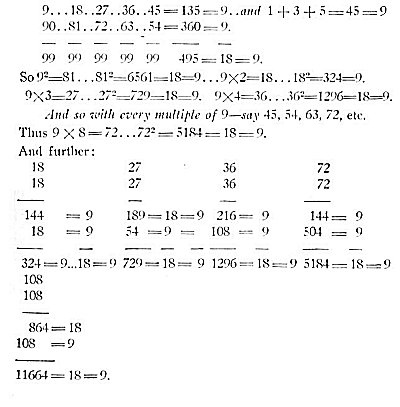
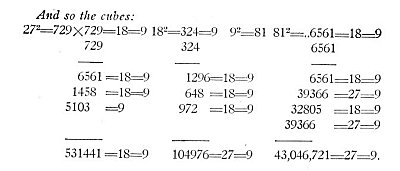 The number 10, or the Denary,
is the measure of everything; and reduces multiplied numbers to unity.
Containing all the numerical and harmonic relations, and all the properties of
the numbers which precede it, it concludes the Abacus or Table of Pythagoras. To
the Mysterious Societies, this number typified the assemblage of all the wonders
of the Universe. They wrote it thus θ, that is to say, Unity in the middle of
Zero, as the centre of a circle, or symbol of Deity. They saw in this figure
everything that should lead to reflection: the centre, the ray, and the
circumference, represented to them God, Man, and the Universe.
This number was, among the Sages, a sign of concord, love,
and peace. To Masons it is a sign of union and good faith; because it is
expressed by joining two hands, or the Master's grip, when the number of fingers
gives 10: and it was represented by the Tetractys of Pythagoras.
The number 12, like the number 7, is celebrated in the
worship of nature. The two most famous divisions of the heavens, that by 7,
which is that of the planets, and that by 12, which is that of the Signs of the
Zodiac, are found upon the religious monuments of all the peoples of the Ancient
World, even to the remote extremes of the East. Although Pythagoras does not
speak of the number 12, it is none the less a sacred number. It is the image of
the Zodiac; and consequently that of the Sun, which rules over it.
Such are the ancient ideas in regard to those numbers which
so often appear in Masonry; and rightly understood, as the old Sages understood
them, they contain many a pregnant lesson.
Before we enter upon the final lesson of Masonic Philosophy,
we will delay a few moments to repeat to you the Christian interpretations of
the Blue Degrees.
In the First Degree, they said, there are three symbols to be
applied.
1st. Man, after the fall, was left naked and defenceless
against the just anger of the Deity. Prone to evil, the human race staggered
blindly onward into the thick darkness of unbelief, bound fast by the strong
cable-tow of the natural and sinful will. Moral corruption was followed by
physical misery. Want and destitution invaded the earth. War and Famine and
Pestilence filled up the measure of evil, and over the sharp flints of
misfortune and wretchedness man toiled with naked and bleeding feet. This
condition of blindness, destitution, misery, and bondage, from which to save the
world the Redeemer came, is symbolized by the condition of the candidate, when
he is brought up for the first time to the door of the Lodge.
2d. Notwithstanding the death of the Redeemer, man can be
saved only by faith, repentance, and reformation. To repent, he must feel the
sharp sting of conscience and remorse, like a sword piercing his bosom. His
confidence in his guide, whom he is told to follow and fear no danger; his trust
in God, which he is caused to profess; and the point of the sword that is
pressed against his naked left breast over the heart, are symbolical of the
faith, repentance and reformation necessary to bring him to the light of a life
in Christ the Crucified.
3d. Having repented and reformed, and bound himself to the
service of God by a firm promise and obligation, the light of Christian hope
shines down into the darkness of the heart of the humble penitent, and blazes
upon his pathway to Heaven. And this is symbolized by the candidate's being
brought to light, after he is obligated, by the Worshipful Master, who in that
is a symbol of the Redeemer, and so brings him to light, with the help of the
brethren, as He taught the Word with the aid of the Apostles.
In the Second Degree there are two symbols:
4th. The Christian assumes new duties toward God and his
fellows. Toward God, of love, gratitude, and veneration, and an anxious desire
to serve and glorify Him; toward his fellows, of kindness, sympathy, and
justice. And this assumption of duty, this entering upon good works, is
symbolized by the Fellow-Craft's obligation; by which, bound as an apprentice to
secrecy merely, and set in the Northeast corner of the Lodge, he descends
as a Fellow-Craft into the body of the brethren, and assumes the
active duties of a good Mason.
5th. The Christian, reconciled to God, sees the world in a
new light. This great Universe is no longer a mere machine, wound up and set
going six thousand or sixty millions years ago, and left to run on afterward
forever, by virtue of a law of mechanics created at the beginning, without
further care or consideration on the part of the Deity; but it has now become to
him a great emanation from God, the product of His thought, not a mere dead
machine, but a thing of life, over which God watches continually, and every
movement of which is immediately produced by His present action, the law of
harmony being the essence of the Deity, re-enacted every instant. And this is
symbolized by the imperfect instruction given in the Fellow-Craft's Degree, in
the sciences, and particularly geometry, connected as the latter is with God
Himself in the mind of a Mason, because the same letter, suspended in the East,
represents both; and astronomy, or the knowledge of the laws of motion and
harmony that govern the spheres, is but a portion of the wider science of
geometry. It is so symbolized, because it is here, in the Second Degree, that
the candidate first receives an other than moral instruction.
There are also two symbols in the Third Degree, which, with
the 3 in the first, and 2 in the second, make the 7.
6th. The candidate, after passing through the first part of
the ceremony, imagines himself a Master; and is surprised to be informed that as
yet he is not, and that it is uncertain whether he ever will be. He is told of a
difficult and dangerous path yet to be travelled, and is advised that upon that
journey it depends whether he will become a Master. This is symbolical of that
which our Saviour said to Nicodemus, that, notwithstanding his morals might be
beyond reproach, he could not enter the Kingdom of Heaven unless he were born
again; symbolically dying, and again entering the world regenerate, like a
spotless infant.
7th. The murder of Hiram, his burial, and his being raised
again by the Master, are symbols, both of the death, burial, and resurrection of
the Redeemer; and of the death and burial in sins of the natural man, and his
being raised again to a new life, or born again, by the direct action of the
Redeemer; after Morality (symbolized by the Entered Apprentice's grip), and
Philosophy (symbolized by the grip of the Fellow-Craft), had failed to raise
him. That of the Lion of the House of Judah is the strong grip, never
to be broken, with which Christ, of the royal line of that House, has clasped to
Himself the whole human race, and embraces them in His wide arms as closely and
affectionately as brethren embrace each other on the five points of fellowship.
As Entered Apprentices and Fellow-Crafts, Masons are taught
to imitate the laudable example of those Masons who labored at the building of
King Solomon's Temple; and to plant firmly and deep in their hearts those
foundation-stones of principle, truth, justice, temperance, fortitude, prudence,
and charity, on which to erect that Christian character which all the storms of
misfortune and all the powers and temptations of Hell shall not prevail against;
those feelings and noble affections which are the most proper homage that can be
paid to the Grand Architect and Great Father of the Universe, and which make the
heart a living temple builded to Him: when the unruly passions are made to
submit to rule and measurement, and their excesses are struck off with the gavel
of self-restraint; and when every action and every principle is accurately
corrected and adjusted by the square of wisdom, the level of humility, and the
plumb of justice.
The two columns, Jachin and Boaz, are the symbols of that
profound faith and implicit trust in God and the Redeemer that are the
Christian's strength; and of those good works by which alone that faith
can be established and made operative and effectual to salvation.
The three pillars that support the Lodge are symbols of a
Christian's HOPE; in a future state of happiness; FAITH in the promises and the
divine character and mission of the Redeemer; and CHARITABLE JUDGMENT of other
men.
The three murderers of Khir-Om symbolize Pontius Pilate,
Caiaphas the High-Priest, and Judas Iscariot: and the three blows given him are
the betrayal by the last, the refusal of Roman protection by Pilate, and the
condemnation by the High-Priest. They also symbolize the blow on the ear, the
scourging, and the crown of thorns. The twelve fellow-crafts sent in search of
the body are the twelve disciples, in doubt whether to believe that the Redeemer
would rise from the dead.
The Master's word, supposed to be lost, symbolizes the
Christian faith and religion, supposed to have been crushed and destroyed when
the Saviour was crucified, after Iscariot had betrayed Him,
and Peter deserted Him, and when the other disciples doubted whether
He would arise from the dead; but which rose from His tomb and flowed rapidly
over the civilized world; and so that which was supposed to be lost was
found. It symbolizes also the Saviour Himself; the WORD that was in the
beginning--that was with God, and that was God; the Word of life,
that was made flesh and dwelt among us, and was supposed to be lost, while He
lay in the tomb, for three days, and His disciples "as yet knew not the
scripture that He must rise again from the dead," and doubted when they heard of
it, and were amazed and frightened and still doubted when He appeared among
them.
The bush of acacia placed at the head of the grave of Khir-Om
is an emblem of resurrection and immortality.
Such are the explanations of our Christian brethren;
entitled, like those of all other Masons, to a respectful 'consideration.
CLOSING INSTRUCTION.
There is no pretence to infallibility in Masonry. It is not
for us to dictate to any man what he shall believe. We have hitherto, in the
instruction of the several Degrees, confined ourselves to laying before you the
great thoughts that have found expression in the different ages of the world,
leaving you to decide for yourself as to the orthodoxy or heterodoxy of each,
and what proportion of truth, if any, each contained. We shall pursue no other
course in this closing Philosophical instruction; in which we propose to deal
with the highest questions that have ever exercised the human mind, with the
existence and the nature of a God, with the existence and the nature of the
human soul, and with the relations of the divine and human spirit with the
merely material Universe. There can be no questions more important to an
intelligent being, none that have for him a more direct and personal interest;
and to this last word of Scottish Masonry we invite your serious and attentive
consideration. And, as what we shall now say will be but the completion and
rounding-off of what we have already said in several of the preceding Degrees,
in regard to the Old Thought and the Ancient Philosophies, we hope that you have
noted and not forgotten our previous lessons, without which this would seem
imperfect and fragmentary.
In its idea of rewarding a faithful and intelligent workman
by conferring upon him a knowledge of the True Word, Masonry has perpetuated a
very great truth, because it involves the proposition that the idea which a man
forms of God is always the most important element in his speculative theory of
the Universe, and in his particular practical plan of action for the Church, the
State, the Community, the Family, and his own individual life. It will ever make
a vast difference in the conduct of a people in war or peace, whether they
believe the Supreme God to be a cruel Deity, delighting in sacrifice and blood,
or a God of Love; and an individual's speculative theory as to the mode and
extent of God's government, and as to the nature and reality of his own
free-will and consequent responsibility, will needs have great influence in
shaping the course of his life and conversation.
We see every day the vast influence of the popular idea of
God. All the great historical civilizations of the race have grown out of the
national ideas which were formed of God; or have been intimately connected with
those ideas. The popular Theology, which at first is only an abstract idea in
the heads of philosophers, by and by shows itself in the laws, and in the
punishments for crime, in the churches, the ceremonies and the sacraments, the
festivals and the fasts, the weddings, the baptisms and the funerals, in the
hospitals, the colleges, the schools, and all the social charities, in the
relations of husband and wife, parent and child, in the daily work and the daily
prayer of every man.
As the world grows in its development, it necessarily outgrows
its ancient ideas of God, which were only temporary and pro-visional. A man who
has a higher conception of God than those about him, and who denies that their
conception is God, is very likely to be called an Atheist by men who are
really far less believers in a God than he. Thus the Christians, who said the
Heathen idols were no Gods, were accounted Atheists by the People, and
accordingly put to death; and Jesus of Nazareth was crucified as an unbelieving
blasphemer, by the Jews.
There is a mere formal Atheism, which is a denial of God in
terms, but not in reality. A man says, There is no God; that is,
no God that is self-originated, or that never originated, but always WAS and HAD
BEEN, who is the cause of existence, who is the Mind and the Providence of the
Universe; and so the order, beauty, and harmony of the world of matter and mind
do not indicate any plan or purpose of Deity. But, he says, NATURE,--meaning by
that the whole sum-total of existence,--that is powerful,
active, wise, and good; Nature is self-originated, or always
was and had been, the cause of its own existence, the mind of the Universe and
the Providence of itself. There is obviously a plan and purpose whereby order,
beauty, and harmony are brought about; but all that is the plan and purpose of
nature.
In such cases, the absolute denial of God is only formal and
not real. The qualities of God are admitted, and affirmed to be real; and
it is a mere change of name to call the possessor of those qualities, Nature,
and not God. The real question is, whether such Qualities exist, as we
call God; and not, by what particular name we shall designate the Qualities. One
man may call the sum total of these Qualities, Nature; another, Heaven; a third,
Universe, a fourth, Matter; a fifth, Spirit; a sixth, God, Theos, Zeus, Alfadir,
Allah, or what he pleases. All admit the existence of the Being, Power, or ENS,
thus diversely named. The name is of the smallest consequence.
Real Atheism is the denial of the existence of any
God, of the actuality of all possible ideas of God. It denies that there is any
Mind, Intelligence, or ENS, that is the Cause and Providence of the Universe,
and of any Thing or any Existence, Soul, Spirit, or Being, that intentionally
or intelligently produces the Order, Beauty, and Harmony thereof, and the
constant and regular modes of operation therein. It must necessarily deny that
there is any law, order, or harmony in existence, or any constant mode of
operation in the world; for it is utterly impossible for any human creature to
conceive, however much he may pretend to do so, of either of these,
except as a consequence of the action of Intelligence; which is, indeed, that
otherwise unknown thing, the existence of which these alone prove; otherwise
than as the cause of these, not a thing at all; a mere name for the
wholly uncognizable cause of these.
The real atheist must deny the existence of the
Qualities of God, deny that there is any mind of or in the Universe, any
self-conscious Providence, any Providence at all. He must deny that there is any
Being or Cause of Finite things, that is self-consciously powerful, wise, just,
loving, and faithful to itself and its own nature. He must deny that there is
any plan in the Universe or any part of it. He must hold, either that
matter is eternal, or that it originated itself, which is absurd, or that it was
originated by an Intelligence, or at least by a Cause; and then he admits a.
God, No doubt it is beyond the reach of our faculties to imagine how
matter originated,--how it began to be, in space where before was
nothing, or God only. But it is equally beyond the reach of our faculties to
imagine it eternal and unoriginated. To hold it to be eternal, without
thought or will; that the specific forms of it, the seed, the rock, the tree,
the man, the solar system, all came with no forethought planning or producing
them, by "chance" or "the fortuitous concourse of atoms" of matter that has no
thought or will; and that they indicate no mind, no plan, no purpose, no
providence, is absurd. It is not to deny the existence of what we
understand by mind, plan, purpose, Providence; but to insist that these words
shall have some other meaning than that which the human race has ever attached
to them: shall mean some unknown thing, for which the human race has no name,
because it has of such a thing no possible idea. Either there never was any such
thing as a "plan," and the word is nonsense, or the Universe exists in
conformity to a plan. The word never meant, and never can mean, any other
thing than that which the Universe exhibits. So with the word "purpose;"
so with the word "Providence." They mean nothing, or else only what the
Universe proves.
It was soon found that the denial of a Conscious Power, the
cause of man and of his life, of a Providence, or a Mind and Intelligence
arranging man in reference to the world, and the world in reference to man,
would not satisfy the instinctive desires of human nature, or account for
the facts of material nature. It did not long answer to say, if it ever
was said, that the Universe was drifting in the void inane, and neither
it, nor any mind within or without it, knew of its whence, its whither, or its
whereabouts; that man was drifting in the Universe, knowing little of his
whereabouts, nothing of his whence or whither; that there was no Mind, no
Providence, no Power, that knew any better; nothing hat guided and directed man
in his drifting, or the Universe in the weltering waste of Time. To say to man
and woman, "your heroism, your bravery, your self-denial all comes to nothing:
your nobleness will do you no good: you will die, and your nobleness will do
mankind no service; for there is no plan or order in all these things;
everything comes and goes by the fortuitous con-course of atoms;" did not, nor
ever will, long satisfy the human mind.
True, the theory of Atheism has been uttered. It has been
said, "Death is the end: this is a world without a God: you are a body without a
soul: there is a Here, but no Hereafter for you; an Earth, but no Heaven. Die,
and return to your dust. Man is bones, blood, bowels, and brain; mind is matter:
there is no soul in the brain, nothing but nerves. We can see all the way to a
little star in the nebula of Orion's belt; so distant that it will take light a
thousand millions of years to come from it to the earth, journeying at the rate
of twelve millions of miles a minute. There is no Heaven this side of that: you
see all the way through: there is not a speck of Heaven; and do you think there
is any beyond it; and if so, when would you reach it? There is no Providence.
Nature is a fortuitous concourse of atoms; thought is a fortuitous function of
matter, a fortuitous result of a fortuitous result, a chance-shot from the great
wind-gun of the Universe, accidentally loaded, pointed at random, and fired off
by chance. Things happen; they are not arranged. There is luck,
and there is ill-luck; but there is no Providence. Die you into dust!" Does all
this satisfy the human instinct of immortality, that makes us ever long, with
unutterable longing, to join ourselves again to our dear ones who have gone away
before us, and to mankind, for eternal life? Does it satisfy our mighty
hungering and thirst for immortality, our anxious longing to come nearer to, and
to know more of, the Eternal Cause of all things?
Men never could be content to believe that there was no mind
that thought for man, no conscience to enact eternal laws, no heart to love
those whom nothing of earth loves or cares for, no will of the Universe to
marshal the nations in the way of wisdom, justice, and love. History is
not--thank God! we know it is not,--the fortuitous concourse of events, or
Nature that of atoms. We cannot believe that there is no plan nor purpose in
Nature, to guide our going out and coming in: that there is a mighty going, but
it goes nowhere; that all beauty, wisdom, affection, justice, morality in the
world, is an accident, and may end to-morrow.
All over the world there is heroism unrequited, or paid with
misery; vice on thrones, corruption in high places, nobleness in poverty or even
in chains, the gentle devotion of woman rewarded by brutal neglect or more
brutal abuse and violence; everywhere want, misery, over-work, and under-wages.
Add to these the Atheist's creed,--a body without a soul, an earth without a
Heaven, a world without a God; and what a Pandemonium would we make of this
world!
The intellect of the Atheist would find matter everywhere;
but no Causing and Providing Mind: his moral sense would find no Equitable Will,
no Beauty of Moral Excellence, no Conscience enacting justice into the
unchanging law of right, no spiritual Order or spiritual Providence, but only
material Fate and Chance. His affections would find only finite things to love;
and to them the dead who were loved and who died yesterday, are like the
rainbow that yesterday evening lived a moment and then passed away. His soul,
flying through the vast Inane, and feeling the darkness with its wings, seeking
the Soul of all, which at once is Reason, Conscience, and the Heart of all that
is, would find no God, but a Universe all disorder; no Infinite, no Reason, no
Conscience, no Heart, no Soul of things; nothing to reverence, to esteem, to
love, to worship, to trust in; but only an Ugly Force, alien and foreign to us,
that strikes down those we love, and makes us mere worms on the hot sand of the
world. No voice would speak from the Earth to comfort him. It is a cruel mother,
that great Earth, that devours her young,--a Force and nothing more. Out of the
sky would smile no kind Providence, in all its thousand starry eyes; and in
storms a malignant violence, with its lightning-sword, would stab into the
darkness, seeking for men to murder.
No man ever was or ever can be content with that. The
evidence of .God has been ploughed into Nature so deeply, and so deeply woven
into the texture of the human soul, that Atheism has never become a faith,
though it has sometimes assumed the shape of theory. Religion is natural to man.
Instinctively he turns to God and reverences and relies on Him. In the
Mathematics of the Heavens, written in gorgeous diagrams of fire, he sees law,
order, beauty, harmony without end: in the ethics of the little nations that
inhabit the ant-hills he sees the same; in all Nature, animate and inanimate, he
sees the evidences of a Design, a Will, an Intelligence, and a God,--of a God
beneficent and loving as well as wise, and merciful and indulgent as well as
powerful.
To man, surrounded by the material Universe, and conscious of
the influence that his material environments exercised upon his fortunes and his
present destiny;--to man, ever confronted with the splendors of the starry
heavens, the regular march of the
seasons, the phenomena of sunrise and moonrise, and all the evidences
of intelligence and design that everywhere pressed upon and overwhelmed him, all
imaginable questions as to the nature and cause of these phenomena constantly
recurred, demanding to be solved, and refusing to be sent away unanswered. And
still, after the lapse of ages, press upon the human mind and demand solution,
the same great questions--perhaps still demanding it in vain.
Advancing to the period when man had ceased to look upon the
separate parts and individual forces of the Universe as gods,--when he had come
to look upon it as a whole, this question, among the earliest, occurred to him,
and insisted on being answered: "Is this material Universe self-existent, or was
it created? Is it eternal, or did it originate?"
And then in succession came crowding on the human mind these
other questions:
"Is this material Universe a mere aggregate of fortuitous
combinations of matter, or is it the result and work of intelligence, acting
upon a plan?
"If there be such an Intelligence, what and where is
it? Is the material Universe itself an Intelligent being? Is it like man,
a body and a soul? Does Nature act upon itself, or is there a Cause beyond it
that acts upon it?
"If there is a personal God, separate from the
material Universe, that created all things, Himself uncreated, is He corporeal
or incorporeal, material or spiritual, the soul of the Universe or wholly apart
from it? and if He be Spirit, what then is spirit?
"Was that Supreme Deity active or quiescent before the
creation; and if quiescent during a previous eternity, what necessity of His
nature moved Him at last to create a world; or was it a mere whim that had no
motive?
"Was matter co-existent with Him, or absolutely created by
him out of nothing? Did He create it, or only mould and shape
and fashion a chaos already existing, co-existent with Himself?
"Did the Deity directly create matter, or was creation
the work of inferior deities, emanations from Himself?
"If He be good and just, whence comes it that, foreknowing
everything, He has allowed sorrow and evil to exist; and how to reconcile with
His benevolence and wisdom the prosperity of vice and the misfortunes of virtue
in this world?"
And then, as to man himself, recurred these other questions,
as they continue to recur to all of us:
"What is it in us that thinks? Is Thought the mere result of
material organization; or is there in us a soul that thinks, separate
from and resident in the body? If the latter, is it eternal and uncreated; and
if not, how created? Is it distinct from God, or an emanation from Him? Is it
inherently immortal, or only so by destination, because God has willed it?
Is it to return to and be merged in Him, or ever to exist, separately from Him,
with its present identity?
"If God has fore-seen and fore-arranged all that occurs, how
has man any real free-will, or the least control over circumstances? How can
anything be done against the will of Infinite Omnipotence; and if all is
done according to that will, how is there any wrong or evil, in what
Infinite Wisdom and Infinite Power does not choose to prevent?
"What is the foundation of the moral law? Did God enact it of
His own mere pleasure; and if so, can He not, when He pleases, repeal it? Who
shalt assure us He will not repeal it, and make right wrong, and virtue vice? Or
is the moral law a necessity of His nature; and if so, who enacted it; and does
not that assert a power, like the old Necessity, superior to Deity?"
And, close-following after these, came the great question of
HEREAFTER, of another Life, of the soul's Destiny; and the thousand other
collateral and subordinate questions, as to matter, spirit, futurity, and God,
that have produced all the systems of philosophy, all metaphysics, and all
theology, since the world began.
What the old philosophic mind thought upon these great
questions, we have already, to some extent, developed. With the
Emanation-doctrine of the Gnostics and the Orient, we have endeavored to make
you familiar. We have brought you face to face with the Kabalists, the Essenes,
and Philo the Jew. We have shown that, and how, much of the old mythology was
derived from the daily and yearly recurring phenomena of the heavens. We have
exhibited to you the ancient notions by which they endeavored to explain to
themselves the existence and prevalence of evil; and we have in some degree made
known to you their metaphysical ideas as to the nature of the Deity. Much more
remains to be done than it is within our power to do. We stand upon the sounding
shore of the great ocean of Time. In front of us stretches out the heaving waste
of the illimitable Past; and its waves, as they roll up to our feet along the
sparkling slope of the yellow sands, bring to us, now and then, from the depths
of that boundless ocean, a shell, a few specimens of algæ torn rudely from their
stems, a rounded pebble; and that is all; of all the vast treasures of ancient
thought that lie buried there, with the mighty anthem of the boundless ocean
thundering over them forever and forever.
Let us once more, and for the last time, along the shore of
that great ocean, gather a few more relics of the Past, and listen to its mighty
voices, as they come, in fragmentary music, in broken and interrupted rhythm,
whispering to us from the great bosom of the Past.
Rites, creeds, and legends express, directly or symbolically,
some leading idea, according to which the Mysteries of Being are supposed to be
explained in Deity. The intricacies of mythical genealogies are a practical
acknowledgment of the mysterious nature of the Omnipotent Deity; displaying in
their beautiful but ineffectual imagery the first efforts of the mind to
communicate with nature: the flowers which fancy strewed before the youthful
steps of Psyche, when she first set out in pursuit of the immortal object of her
love. Theories and notions, in all their varieties of truth and falsehood, are a
machinery more or less efficacious, directed to the same end. Every religion
was, in its origin, an embryo philosophy, or an attempt to interpret the unknown
by mind; and it was only when philosophy, which is essentially progress, outgrew
its first acquisitions, that religion became a thing apart, cherishing as
unalterable dogmas the notions which philosophy had abandoned. Separated from
philosophy, it became arrogant and fantastical, professing to have already
attained what its more authentic representative was ever pursuing in vain; and
discovering, through its initiations and Mysteries, all that to its contracted
view seemed wanting to restore the well-being of mankind, the means of
purification and expiation, remedies for disease, expedients to cure the
disorders of the soul, and to propitiate the gods.
Why should we attempt to confine the idea of the Supreme Mind
within an arbitrary barrier, or exclude from the limits of veracity any
conception of the Deity, which, if imperfect and
inadequate, may be only a little more so than our own? "The name of
God," says Hobbes, "is used not to make us conceive Him, for He is
inconceivable, but that we may honor Him." "Believe in God, and adore
Him," said the Greek Poet, "but investigate Him not; the inquiry is fruitless,
seek not to discover who God is; for, by the desire to know, you offend Him who
chooses to remain unknown." "When we attempt," says Philo, "to investigate the
essence of the Absolute Being, we fall into an abyss of perplexity; and the only
benefit to be derived from such researches is the conviction of their
absurdity."
Yet man, though ignorant of the constitution of the dust on
which he treads, has ventured, and still ventures, to speculate on the nature of
God, and to define dogmatically in creeds the subject least within the compass
of his faculties; and even to hate and persecute those who will not accept his
views as true.
But though a knowledge of the Divine Essence is impossible,
the conceptions formed respecting it are interesting, as indications of
intellectual development. The history of religion is the history of the human
mind; and the conception formed by it of Deity is always in exact relation to
its moral and intellectual attainments. The one is the index and the measure of
the other.
The negative notion of God, which consists in
abstracting the inferior and finite, is, according to Philo, the only way in
which it is possible for man worthily to apprehend the nature of God. After
exhausting the varieties of symbolism, we contrast the Divine Greatness with
human littleness, and employ expressions apparently affirmative, such as
"Infinite," "Almighty," "All-wise," "Omnipotent," "Eternal," and the like; which
in reality amount only to denying, in regard to God, those limits which con-fine
the faculties of man; and thus we remain content with a name which is a mere
conventional sign and confession of our ignorance.
The Hebrew יהוה and the Greek To ON expressed abstract
existence, without outward manifestation or development. Of the same nature are
the definitions, "God is a sphere whose centre is everywhere, and whose
circumference nowhere;" "God is He who sees all, Himself unseen:" and finally,
that of Proclus and Hegel--"the Το μη ον--that which has no outward and positive
existence." Most of the so-called ideas or definitions of the "Absolute" are
only a collection of negations; from which, as they affirm nothing, nothing is
learned.
God was first recognized in the heavenly bodies and in the
elements. When man's consciousness of his own intellectuality was matured, and
he became convinced that the internal faculty of thought was something more
subtle than even the most subtle elements, he transferred that new conception to
the object of his worship, and deified a mental principle instead of a physical
one. He in every case makes God after his own image; for do what we will, the
highest efforts of human thought can conceive nothing higher than the supremacy
of intellect; and so he ever conies back to some familiar type of exalted
humanity. He at first deifies nature, and afterward himself.
The eternal aspiration of the religious sentiment in man is
to become united with God. In his earliest development, the wish and its
fulfillment were simultaneous, through unquestioning belief. In proportion as
the conception of Deity was exalted, the notion of His terrestrial presence or
proximity was abandoned; and the difficulty of comprehending the Divine
Government, together with the glaring superstitious evils arising out of its
misinterpretation, endangered the belief in it altogether.
Even the lights of Heaven, which, as "bright potentates of
the sky," were formerly the vigilant directors of the economy of earth, now
shine dim and distant, and Uriel no more descends upon a sunbeam. But the real
change has been in the progressive ascent of man's own faculties, and not in the
Divine Nature; as the Stars are no more distant now than when they were supposed
to rest on the shoulders of Atlas. And yet a little sense of disappointment and
humiliation attended the first awakening of the soul, when reason, looking
upward toward the Deity, was impressed with a dizzy sense of having fallen.
But hope revives in despondency; and every nation that ever
advanced beyond the most elementary conceptions, felt the necessity of an
attempt to fill the chasm, real or imaginary, separating man from God. To do
this was the great task of poetry, philosophy, and religion. Hence the
personifications of God's attributes, developments, and manifestations, as
"Powers," "Intelligences," "Angels," "Emanations;" through which and the
oracular faculty in himself, man could place himself in communion with God.
The various ranks and orders of mythical beings imagined by
Persians, Indians, Egyptians, or Etrurians, to preside over the various
departments of nature, had each his share in a scheme to
bring man into closer approximation to the Deity; they eventually
gave way only before an analogous though less picturesque symbolism; and the
Deities and Dæmons of Greece and Rome were perpetuated with only a change of
names, when their offices were transferred to Saints and Martyrs. The attempts
by which reason had sometimes endeavored to span the unknown by a bridge of
metaphysics, such as the idealistic systems of Zoroaster, Pythagoras, or Plato,
were only a more refined form of the poetical illusions which satisfied the
vulgar; and man still looked back with longing to the lost golden age, when his
ancestors communed face to face with the Gods; and hoped that, by propitiating
Heaven, he might accelerate the renewal of it in the islands of the Far West,
under the sceptre of Kronos, or in a centralization of political power at
Jerusalem. His eager hope overcame even the terrors of the grave; for the Divine
power was as infinite as human expectation, and the Egyptian, duly ensepulchred
in the Lybian Catacombs, was supposed to be already on his way to the Fortunate
Abodes under the guidance of Hermes, there to obtain a perfect association and
reunion with his God.
Remembering what we have already said elsewhere in regard to
the old ideas concerning the Deity, and repeating it as little as possible, let
us once more put ourselves in communion with the Ancient poetic and philosophic
mind, and endeavor to learn of it what it thought, and how it solved the great
problems that have ever tortured the human intellect.
The division of the First and Supreme Cause into two parts,
one Active and the other Passive, the Universe Agent and Patient, or the
hermaphroditic God-World, is one of the most ancient and widespread dogmas of
philosophy or natural theology. Almost every ancient people gave it a place in
their worship, their mysteries, and their ceremonies.
Ocellus Lucanus, who seems to have lived shortly after
Pythagoras opened his School in Italy, five or six hundred years before our era,
and in the time of Solon, Thales, and the other Sages who had studied in the
Schools of Egypt, not only recognizes the eternity of the Universe, and its
divine character as an unproduced and indestructible being, but also the
distinction of Active and Passive causes in what he terms the Grand Whole, or
the single hermaphroditic Being that comprehends all existences, as well causes
as effects; and which is a system regularly ordered, perfect
and complete, of all Natures. He well apprehended the dividing-line
that separates existence eternally the same, from that which eternally changes;
the nature of celestial from that of terrestrial bodies, that of causes from
that of effects, that which is from that which only BECOMES,--a distinction that
naturally struck every thinking man.
We shall not quote his language at full length. The heavenly
bodies, he thought, are first and most noble; they move of themselves, and ever
revolve, without change of form or essence. Fire, water, earth, and air change
incessantly and continually, not place, but form. Then, as in the Universe there
are generation and cause of generation,--as generation is where there are change
and displacement of parts, and cause where there is stability of nature,
evidently it belongs to what is the cause of generation, to move and to act, and
to the recipient, to be made and moved. In his view, everything above the Moon
was the habitation of the gods; all below, that of Nature and discord; this
operates dissolution of things made; that, production of those that are
being made. As the world is unproduced and indestructible, as it had no
beginning, and will have no end, necessarily the principle that operates
generation in another than itself, and that which operates it in itself, have
co-existed.
The former is all above the moon, and especially the sun: the
latter is the sublunary world. Of these two parts, one active, the other
passive--one divine and always the same, the other mortal and ever changing, all
that we call the "world" or "universe" is composed.
These accorded with the principles of the Egyptian
philosophy, which held that man and the animals had always existed together with
the world; that they were its effects, eternal like itself. The chief divisions
of nature into active and passive causes, its system of generation and
destruction, and the concurrence of the two great principles, Heaven and earth,
uniting to form all things, will, according to Ocellus, always continue to
exist. "Enough," he concludes, "as to the Universe, the generations and
destructions effected in it, the mode in which it now exists, the mode in which
it will ever exist, by the eternal qualities of the two principles, one always
moving, the other always moved; one always governing, the other always
governed."
Such is a brief summary of the doctrine of this philosopher,
whose work is one of the most ancient that has survived to us. The
subject on which he treated occupied in his time all men's minds: the poets sang
of cosmogonies and theogonies, and the philosophers wrote treatises on the birth
of the world and the elements of its composition. The cosmogony of the Hebrews;
attributed to Moses; that of the Phœnicians, ascribed to Sanchoniathon; that of
the Greeks, composed by Hesiod; that of the Egyptians, the Atlantes, and the
Cretans, preserved by Diodorus Siculus; the fragments of the theology of
Orpheus, divided among different writers; the books of the Persians, or their
Boundehesh; those of the Hindūs; the traditions of the Chinese and the people of
Macassar; the cosmogonic chants which Virgil puts in the mouth of Iopas at
Carthage; and those of the old Silenus, the first book of the Metamorphoses of
Ovid; all testify to the antiquity and universality of these fictions as to the
origin of the world and its causes.
At the head of the causes of nature, Heaven and earth were
placed; and the most apparent parts of each, the sun, the moon, the fixed stars
and planets, and, above all, the zodiac, among the active causes of
generation; and among the passive, the several elements. These causes
were not only classed in the progressive order of their energy, Heaven and earth
heading the respective lists, but distinct sexes were in some sort assigned to
them, and characteristics analogous to the mode in which they concur in
universal generation.
The doctrine of Ocellus was the general doctrine everywhere,
it naturally occurring to all to make the same distinction. The Egyptians did
so, in selecting those animals in which they recognized these emblematic
qualities, in order to symbolize the double sex of the Universe. Their God KNEPH,
out of whose mouth issued the Orphic egg, whence the author of the Clementine
Recognitions makes a hermaphroditic figure to emerge, uniting in itself the two
principles whereof Heaven and the earth are forms, and which enter into the
organization of all beings which the heavens and the earth engender by their
concourse, furnishes another emblem of the double power, active and passive,
which the ancients saw in the Universe, and which they symbolized by the egg.
Orpheus, who studied in Egypt, borrowed from the theologians of that country the
mysterious forms under which the science of nature was veiled, and carried into
Greece the symbolic egg,
with its division into two parts or causes figured by the hermaphroditic being
that issued from it, and whereof Heaven and earth are composed.
The Brahmins of India expressed the same cosmogonic idea by a
statue, representative of the Universe, uniting in itself both sexes. The male
sex offered an image of the sun, centre of the active principle, and the female
sex that of the moon, at the sphere whereof, proceeding downward, the passive
portion of nature begins. The Lingam, unto the present day revered in the Indian
temples, being but the conjunction of the organs of generation of the two sexes,
was an emblem of the same. The Hindūs have ever had the greatest veneration for
this symbol of ever-reproductive nature. The Greeks consecrated the same symbols
of universal fruitfulness in their Mysteries; and they were exhibited in the
sanctuaries of Eleusis. They appear among the sculptured ornaments of all the
Indian temples. Tertullian accuses the Valentinians of having adopted the custom
of venerating them; a custom, he says, introduced by Melampus from Egypt into
Greece. The Egyptians consecrated the Phallus in the Mysteries of Osiris and
Isis, as we learn from Plutarch and Diodorus Siculus; and the latter assures us
that these emblems were not consecrated by the Egyptians alone, but by every
people. They certainly were so among the Persians and Assyrians; and they were
regarded everywhere as symbolic of the generative and productive powers of all
animated beings. In those early ages, the works of Nature and all her agents
were sacred like herself.
For the union of Nature with herself is a chaste marriage, of
which the union of man and woman was a natural image, and their organs were an
expressive emblem of the double energy which manifests itself in Heaven and
Earth uniting together to produce all beings. "The Heavens," says Plutarch,
"seemed to men to fulfill the functions of father, and the Earth of mother. The
former impregnated the earth with its fertilizing rains, and the earth,
receiving them, became fruitful and brought forth." Heaven, which covers and
embraces the earth everywhere, is her potent spouse, uniting himself to her to
make her fruitful, without which she would languish in everlasting sterility,
buried in the shades of chaos and of night. Their union is their marriage; their
productions or parts are their children. The skies are our Father, and Nature
the great Mother of us all.
This idea was not the dogma of a single sect, but the general
opinion of all the Sages. "Nature was divided," says Cicero, '"into two parts,
one active, and the other that submitted itself to this action, which it
received, and which modified it. The former was deemed to be a Force, and the
latter the material on which that Force exerted itself." Macrobius repeated
almost literally the doctrine of Ocellus. Aristotle termed the earth the
fruitful mother, environed on all sides by the air. Above it was Heaven, the
dwelling-place of the gods and the divine stars, its substance ether, or a fire
incessantly moving in circles, divine and incorruptible, and subject to no
change. Below it, nature, and the elements, imitable and acted on, corruptible
and mortal.
Synesius said that generations were effected in the portions
of the Universe which we inhabit; while the cause of generations resided in the
portions above us, whence descend to us the germs of the effects produced here
below. Proclus and Simplicius deemed Heaven the Active Cause and Father,
relatively to the earth. The former says that the World or the Whole is a single
Animal; what is done in it, is done by it; the same World acts,
and acts upon itself. He divides it into "Heaven" and "Generation." In
the former, he says, are placed and arranged the conservative causes of
generation, superintended by the Genii and Gods. The Earth, or Rhea, associated
ever with Saturn in production, is mother of the effects of which Heaven is
Father; the womb or bosom that receives the fertilizing energy of the God that
engenders ages. The great work of generation is operated, he says, primarily by
the action of the Sun, and secondarily by that of the Moon, so that the Sun is
the primitive source of this energy, as father and chief of the male gods that
form his court. He follows the action of the male and female principles through
all the portions and divisions of nature, attributing to the former the origin
of stability and identity, to the latter, that of diversity and mobility. Heaven
is to the earth, he says, as the male to the female. It is the movement of the
heavens that, by their revolutions, furnished the seminal incitements and
forces, whose emanations received by the earth, make it fruitful, and cause it
to produce animals and plants of every kind.
Philo says that Moses recognized this doctrine of two causes,
active and passive; but made the former to reside in the Mind or Intelligence
external to matter.
The ancient astrologers divided the twelve signs of the
Zodiac into six male and six female, and assigned them to six male and six
female Great Gods. Heaven and Earth, or Ouranos and Ghê, were among most ancient
nations, the first and most ancient Divinities. We find them in the Phœnician
history of Sanchoniathon, and in the Grecian Genealogy of the Gods given by
Hesiod. Everywhere they marry, and by their union produce the later Gods. "In
the beginning," says Apollodorus, "Ouranos or the Heavens was Lord of all the
Universe: he took to wife Ghê or the earth, and had by her many children." They
were the first Gods of the Cretans, and under other names, of the Armenians, as
we learn from Berosus, and of Panchaîa, an island South of Arabia, as we learn
from Euhemerus. Orpheus made the Divinity, or the "Great Whole," male and
female, because, he said, it could produce nothing, unless it united in itself
the productive force of both sexes. He called Heaven PANGENETOR, the Father of
all things, most ancient of Beings, beginning and end of all, containing in
Himself the incorruptible and unwearying force of Necessity.
The same idea obtained in the rude North of Europe. The
Scythians made the earth to be the wife of Jupiter; and the Germans adored her
under the name of HERTA. The Celts worshipped the Heavens and the Earth, and
said that without the former the latter would be sterile, and that their
marriage produced all things. The Scandinavians acknowledged BÖR or the Heavens,
and gave FURTUR, his son, the Earth as his wife. Olaus Rudbeck adds, that their
ancestors were persuaded that Heaven intermarried with the Earth, and thus
uniting his forces with hers, produced animals and plants. This marriage of
Heaven and Earth produced the AZES, Genii famous in the theology of the North.
In the theology of the Phrygians and Lydians, the ASII were born of the marriage
of the Supreme God with the Earth, and Firmicus informs us that the Phrygians
attributed to the Earth supremacy over the other elements, and considered her
the Great Mother of all things.
Virgil sings the impregnation of the joyous earth, by the
Ether, its spouse, that descends upon its bosom, fertilizing it with rains.
Columella sings the loves of Nature and her marriage with Heaven annually
consummated at the sweet Spring-time. He describes the Spirit of Life, the soul
that animates the world, fired with the passion of Love, uniting with Nature and
itself, itself a part of Nature, and filling its own bosom with new productions.
This union of the Universe with itself, this mutual action of two sexes, he
terms "the great Secrets of Nature," the Mysteries of the Union of Heaven with
Earth, imaged in the Sacred Mysteries of Atys and Bacchus."
Varro tells us that the great Divinities adored at Samothrace
were the Heavens and the Earth, considered as First Causes or Primal Gods, and
as male and female agents, one bearing to the other the relations that the Soul
and Principle of Movement bear to the body or the matter that receives them.
These were the gods revered in the Mysteries of that Island, as they were in the
orgies of Phœnicia.
Everywhere the sacred body of Nature was covered with the
veil of allegory, which concealed it from the profane, and allowed it to be seen
only by the sage who thought it worthy to be the object of his study and
investigation. She showed herself to those only who loved her in spirit and in
truth, and she abandoned the indifferent and careless to error and to ignorance.
"The Sages of Greece," says Pausanias, "never wrote otherwise than in an
enigmatical manner, never naturally and directly." "Nature," says Sallust the
Philosopher, "should be sung only in a language that imitates the secrecy of her
processes and operations. She is herself an enigma. We see only bodies in
movement; the forces and springs that move them are hidden from us." The poets
inspired by the Divinity, the wisest philosophers, all the theologians, the
chiefs of the initiations and Mysteries, even the gods uttering their oracles,
have borrowed the figurative language of allegory. "The Egyptians," says Proclus,
"preferred that mode of teaching, and spoke of the great secrets of Nature, only
in mythological enigmas." The Gymnosophists of India and the Druids of Gaul lent
to science the same enigmatic language, and in the same style wrote the
Hierophants of Phœnicia.
The division of things into the active and the passive cause
leads to that of the two Principles of Light and Darkness, connected with and
corresponding with it. For Light comes from the ethereal substance that composes
the active cause, and darkness from earth or the gross matter which composes the
passive cause. In Hesiod, the Earth, by its union with Tartarus, engenders
Typhon. Chief of the Powers or Genii of Darkness. But it unites
itself with the Ether or Ouranos, when it engenders the Gods of
Olympus, or the Stars, children of Starry Ouranos.
Light was the first Divinity worshipped by men. To it they
owed the brilliant spectacle of Nature. It seems an emanation from the Creator
of all things, making known to our senses the Universe which darkness hides from
our eyes, and, as it were, giving it existence. Darkness, as it were, reduces
all nature again to nothingness, and almost entirely annihilates man.
Naturally, therefore, two substances of opposite natures were
imagined, to each of which the world was in turn subjected, one contributing to
its felicity and the other to its misfortune. Light multiplied its enjoyments;
Darkness despoiled it of them: the former was its friend, the latter its enemy.
To one all good was attributed; to the other all evil; and thus the words
"Light" and "Good" became synonymous, and the words "Darkness" and "Evil." It
seeming that Good and Evil could not flow from one and the same source, any more
than could Light and Darkness, men naturally imagined two Causes or Principles,
of different natures and opposite in their effects, one of which shed Light and
Good, and the other Darkness and Evil, on the Universe.
This distinction of the two Principles was admitted in all
the Theologies, and formed one of the principal bases of all religions. It
entered as a primary element into the sacred fables, the cosmogonies and the
Mysteries of antiquity. "We are not to suppose," says Plutarch, "that the
Principles of the Universe are inanimate bodies, as Democritus and Epicurus
thought; nor that a matter devoid of qualities is organized and arranged by a
single Reason or Providence, Sovereign over all things, as the Stoics held; for
it is not possible that a single Being, good or evil, is the cause of all,
inasmuch as God can in nowise be the cause of any evil. The harmony of the
Universe is a combination of contraries, like the strings of a lyre, or that of
a bow, which alternately is stretched and relaxed." "The good," says Euripides,
"is never separated from the Evil. The two must mingle, that all may go well."
And this opinion as to the two principles, continues Plutarch, "is that of all
antiquity. From the Theologians and Legislators it passed to the Poets and
Philosophers. Its author is unknown; but the opinion itself is established by
the traditions of the whole human race, and consecrated in the mysteries and
sacrifices both of the Greeks and Barbarians, wherein was recognized the dogma
of opposing principles in
nature, which, by their contrariety, produce the mixture of good and evil. We
must admit two contrary causes, two opposing powers, which lead, one to the
right and the other to the left, and thus control our life, as they do the
sublunary world, which is therefore subject to so many changes and
irregularities of every kind. For if there can be no effect without a cause, and
if the Good cannot be the cause of the Evil, it is absolutely necessary that
there should be a cause for the Evil, as there is one for the Good." This
doctrine, he adds, has been generally received among most nations, and
especially by those who have had the greatest reputation for wisdom. All have
admitted two gods, with different occupations, one making the good and the other
the evil found in nature. The former has been styled "God," the latter "Demon."
The Persians, or Zoroaster, named the former Ormuzd and the latter Ahriman; of
whom they said one was of the nature of Light, the other of that of Darkness.
The Egyptians called the former Osiris, and the latter Typhon, his eternal
enemy.
The Hebrews, at least after their return from the Persian
captivity, had their good Deity, and the Devil, a bad and malicious Spirit, ever
opposing God, and Chief of the Angels of Darkness, as God was of those of Light.
The word "Satan" means, in Hebrew, simply, "The Adversary."
The Chaldæans, Plutarch says, had their good and evil stars.
The Greeks had their Jupiter and Pluto, and their Giants and Titans, to whom
were assigned the attributes of the Serpent with which Pluto or Serapis was
encircled, and the shape whereof was assumed by Typhon, Ahriman, and the Satan
of the Hebrews. Every people had something equivalent to this.
The People of Pegu believe in two Principles, one author of
Good and the other of Evil, and strive to propitiate the latter, while they
think it needless to worship the former, as he is incapable of doing evil. The
people of Java, of the Moluccas, of the Gold Coast, the Hottentots, the people
of Teneriffe and Madagascar, and the Savage Tribes of America, all worship and
strive to avert the anger and propitiate the good-will of the Evil Spirit.
But among the Greeks, Egyptians, Chaldæans, Persians, and
Assyrians, the doctrine of the two Principles formed a complete and regularly
arranged theological system. It was the basis of the religion of the Magi and of
Egypt. The author of an ancient
work, attributed to Origen, says that Pythagoras learned from Zarastha, a
Magus at Babylon (the same, perhaps, as Zerdusht or Zoroaster), that there are
two principles of all things, whereof one is the father and the other the
mother; the former, Light, and the latter, Darkness. Pythagoras thought
that the Dependencies on Light were warmth, dryness, lightness, swiftness; and
those on Darkness, cold, wet, weight, and slowness; and that the world derived
its existence from these two principles, as from the male and the female.
According to Porphyry, he conceived two opposing powers, one good, which he
termed Unity, the Light, Right, the Equal, the Stable, the Straight; the other
evil, which he termed Binary, Darkness, the Left, the Unequal, the Unstable, the
Crooked. These ideas he received from the Orientals, for he dwelt twelve years
at Babylon, studying with the Magi. Varro says he recognized two Principles of
all things,--the Finite and the Infinite, Good and Evil, Life and Death, Day and
Night. White he thought was of the nature of the Good Principle, and Black of
that of the Evil; that Light and Darkness, Heat and Cold, the Dry and the Wet,
mingled in equal proportions; that Summer was the triumph of heat, and Winter of
cold; that their equal combination produced Spring and Autumn, the former
producing verdure and favorable to health, and the latter, deteriorating
everything, giving birth to maladies. He applied the same idea to the rising and
setting of the sun; and, like the Magi, held that God or Ormuzd in the body
resembled light, and in the soul, truth.
Aristotle, like Plato, admitted a principle of Evil, resident
in matter and in its eternal imperfection.
The Persians said that Ormuzd, born of the pure Light, and
Ahriman, born of darkness, were ever at war. Ormuzd produced six Gods,
Beneficence, Truth, Good Order, Wisdom, Riches, and Virtuous Joy. These were so
many emanations from the Good Principle, so many blessings bestowed by it on
men. Ahriman, in his turn, produced six Devs, opponents of the six emanations
from Ormuzd. Then Ormuzd made himself three times as great as before, ascended
as far above the sun as the sun is above the earth, and adorned the heavens with
stars, of which he made Sirius the sentinel or advance-guard: that he then
created twenty-four other Deities, and placed them in an egg, where Ahriman also
placed twenty-four others, created by him, who broke the egg,
and so intermingled Good and Evil. Theopompus adds that, according to
the Magi, for two terms of three thousand years, each of the two Principles is
to be by turns victor and the other vanquished; then for three thousand more for
each they are to contend with each other, each destroying reciprocally the works
of the other; after which Ahriman is to perish, and men, wearing transparent
bodies, to enjoy unutterable happiness.
The twelve great Deities of the Persians, the six Amshaspands
and six Devs, marshalled, the former under the banner of Light, and the latter
under that of Darkness, are the twelve Zodiacal Signs or Months; the six supreme
signs, or those of Light, or of Spring and Summer, commencing with Aries, and
the six inferior, of Darkness, or of Autumn and Winter, commencing with Libra.
Limited Time, as contradistinguished from Time without limits, or Eternity, is
Time created and measured by the celestial revolutions. It is comprehended in a
period divided into twelve parts, each subdivided into a thousand parts, which
the Persians termed years. Thus the circle annually traversed by the Sun was
divided into 12,000 parts, or each sign into 3,000: and thus, each year, the
Principle of Light and Good triumphed for 3,000 years, that of Evil and Darkness
for 3,000, and they mutually destroyed each other's labors for 6,000, or 3,000
for each: so that the Zodiac was equally divided between them. And accordingly
Ocellus Lucanus, the Disciple of Pythagoras, held that the principal cause of
all sublunary effects resided in the Zodiac, and that from it flowed the good or
bad influences of the planets that revolved therein.
The twenty-four good and twenty-four evil Deities, enclosed
in the Egg, are the forty-eight constellations of the ancient sphere, equally
divided between the realms of Light and Darkness, on the concavity of the
celestial sphere which was apportioned among them; and which, enclosing the
world and planets, was the mystic and sacred egg of the Magi, the Indians, and
the Egyptians,--the egg that issued from the mouth of the God Kneph, that
figured as the Orphic Egg in the Mysteries of Greece, that issued from the God
Chumong of the Coresians, and from the Egyptian Osiris and the God Phanes of the
Modern Orphics, Principle of Light,--the egg crushed by the Sacred Bull of the
Japanese, and from which the world emerged; that placed by the Greeks at the
feet of Bacchus the bull-horned God, and from which Aristophanes makes Love
emerge, who with Night organizes Chaos.
Thus the Balance, the Scorpion, the Serpent of Ophiucus, and
the Dragon of the Hesperides became malevolent Signs and Evil Genii; and entire
nature was divided between the two principles, and between the agents or partial
causes subordinate to them. Hence Michael and his Archangels, and Satan and his
fallen compeers. Hence the wars of Jupiter and the Giants, in which the Gods of
Olympus fought on the side of the Light-God, against the dark progeny of earth
and Chaos; a war which Proclus regarded as symbolizing the resistance opposed by
dark and chaotic matter to the active and beneficent force which gives it
organization; an idea which in part appears in the old theory of two Principles,
one innate in the active and luminous substance of Heaven, and the other in the
inert and dark substance of matter that resists the order and the good that
Heaven communicates to it.
Osiris conquers Typhon, and Ormuzd, Ahriman, when, at the
Vernal Equinox, the creative action of Heaven and its demiourgic energy is most
strongly manifested. Then the principle of Light and Good overcomes that of
Darkness and Evil, and the world rejoices, redeemed from cold and wintry
darkness by the beneficent Sign into which the Sun then enters triumphant and
rejoicing, after his resurrection.
From the doctrine of the two Principles, Active and Passive,
grew that of the Universe, animated by a Principle of Eternal Life, and by a
Universal Soul, from which every isolated and temporary being received at its
birth an emanation, which, at the death of such being, returned to its source.
The life of matter as much belonged to nature as did matter itself; and as life
is manifested by movement, the sources of life must needs seem to be placed in
those luminous and eternal bodies, and above all in the Heaven in which they
revolve, and which whirls them along with itself in that rapid course that is
swifter than all other movement. And fire and heat have so great an analogy with
life, that cold, like absence of movement, seemed the distinctive characteristic
of death. Accordingly, the vital fire that blazes in the Sun and produces the
heat that vivifies everything, was regarded as the principle of organization and
life of all sublunary beings.
According to this doctrine, the Universe is not to be
regarded, in its creative and eternal action, merely as an immense machine,
moved by powerful springs and forced into a continual movement, which, emanating
from the circumference, extends to the centre,
acts and re-acts in every possible direction, and re-produces in
succession all the varied forms which matter receives. So to regard it would be
to recognize a cold and purely mechanical action, the energy of which could
never produce life.
On the contrary, it was thought, the Universe should be
deemed an immense Being, always living, always moved and always moving in an
eternal activity inherent in itself, and which, subordinate to no foreign cause,
is communicated to all its parts, connects them together, and makes of the world
of things a complete and perfect whole. The order and harmony which reign
therein seem to belong to and be a part of it, and the design of the various
plans of construction of organized beings would seem to be graven in its Supreme
Intelligence, source of all the other Intelligences which it communicates
together with life to man. Nothing existing out of it, it must be regarded as
the principle and term of all things.
Chæremon had no reason for saying that the Ancient Egyptians,
inventors of the sacred fables, and adorers of the Sun and the other luminaries,
saw in the Universe only a machine, without life and without intelligence,
either in its whole or in its parts; and that their cosmogony was a pure
Epicureanism, which required only matter and movement to organize its world and
govern it. Such an opinion would necessarily exclude all religious worship.
Wherever we suppose a worship, there we must suppose intelligent Deities who
receive it, and are sensible to the homage of their adorers; and no other people
were so religious as the Egyptians.
On the contrary, with them the immense, immutable, and
Eternal Being, termed "God" or "the Universe," had eminently, and in all their
plenitude, that life and intelligence which sublunary beings, each an infinitely
small and temporary portion of itself, possess in a far inferior degree and
infinitely less quantity. It was to them, in some sort, like the Ocean, whence
the springs, brooks, and rivers have risen by evaporation, and to the bosom
whereof they return by a longer or shorter course, and after a longer or shorter
separation from the immense mass of its waters. The machine of the Universe was,
in their view, like that of man, moved by a Principle of Life which kept it in
eternal activity, and circulated in all its parts. The Universe was a living and
animated being, like man and the other animals; or rather they were so only
because the Universe was essentially so, and for a few moments communicated to
each an infinitely minute portion of
its eternal life, breathed by it into the inert and gross matter of
sublunary bodies. That withdrawn, man or the animal died; and the Universe
alone, living and circulating around the wrecks of their bodies, by its eternal
movement, organized and animated new bodies, returning to them the eternal fire
and subtle substance which vivifies itself, and which, incorporated in its
immense mass, was its universal soul.
These were the ancient ideas as to this Great GOD, Father of
all the gods, or of the World; of this BEING, Principle of all things, and of
which nothing other than itself is Principle,--the Universal cause that was
termed God. Soul of the Universe, eternal like it, immense like it, supremely
active and potent in its varied operations, penetrating all parts of this vast
body, impressing a regular and symmetrical movement on the spheres, making the
elements instinct with activity and order, mingling with everything, organizing
everything, vivifying and preserving everything,--this was the UNIVERSE-GOD
which the ancients adored as Supreme Cause and God of Gods.
Anchises, in the Æneid, taught Æneas this doctrine of
Pythagoras, learned by him from his Masters, the Egyptians, in regard to the
Soul and Intelligence of the Universe, from which our souls and
intelligences, as well as our life and that of the animals, emanate, Heaven,
Earth, the Sea, the Moon and the Stars, he said, are moved by a principle of
internal life which perpetuates their existence; a great intelligent soul, that
penetrates every part of the vast body of the Universe, and, mingling with
everything, agitates it by an eternal movement. It is the source of life in all
living things. The force which animates all, emanates from the eternal fire that
burns in Heaven. In the Georgics, Virgil repeats the same doctrine; and that, at
the death of every animal, the life that animated it, part of the universal
life, returns to its Principle and to the source of life that circulates in the
sphere of the Stars.
Servius makes God the active Cause that organizes the
elements into bodies, the vivifying breath or spirit, that, spreading through
matter or the elements, produces and engenders all things. The elements compose
the substance of our bodies: God composes the souls that vivify these bodies.
From it come the instincts of animals, from it their life, he says: and when
they die, that life returns to and re-enters into the Universal Soul, and their
bodies into Universal Matter.
Timæus of Locria and Plato his Commentator wrote of the Soul
of the World, developing the doctrine of Pythagoras, who thought, says Cicero,
that God is the Universal Soul, resident everywhere in nature, and of which our
Souls are but emanations. "God is one," says Pythagoras, as cited by
Justin Martyr: "He is not, as some think, without the world, but within
it, and entire in its entirety. He sees all that becomes, forms all
immortal beings, is the author of their powers and performances, the origin of
all things, the Light of Heaven, the Father, the Intelligence, the
Soul of all beings, the Mover of all spheres."
God, in the view of Pythagoras, was ONE, a single substance,
whose continuous parts extended through all the Universe, without separation,
difference, or inequality, like the soul in the human body. He denied the
doctrine of the spiritualists, who had severed the Divinity from the Universe,
making Him exist apart from the Universe, which thus became no more than a
material work, on which acted the Abstract Cause, a God, isolated from it. The
Ancient Theology did not so separate God from the Universe. This Eusebius
attests, in saying that but a small number of wise men, like Moses, had sought
for God or the Cause of all, outside of that ALL; while the Philosophers of
Egypt and Phœnicia, real authors of all the old Cosmogonies, had placed the
Supreme Cause in the Universe itself, and in its parts, so that, in their
view, the world and all its parts are in God.
The World or Universe was thus compared to man: the Principle
of Life that moves it, to that which moves man; the Soul of the World to that of
man. Therefore Pythagoras called man a microcosm, or little world, as
possessing in miniature all the qualities found on a great scale in the
Universe; by his reason and intelligence partaking of the Divine Nature: and by
his faculty of changing aliments into other substances, of growing, and
re-producing himself, partaking of elementary Nature. Thus he made the Universe
a great intelligent Being, like man--an immense Deity, having in itself, what
man has in himself, movement, life, and intelligence, and besides, a perpetuity
of existence, which man has not; and, as having in itself perpetuity of movement
and life, therefore the Supreme Cause of all.
Everywhere extended, this Universal Soul does not, in the
view of Pythagoras, act everywhere equally nor in the same manner. The highest
portion of the Universe, being as it were its head,
seemed to him its principal seat, and there was the guiding power of
the rest of the world. In the seven concentric spheres is resident an eternal
order, fruit of the intelligence, the Universal Soul that moves, by a constant
and regular progression, the immortal bodies that form the harmonious system of
the heavens.
Manilius says: "I sing the invisible and potent Soul of
Nature; that Divine Substance which, everywhere inherent in Heaven, Earth, and
the Waters of the Ocean, forms the bond that holds together and makes one all
the parts of the vast body of the Universe. It, balancing all Forces, and
harmoniously arranging the varied relations of the many members of the world,
maintains in it the life and regular movement that agitate it, as a result of
the action of the living breath or single spirit that dwells in all its parts,
circulates in all the channels of universal nature, flashes with rapidity to all
its points, and gives to animated bodies the configurations appropriate to the
organization of each . . . . This eternal Law, this Divine Force, that maintains
the harmony of the world, makes use of the Celestial Signs to organize and guide
the animated creatures that breathe upon the earth; and gives to each of them
the character and habits most appropriate. By the action of this Force Heaven
rules the condition of the Earth and of its fields cultivated by the husbandman:
it gives us or takes from us vegetation and harvests: it makes the great ocean
overpass its limits at the flow, and retire within them again at the ebbing, of
the tide."
Thus it is no longer by means of a poetic fiction only that
the heavens and the earth become animated and personified, and are deemed living
existences, from which other existences proceed. For now they live, with their
own life, a life eternal like their bodies, each gifted with a life and perhaps
a soul, like those of man, a portion of the universal life and universal soul;
and the other bodies that they form, and which they contain in their bosoms,
live only through them and with their life, as the embryo lives in the bosom of
its mother, in consequence and by means of the life communicated to it, and
which the mother ever maintains by the active power of her own life. Such is the
universal life of the world, reproduced in all the beings which its superior
portion creates in its inferior portion, that is as it were the matrix of
the world, or of the beings that the heavens engender in its bosom,
"The soul of the world," says Macrobius, "is nature itself"
[as the soul of man is man
himself], "always acting through the celestial spheres which .it moves, and
which but follow the irresistible impulse it impresses on them. The heavens, the
sun, great seat of generative power, the signs, the stars, and the planets act
only with the activity of the soul of the Universe. From that soul, through
them, come all the variations and changes of sublunary nature, of which the
heavens and celestial bodies are but the secondary causes. The zodiac, with its
signs, is an existence, immortal and divine, organized by the universal soul,
and producing, or gathering in itself, all the varied emanations of the
different powers that make up the nature of the Divinity."
This doctrine, that gave to the heavens and the spheres
living souls, each a portion of the universal soul, was of extreme antiquity. It
was held by the old Sabæans. It was taught by Timæus, Plato, Speusippus,
Iamblichus, Macrobius, Marcus Aurelius, and Pythagoras. When once men had
assigned a soul to the Universe, containing in itself the plenitude of the
animal life of particular beings, and even of the stars, they soon supposed that
soul to be essentially intelligent, and the source of intelligence of all
intelligent beings. Then the Universe became to them not only animated but
intelligent, and of that intelligence the different parts of nature partook.
Each soul was the vehicle, and, as it were, the envelope of the intelligence
that attached itself to it, and could repose nowhere else. Without a soul there
could be no intelligence; and as there was a universal soul, source of all
souls, the universal soul was gifted with a universal intelligence, source of
all particular intelligences. So the soul of the world contained in itself the
intelligence of the world. All the agents of nature into which the universal
soul entered, received also a portion of its intelligence, and the Universe, in
its totality and in its parts, was filled with intelligences, that might be
regarded as so many emanations from the sovereign and universal intelligence.
Wherever the divine soul acted as a cause, there also was intelligence; and thus
Heaven, the stars, the elements, and all parts of the Universe, became the seats
of so many divine intelligences. Every minutest portion of the great soul became
a partial intelligence, and the more it was disengaged from gross matter, the
more active and intelligent it was. And all the old adorers of nature, the
theologians, astrologers, and poets, and the most distinguished philosophers,
supposed that the stars were so many animated and intelligent beings, or
eternal bodies, active causes of effects here below, whom a principle
of life animated, and whom an intelligence directed, which was but an emanation
from, and a portion of, the universal life and intelligence of the world.
The Universe itself was regarded as a supremely intelligent
being. Such was the doctrine of Timæus of Locria. The soul of man was part of
the intelligent soul of the Universe, and therefore itself intelligent. His
opinion was that of many other philosophers. Cleanthes, a disciple of ZENO,
regarded the Universe as God, Or as the unproduced and universal cause of all
effects produced. He ascribed a soul and intelligence to universal nature, and
to this intelligent soul, in his view, divinity belonged. From it the
intelligence of man was an emanation, and shared its divinity. Chrysippus, the
most subtle of the Stoics, placed in the universal reason that forms the soul
and intelligence of nature, that divine force or essence of the Divinity which
he assigned to the world moved by the universal soul that pervades its every
part.
An interlocutor in Cicero's work, De Natura Deorum,
formally argues that the Universe is necessarily intelligent and wise, because
man, an infinitely small portion of it, is so. Cicero makes the same argument in
his oration for Milo. The physicists came to the same conclusion as the
philosophers. They supposed that movement essentially belonged to the soul, and
the direction of regular and ordered movements to the intelligence. And, as both
movement and order exist in the Universe, therefore, they held, there must be in
it a soul and an intelligence that role it, and are not to be distinguished from
itself; because the idea of the Universe is but the aggregate of all the
particular ideas of all things that exist.
The argument was, that the Heavens, and the Stars which make
part of them, are animated, because they possess a portion of the
Universal Soul: they are intelligent beings, because that Universal Soul,
part whereof they possess, is supremely intelligent; and they share Divinity
with Universal Nature, because Divinity resides in the Universal Soul and
Intelligence which move and rule the world, and of each of which they hold a
share. By this process of logic, the interlocutor in Cicero assigned Divinity to
the Stars, as animated beings gifted with sensibility and intelligence, and
composed of the noblest and purest portions of the ethereal substance, unmixed
with matter of an alien nature, and
essentially containing light and heat. Hence he concluded them to be
so many gods, of an intelligence superior to that of other existences,
corresponding to the lofty height in which they moved with such perfect
regularity and admirable harmony, with a movement spontaneous and free. Hence he
made them "Gods," active, eternal, and intelligent "Causes"; and peopled the
realm of Heaven with a host of Eternal Intelligences, celestial Genii or Angels,
sharing the universal Divinity, and associated with it in the administration of
the Universe, and the dominion exercised over sublunary nature and man.
We make the motive-force of the planets to be a
mechanical law, which we explain by the combination of two forces, the
centripetal and centrifugal, whose origin we cannot demonstrate, but
whose force we can calculate. The ancients regarded them as moved by an
intelligent force that had its origin in the first and universal Intelligence.
Is it so certain, after all, that we are any nearer the truth than they were; or
that we know what our "centripetal and centrifugal forces" mean; for what
is a force? With us, the entire Deity acts upon and moves each
planet, as He does the sap that circulates in the little blade of grass, and in
the particles of blood in the tiny veins of the invisible rotifer. With the
Ancients, the Deity of each Star was but a portion of the Universal God, the
Soul of Nature. Each Star and Planet, with them, was moved of itself, and
directed by its own special intelligence. And this opinion of Achilles
Tatius, Diodorus, Chrysippus, Aristotle, Plato, Heraclides of Pontus,
Theophrastus, Simplicius, Macrobius, and Proclus, that in each Star there is an
immortal Soul and Intelligence, part of the Universal Soul and Intelligence of
the Whole,--this opinion of Orpheus, Plotinus, and the Stoics, was in reality,
that of many Christian philosophers. For Origen held the same opinion; and
Augustin held that every visible thing in the world was superintended by an
Angelic Power: and Cosma, the Monk, believed that every Star was under the
guidance of an Angel; and the author of the Octateuch, written in the time of
the Emperor Justin, says that they are moved by the impulse communicated to them
by Angels stationed above the firmament. Whether the stars were animated beings,
was a question that Christian antiquity did not decide. Many of the Christian
doctors believed they were. Saint Augustin hesitates, Saint Jerome doubts, if
Solomon did not assign souls to the Stars. Saint Ambrose does not doubt they
have souls; and Pamphilus says that many of the Church believe they are
reasonable beings, while many think otherwise, but that neither one nor the
other opinion is heretical.
Thus the Ancient Thought, earnest and sincere, wrought out
the idea of a Soul inherent in the Universe and in its several parts. The
next step was to separate that Soul from the Universe, and give to it an
external and independent existence and personality; still omnipresent, in every
inch of space and in every particle of matter, and yet not a part of Nature, but
its Cause and its Creator. This is the middle ground between the two doctrines,
of Pantheism (or that all is God, and God is in all and is all), on the
one side, and Atheism (or that all is nature, and there is no other God), on the
other; which doctrines, after all, when reduced to their simplest terms, seem to
be the same.
We complacently congratulate ourselves on our recognition of
a personal God, as being the conception most suited to human sympathies,
and exempt from the mystifications of Pantheism. But the Divinity remains still
a mystery, notwithstanding all the devices which symbolism, either from the
organic or inorganic creation, can supply; and personification is itself a
symbol, liable to misapprehension as much as, if not more so than, any other,
since it is apt to degenerate into a mere reflection of our own infirmities; and
hence any affirmative idea or conception that we can, in our own minds, picture
of the Deity, must needs be infinitely inadequate.
The spirit of the Vedas (or sacred Indian Books, of great
antiquity), as understood by their earliest as well as most recent expositors,
is decidedly a pantheistic monotheism--one God, and He all in all; the many
divinities, numerous as the prayers ad-dressed to them, being resolvable into
the titles and attributes of a few, and ultimately into THE ONE. The machinery
of personification was understood to have been unconsciously assumed as a mere
expedient to supply the deficiencies of language; and the Mimansa justly
considered itself as only interpreting the true meaning of the Mantras, when it
proclaimed that, in the beginning, "Nothing was but Mind, the Creative Thought
of Him which existed alone from the beginning, and breathed without afflation."
The idea suggested in the Mantras is dogmatically asserted and developed in the
Upanischadas. The Vedanta philosophy,
assuming the mystery of the "ONE IN MANY" as the fundamental article
of faith, maintained not only the Divine Unity, but the identity of matter and
spirit. The unity which it advocates is that of mind. Mind is the Universal
Element, the One God, the Great Soul, Mahaatma. He is the material as well as
efficient cause, and the world is a texture of which he is both the web and the
weaver. He is the Macrocosmos, the universal organism called Pooroosha, of which
Fire, Air, and Sun are only the chief members. His head is light, his eyes the
sun and moon, his breath the wind, his voice the opened Vedas. All proceeds from
Brahm, like the web from the spider and the grass from the earth.
Yet it is only the impossibility of expressing in language
the origination of matter from spirit, which gives to Hindu philosophy the
appearance of materialism. Formless Himself, the Deity is present in all forms.
His glory is displayed in the Universe as the image of the sun in water, which
is, yet is not, the luminary itself. All maternal agency and appearance, the
subjective world, are to a great extent phantasms, the notional representations
of ignorance. They occupy, however, a middle ground between reality and
non-reality; they are unreal, because nothing exists but Brahm; yet in some
degree real, inasmuch as they constitute an outward manifestation of him. They
are a self-induced hypostasis of the Deity, under which He presents to
Himself the whole of animate and inanimate Nature, the actuality of the
moment, the diversified appearances which successively invest the one
Pantheistic Spirit.
The great aim of reason is to generalize; to discover unity
in multiplicity, order in apparent confusion; to separate from the accidental
and the transitory, the stable and universal. In the contemplation of Nature,
and the vague, but almost intuitive perception of a general uniformity of plan
among endless varieties of operation and form, arise those solemn and
reverential feelings, which, if accompanied by intellectual activity, may
eventually ripen into philosophy.
Consciousness of self and of personal identity is co-existent
with our existence. We cannot conceive of mental existence without it. It is not
the work of reflection nor of logic, nor the result of observation, experiment,
and experience. It is a gift from God, like instinct; and that consciousness of
a thinking soul which is
really the person that we are, and other than our body, is the best and most
solid proof of the soul's existence. We have the same consciousness of a Power
on which we are dependent; which we can define and form an idea or
picture of, as little as we can of the soul, and yet which we feel, and
therefore know, exists. True and correct ideas of that Power, of the
Absolute Existence from which all proceeds, we cannot trace; if by true and
correct we mean adequate ideas; for of such we are not, with our limited
faculties, capable. And ideas of His nature, so far correct as we are capable of
entertaining, can only be attained either by direct inspiration or by the
investigations of philosophy.
The idea of the universal preceded the recognition of any
system for its explanation. It was felt rather than understood; and it
was long before the grand conception on which all philosophy rests received
through deliberate investigation that analytical development which might
properly entitle it to the name. The sentiment, when first observed by the
self-conscious mind, was, says Plato, "a Divine gift, communicated to mankind by
some Prometheus, or by those ancients who lived nearer to the gods than our
degenerate selves." The mind deduced from its first experiences the notion of a
general Cause or Antecedent, to which it shortly gave a name and personified it.
This was the statement of a theorem, obscure in proportion to its generality.
It explained all things but itself. It was a true cause, but an
incomprehensible one. Ages had to pass before the nature of the theorem
could be rightly appreciated, and before men, acknowledging the First Cause to
be an object of faith rather than science, were contented to confine their
researches to those nearer relations of existence and succession, which are
really within the reach of their faculties. At first, and for a long time, the
intellect deserted the real for a hastily-formed ideal world, and the
imagination usurped the place of reason, in attempting to put a construction on
the most general and inadequate of conceptions, by transmuting its symbols into
realities, and by substantializing it under a thousand arbitrary forms.
In poetry, the idea of Divine unity became, as in Nature,
obscured by a multifarious symbolism; and the notionalities of transcendental
philosophy reposed on views of nature scarcely more profound than those of the
earliest symbolists. Yet the idea of unity was rather obscured than
extinguished; and Xenophanes
appeared as an enemy of Homer, only because he more emphatically insisted on
the monotheistic element, which, in poetry, has been comparatively overlooked.
The first philosophy reasserted the unity which poetry had lost; but being
unequal to investigate its nature, it again resigned it to the world of
approximate sensations, and became bewildered in materialism, considering the
conceptional whole or First Element as some refinement of matter, unchangeable
in its essence, though subject to mutations of quality and form in an eternal
succession of seeming decay and regeneration; comparing it to water, air, or
fire, as each endeavored to refine on the doctrine of his predecessor, or was
influenced by a different class of theological traditions.
In the philosophical systems, the Divine Activity, divided by
the poets and by popular belief among a race of personifications, in whom the
idea of descent replaced that of cause, or of pantheistic evolution, was
restored, without subdivision or reservation, to nature as a whole; at first as
a mechanical force or life; afterward as an all-pervading soul
or inherent thought; and lastly as an external directing Intelligence.
The Ionian revival of pantheism was materialistic. The Moving
Force was inseparable from a material element, a subtle yet visible ingredient.
Under the form of air or fire, the principle of life was
associated with the most obvious material machinery of nature. Everything, it
was said, is alive and full of gods. The wonders of the volcano, the magnet, the
ebb and flow of the tide, were vital indications, the breathing or moving of the
Great World-Animal. The imperceptible. ether of Anaximenes had no positive
quality beyond the atmospheric air with which it was easily confused: and even
the "Infinite" of Anaximander, though free of the conditions of quality or
quantity, was only an ideal chaos, relieved of its coarseness by negations. It
was the illimitable storehouse or Pleroma, out of which is evolved the endless
circle of phenomenal change. A moving Force was recognized in, but not clearly
distinguished from, the material. Space, Time, Figure, and Number, and
other common forms or properties, which exist only as attributes, were
treated as substances, or at least as making a substantial connection
between the objects to which they belong: and all the conditions of material
existence were supposed to have been evolved out of the Pythagorean Monad.
The Eleatic philosophers treated conceptions not only as
entities, but as the only entities, alone possessing the stability
and certainty and reality vainly sought among phenomena. The only reality was
Thought. "All real existence," they said, "is mental existence;
non-existence, being inconceivable, is therefore impossible; existence fills up
the whole range of thought, and is inseparable from its exercise; thought and
its object are one."
Xenophanes used ambiguous language, applicable to the
material as well as to the mental, and exclusively appropriate to neither. In
other words, he availed himself of material imagery to illustrate an indefinite
meaning. In announcing the universal being, he appealed to the heavens as the
visible manifestation, calling it spherical, a term borrowed from the
material world. He said that God was neither moved nor unmoved, limited nor
unlimited. He did not even attempt to express clearly what cannot be conceived
clearly; admitting, says Simplicius, that such speculations were above physics.
Parmenides employed similar expedients, comparing his metaphysical Deity to a
sphere, or to heat, an aggregate or a continuity, and so involuntarily
withdrawing its nominal attributes.
The Atomic school, dividing the All into Matter and Force,
deemed matter unchangeable in its ultimate constitution, though infinitely
variable in its resultant forms. They made all variety proceed from the varied
combinations of atoms; but they required no mover nor director of the atoms
external to themselves; no universal Reason; but a Mechanical Eternal
Necessity, like that of the Poets. Still it is doubtful whether there ever
was a time when reason could be said to be entirely asleep, a stranger to its
own existence, notwithstanding this apparent materialism. The earliest
contemplation of the external world, which brings it into an imagined
association with ourselves, assigns, either to its whole or its parts, the
sensation and volition which belong to our own souls.
Anaxagoras admitted the existence of ultimate elementary
particles, as Empedocles did, from the combinations whereof all material
phenomena resulted. But he asserted the Moving Force to be Mind; and yet, though
he clearly saw the impossibility of advancing by illustration or definition
beyond a reasonable faith, or a simple negation of materiality, yet he could not
wholly desist from the endeavor to illustrate the nature of this non-matter or
mind, by symbols drawn from those physical considerations which
decided him in placing it in a separate category. Whether as human
reason, or as the regulating Principle in nature, he held it different from all
other things in character and effect, and that therefore it must necessarily
differ in its essential constitution. It was neither Matter, nor a Force
conjoined with matter, or homogeneous with it, but independent and generically
distinct, especially in this, that, being the source of all motion, separation,
and cognition, it is something entirely unique, pure, and unmixed; and so, being
unhindered by any interfering influence limiting its independence of individual
action, it has Supreme Empire over all things, over the vortex of worlds as well
as over all that live in them. It is most penetrating and powerful, mixing with
other things, though no other thing mixes with it; exercises universal control
and cognition, and includes the Necessity of the Poets, as well as the
independent power of thought which we exercise within ourselves. In short, it is
the self-conscious power of thought extended to the Universe, and exalted into
the Supreme External Mind which sees, knows, and directs all things.
Thus Pantheism and Materialism were both avoided; and matter,
though as infinitely varied as the senses represent it, was held in a bond of
unity transferred to a ruling power apart from it. That Power could not be Prime
Mover, if it were itself moved; nor All-Governing, if not apart from the things
it governs. If the arranging Principle were inherent in matter, it would
have been impossible to account for the existence of a chaos: if something
external, then the old Ionian doctrine of a "beginning" became more easily
conceivable, as being the epoch at which the Arranging Intelligence commenced
its operations.
But this grand idea of an all-governing independent mind
involved difficulties which proved insuperable; because it gave to matter, in
the form of chaos, an independent and eternal self-existence, and so introduced
a dualism of mind and matter. In the Mind or Intelligence, Anaxagoras included
not only life and motion, but the moral principles of the noble and good; and
probably used the term on account of the popular misapplication of the word
"God," and as being less liable to misconstruction, and more specifically
marking his idea. His "Intelligence" principle remained practically liable to
many of the same defects as the "Necessity" of the poets. It was the
presentiment of a great idea, which it was for the time impossible to explain or
follow out. It was not yet intelligible, nor was even the road opened
through which it might be approached.
Mind cannot advance in metaphysics beyond self-deification.
In attempting to go further, it only enacts the apotheosis of its own subtle
conceptions, and so sinks below the simpler ground already taken. The realities
which Plato could not recognize in phenomena, he discovered within his own mind,
and as unhesitatingly as the old Theosophists installed its creations among the
gods. He, like most philosophers after Anaxagoras, made the Supreme Being to be
Intelligence; but in other respects left His nature undefined, or rather
indefinite through the variety of definitions, a conception vaguely floating
between Theism and Pan-theism. Though deprecating the demoralizing tendencies of
poetry, he was too wise to attempt to replace them by other representations of a
positive kind. He justly says, that spiritual things can be made intelligible
only through figures; and the forms of allegorical expression which, in a rude
age, had been adopted unconsciously, were designedly chosen by the philosopher
as the most appropriate vehicles for theological ideas.
As the devices of symbolism were gradually stripped away, in
order, if possible, to reach the fundamental conception, the religious feeling
habitually connected with it seemed to evaporate under the process. And yet the
advocates of Monotheism, Xenophanes and Heraclitus, declaimed only against the
making of gods in human form. They did not attempt to strip nature of its
divinity, but rather to recall religious contemplation from an exploded
symbolism to a purer one. They continued the veneration which, in the background
of poetry, has been maintained for Sun and Stars, the Fire or Ether. Socrates
prostrated himself before the rising luminary; and the eternal spheres, which
seem to have shared the religious homage of Xenophanes, retained a secondary and
qualified Divinity in the Schools of the Peripatetics and Stoics.
The unseen being or beings revealed only to the Intellect
became the theme of philosophy; and their more ancient symbols, if not openly
discredited, were passed over with evasive generality, as beings respecting
whose problematical existence we must be "content with what has been reported by
those ancients, who, assuming to be their descendants, must therefore be
supposed to have been well acquainted with their own ancestors and family
connections." And the Theism of Anaxagoras was still more decidedly
subversive, not only of Mythology, but of the whole religion of outward nature;
it being an appeal from the world without, to the consciousness of spiritual
dignity within man.
In the doctrines of Aristotle, the world moves on
uninterruptedly, always changing, yet ever the same, like Time, the Eternal Now,
knowing neither repose nor death. There is a principle which makes good the
failure of identity, by multiplying resemblances; the destruction
of the individual by an eternal renewal of the form in which
matter is manifested. This regular eternal movement implies an Eternal
Mover; not an inert Eternity, such as the Platonic Eidos, but one always
acting, His essence being to act, for otherwise he might
never have acted, and the existence of the world would be an accident; for
what should have, in that case, decided Him to act, after long inactivity? Nor
can He be partly in act and partly potential, that is, quiescent
and undetermined to act or not to act, for even in that case motion would not be
eternal, but contingent and precarious. He is therefore wholly in act, a
pure, untiring activity, and for the sane reasons wholly immaterial. Thus
Aristotle avoided the idea that God was inactive and self-contemplative for an
eternity, and then for some unknown reason, or by some unknown motive, commenced
to act outwardly and produce; but he incurred the opposite hazard, of making the
result of His action, matter and the Universe, be co-existent with Himself; or,
in other words, of denying that there was any time when His outward action
commenced.
The First Cause, he said, unmoved, moves all. Act was
first, and the Universe has existed forever; one persistent cause directing
its continuity. The unity of the First Mover follows from His
immateriality. If He were not Himself unmoved, the series of motions and causes
of motion would be infinite. Unmoved, therefore, and unchangeable Himself, all
movement, even that in space, is caused by Him: He is necessary: He cannot be
otherwise than as He is; and it is only through the necessity of His being that
we can account for those necessary eternal relations which make a science of
Being possible. Thus Aristotle leaned to a seemingly personal God; not a Being
of parts and passions, like the God of the Hebrews, or that of the mass even of
educated men in our own day, but a Substantial Head of all the categories of
being, an Individuality of Intelligence, the dogma of Anaxagoras revived
out of a more elaborate and profound analysis of Nature; something
like that living unambiguous Principle which the old poets, in advance of the
materialistic cosmogonists from Night and Chaos, had discovered in Ouranos or
Zeus. Soon, however, the vision of personality is withdrawn, and we reach that
culminating point of thought where the real blends with the ideal; where moral
action and objective thought (that is, thought exercised as to anything outside
of itself), as well as the material body, are excluded; and where the divine
action in the world retains its veil of impenetrable mystery, and to the utmost
ingenuity of research presents but a contradiction. At this extreme, the series
of efficient causes resolves itself into the Final Cause. That which moves,
itself unmoved, can only be the immobility of Thought or Form. God is
both formal, efficient, and final cause; the One Form comprising all forms, the
one good including all good, the goal of the longing of the University, moving
the world as the object of love or rational desire moves the individual. He is
the internal or self-realized Final Cause, having no end beyond Himself. He is
no moral agent; for if He were, He would be but an instrument for producing
something still higher and greater. One sort of act only, activity of mind or
thought, can be assigned to Him who is at once all act yet all repose. What we
call our highest pleasure, which distinguishes wakefulness and sensation, and
which gives a reflected charm to hope and memory, is with Him perpetual. His
existence is unbroken enjoyment of that which is most excellent but only
temporary with us. The divine quality of active and yet tranquil
self-contemplation characterizing intelligence, is pre-eminently possessed by
the divine mind; His thought, which is His existence, being, unlike ours,
unconditional and wholly act. If He can receive any gratification or enjoyment
from that which exists beyond Himself, He can also be displeased and pained with
it, and then He would be an imperfect being. To suppose pleasure experienced by
Him from anything outward, supposes an insufficient prior enjoyment and
happiness, and a sort of dependency. Man's Good is beyond himself; not so God's.
The eternal act which produces the world's life is the eternal desire of good.
The object of the Absolute Thought is the Absolute Good. Nature is all movement,
and Thought all repose. In contemplating that absolute good, the Finality can
contemplate only itself; and thus, all material interference being excluded, the
distinction of subject and
object vanishes in complete identification, and the Divine Thought is "the
thinking of thought." The energy of mind is life, and God is that energy in its
purity and perfection. He is therefore life itself, eternal and perfect; and
this sums up all that is meant by the term "God." And yet, after all this
transcendentalism, the very essence of thought consists in its mobility and
power of transference from object to object; and we can conceive of no thought,
without an object beyond itself, about which to think, or of any activity in
mere self-contemplation, without out-ward act, movement, or manifestation.
Plato endeavors to show how the Divine Principle of Good
becomes realized in Nature: Aristotle's system is a vast analogical induction to
prove how all Nature tends toward a final good. Plato considered Soul as a
principle of movement, and made his Deity realize, that is, turn into realities,
his ideas as a free, intelligent Force. Aristotle, for whom Soul is the
motionless centre from which motion radiates, and to which it converges,
conceives a correspondingly unmoved God. The Deity of Plato creates,
superintends, and rejoices in the universal joy of, His creatures. That of
Aristotle is the perfection of man's intellectual activity extended to the
Universe. When he makes the Deity to be an eternal act of self-contemplation,
the world is not excluded from His cognizance, for He contemplates it within
Himself. Apart from and beyond the world, He yet mysteriously intermingles with
it. He is universal as well as individual; His agency is necessary and general,
yet also makes the real and the good of the particular.
When Plato had given to the unformed world the animal life of
the Ionians, and added to that the Anaxagorean Intelligence, overruling the wild
principle of Necessity; and when to Intelligence was added Beneficence; and the
dread Wardours, Force and Strength, were made subordinate to Mildness and
Goodness, it seemed as if a further advance were impossible, and that the Deny
could not be more than The Wise and The Good.
But the contemplation of the Good implies that of its
opposite, Evil. When God is held to be "The Good," it is not because Evil is
unknown, but because it is designedly excluded from His attributes. But if Evil
be a separate and independent existence, how would it fare with His prerogative
of Unity and Supremacy? To meet this dilemma, it remained only to fall back on
something more or less akin to the vagueness of antiquity; to make a virtual
confession of ignorance, to deny the ultimate reality of evil, like
Plato and Aristotle, or, with Speusippus, the eternity of its antithetical
existence, to surmise that it is only one of those notions which are indeed
provisionally indispensable in a condition of finite knowledge, but of which so
many have been already discredited by the advance of philosophy; to revert, in
short, to the original conception of "The Absolute," or of a single Being, in
whom all mysteries are explained, and before whom the disturbing principle is
reduced to a mere turbid spot on the ocean of Eternity, which to the eye of
faith may be said no longer to exist.
But the absolute is nearly allied to the non-existent. Matter
and evil obtruded themselves too constantly and convincingly to he confuted or
cancelled by subtleties of Logic. It is in vain to attempt to merge the world in
God, while the world of experience exhibits contrariety, imperfection, and
mutability, instead of the immutability of its source. Philosophy was but
another name for uncertainty; and after the mind had successively deified Nature
and its own conceptions, without any practical result but toilsome occupation;
when the reality it sought, without or within, seemed ever to elude its grasp,
the intellect, baffled in its higher flights, sought advantage and repose in
aiming at truth of a lower but more applicable kind.
The Deity of Plato is a Being proportioned to human
sympathies; the Father of the World, as well as its Creator; the author of good
only, not of evil. "Envy," he says, "is far removed from celestial beings, and
man, if willing, and braced for the effort, is permitted to aspire to a
communion with the solemn troops and sweet societies of Heaven. God is the Idea
or Essence of Goodness, the Good itself [τὸ ἀγαθόν]; in goodness, He created the
World, and gave to it the greatest perfection of which it was susceptible;
making it, as far as possible, an image of Himself. The sublime type of all
excellence is an object not only of veneration but love." The Sages of old had
already intimated in enigmas that God is the Author of Good; that like the Sun
in Heaven, or Æsculapius on earth, He is "Healer," "Saviour," and "Redeemer,"
the destroyer and averter of Evil, ever healing the mischiefs inflicted by Herè,
the wanton or irrational power of nature.
Plato only asserts with more distinctness the dogma of
antiquity when he recognizes LOVE as the highest and most beneficent of gods,
who gives to nature the invigorating energy restored by the
art of medicine to the body; since Love is emphatically the physician
of the Universe, the Æsculapius to whom Socrates wished to sacrifice in the hour
of his death.
A figurative idea, adopted from familiar imagery, gave that
endearing aspect to the divine connection with the Universe which had commanded
the earliest assent of the sentiments, until, rising in refinement with the
progress of mental cultivation, it ultimately established itself as firmly in
the deliberate approbation of the understanding, as it had ever responded to the
sympathies. Even the rude Scythians, Bithynians, and Scandinavians, called God
their "Father"; all nations traced their ancestry more or less directly to
Heaven. The Hyperborean Olen, one of the oldest symbols of the religious
antiquity of Greece, made Love the First-born of Nature. Who will venture to
pronounce at what time God was first worthily and truly honored, or when man
first began to feel aright the mute eloquence of nature? In the obscure physics
of the mystical Theologers who preceded Greek philosophy, Love was the Great
First Cause and Parent of the Universe. "Zeus," says Proclus, "when entering
upon the work of creation, changed Himself into the form of Love: and He brought
forward Aphroditè, the principle of Unity and Universal Harmony, to display her
light to all. In the depths of His mysterious being, He contains the principle
of love within Himself; in Him creative wisdom and blessed love are united."
"From the first
Of Days on these his love divine be fixed,
His admiration; till in time complete
What he admired and loved, his vital smile
Unfolded into being."
The speculators of the venerable East, who had conceived the
idea of an Eternal Being superior to all affection and change, in his own
sufficiency enjoying a plenitude of serene and independent bliss, were led to
inquire into the apparently inconsistent fact of the creation of the world. Why,
they asked, did He, who required nothing external to Himself to complete His
already-existing Perfection, come forth out of His unrevealed and perfect
existence, and become incorporated in the vicissitudes of nature? The solution
of the difficulty was Love. The Great Being beheld the beauty of His own
conception, which dwelt with Him alone from the beginning, Maia, or Nature's
loveliness, at once the germ
of passion and the source of worlds. Love became the universal parent, when
the Deity, before remote and inscrutable, became ideally separated into the
loving and the beloved.
And here again recurs the ancient difficulty; that, at
whatever early period this creation occurred, an eternity had previously
elapsed, during which God, dwelling alone in His unimpeached unity, had no
object for His love; and that the very word implies to us an existing object
toward which the love is directed; so that we cannot conceive of love in the
absence of any object to be loved; and therefore we again return to this point,
that if love is of God's essence, and He is unchangeable, the same necessity of
His nature, supposed to have caused creation, must ever have made His existence
without an object to love impossible: and so that the Universe must have been
co-existent with Himself.
The questions how and why evil exists in the Universe: how
its existence is to be reconciled with the admitted wisdom and goodness and
omnipotence of God; and how far man is a free agent, or controlled by an
inexorable necessity or destiny, have two sides. On one, they are questions as
to the qualities and attributes of Got; for we must infer His moral nature from
His mode of governing the Universe, and they ever enter into any consideration
of His intellectual nature: and on the other, they directly concern the moral
responsibility, and therefore the destiny, of man. All-important, therefore, in
both points of view, they have been much discussed in all ages of the world, and
have no doubt urged men, more than all other questions have, to endeavor to
fathom the profound mysteries of the Nature and the mode of Existence and action
of an incomprehensible God.
And, with these, still another question also presents itself:
whether the Deity governs the Universe by fixed and unalterable laws, or by
special Providences and interferences, so that He may be induced to change His
course and the results of human or material action, by prayer and supplication.
God alone is all-powerful; but the human soul has in all ages
asserted its claim to be considered as part of the Divine. "The purity of the
spirit," says Van Helmont, "is shown through energy and efficaciousness of will.
God, by the agency of an infinite will, created the Universe, and the same sort
of power in an inferior degree, limited more or less by external hindrances,
exists in all spiritual beings." The higher we ascend in antiquity, the more
does prayer take the form of incantation; and that form it still in a
great degree retains, since the rites of public worship are generally considered
not merely as an expression of trust or reverence, as real spiritual acts, the
effect of which is looked for only within the mind of the worshipper, but as
acts from which some direct outward result is anticipated, the attainment of
some desired object, of health or wealth, of supernatural gifts for body or
soul, of exemption from danger, or vengeance upon enemies. Prayer was able to
change the purposes of Heaven, and to make the Devs tremble under the abyss. It
exercised a compulsory influence over the gods. It promoted the magnetic
sympathy of spirit with spirit; and the Hindū and Persian liturgies, addressed
not only to the Deity Himself, but to His diversified manifestations, were
considered wholesome and necessary iterations of the living or creative Word
which at first effectuated the divine will, and which from instant to instant
supports the universal frame by its eternal repetition.
In the narrative of the Fall we have the Hebrew mode of
explaining the great moral mystery, the origin of evil and the apparent
estrangement from Heaven; and a similar idea, variously modified, obtained in
all the ancient creeds. Everywhere, man had at the beginning been innocent and
happy, and had lapsed, by temptation and his own weakness, from his first
estate. Thus was accounted for the presumed connection of increase of knowledge
with increase of misery, and, in particular, the great penalty of death was
reconciled with Divine Justice. Subordinate to these greater points were the
questions, Why is the earth covered with thorns and weeds? whence the origin of
clothing, of sexual shame and passion? whence the infliction of labor, and how
to justify the degraded condition of woman in the East, or account for the
loathing so generally felt toward the Serpent Tribe?
The hypothesis of a fall, required under some of its
modifications in all systems, to account for the apparent imperfection in the
work of a Perfect Being, was, in Eastern philosophy, the unavoidable
accompaniment and condition of limited or individual existence; since the Soul,
considered as a fragment of the Universal Mind, might be said to have lapsed
from its pre-eminence when parted from its source, and ceasing to form part of
integral perfection. The theory of its reunion was correspondent to the assumed
cause of its degradation. To reach its prior condition,
its individuality must cease; it must be emancipated by re-absorption
into the Infinite, the consummation of all things in God, to be promoted by
human effort in spiritual meditation or self-mortification, and completed in the
magical transformation of death.
And as man had fallen, so it was held that the Angels of Evil
had, from their first estate, to which, like men, they were, in God's good time,
to be restored, and the reign of evil was then to cease forever. To this great
result all the Ancient Theologies point; and thus they all endeavored to
reconcile the existence of Sin and Evil with the perfect and undeniable wisdom
and beneficence of God.
With man's exercise of thought are inseparably connected
freedom and responsibility. Man assumes his proper rank as a moral agent, when
with a sense of the limitations of his nature arise the consciousness of
freedom, and of the obligations accompanying its exercise, the sense of duty and
of the capacity to perform it. To suppose that man ever imagined himself not to
be a free agent until he had argued himself into that belief, would be to
suppose that he was in that below the brutes; for he, like them, is conscious
of his freedom to act. Experience alone teaches him that this freedom of action
is limited and controlled; and when what is outward to him restrains and limits
this freedom of action, he instinctively rebels against it as a wrong. The rule
of duty and the materials of experience are derived from an acquaintance with
the conditions of the external world, in which the faculties are exerted; and
thus the problem of man involves those of Nature and God. Our freedom, we learn
by experience, is determined by an agency external to us; our happiness is
intimately dependent on the relations of the outward World, and on the moral
character of its Ruler.
Then at once arises this problem: The God of Nature must be
One, and His character cannot be suspected to be other than good. Whence, then,
came the evil, the consciousness of which must invariably have preceded or
accompanied man's moral development? On this subject human opinion has ebbed and
flowed between two contradictory extremes, one of which seems inconsistent with
God's Omnipotence, and the other with His beneficence. If God, it was said, is
perfectly wise and good, evil must arise from some independent and
hostile principle: if, on the other hand, all agencies are subordinate to
One, it is difficult, if evil does indeed exist,
if there is any such thing as Evil, to avoid the impiety of making
God the Author of it.
The recognition of a moral and physical dualism in nature was
adverse to the doctrine of Divine Unity. Many of the Ancients thought it absurd
to imagine one Supreme Being, like Homer's Jove, distributing good and evil out
of two urns. They therefore substituted, as we have seen, the doctrine of two
distinct and eternal principles; some making the cause of evil to be the
inherent imperfection of matter and the flesh, without explaining how God was
not the cause of that; while others personified the required agency, and
fancifully invented an Evil Principle, the question of whose origin indeed
involved all the difficulty of the original problem, but whose existence, if
once taken for granted, was sufficient as a popular solution of the mystery; the
difficulty being supposed no longer to exist when pushed a step further off, as
the difficulty of conceiving the world upheld by an elephant was supposed to be
got rid of when it was said that the elephant was supported by a tortoise.
The simpler, and probably the older, notion, treated the one
only God as the Author of all things. "I form the light," says Jehovah, "and
create darkness; I cause prosperity and create evil; I, the Lord, do all these
things." "All mankind," says Maximus Tyrius, "are agreed that there exists one
only Universal King and Father, and that the many gods are His Children." There
is nothing improbable in the supposition that the primitive idea was that there
was but one God. A vague sense of Nature's Unity, blended with a dim perception
of an all-pervading Spiritual Essence, has been remarked among the earliest
manifestations of the Human Mind. Everywhere it was the dim remembrance,
uncertain and indefinite, of the original truth taught by God to the first men.
The Deity of the Old Testament is everywhere represented as
the direct author of Evil, commissioning evil and lying spirits to men,
hardening the heart of Pharaoh, and visiting the iniquity of the individual
sinner on the whole people. The rude conception of sternness predominating over
mercy in the Deity, can alone account for the human sacrifices, purposed, if not
executed, by Abraham and Jephthah. It has not been uncommon, in any age or
country of the world, for men to recognize the existence of one God, without
forming any becoming estimate of His dignity. The
causes of both good and ill are referred to a mysterious centre, to
which each assigns such attributes as correspond with his own intellect and
advance in civilization. Hence the assignment to the Deity of the feelings of
envy and jealousy. Hence the provocation given by the healing skill of
Æsculapius and the humane theft of fire by Prometheus. The very spirit of
Nature, personified in Orpheus, Tantalus, or Phineus was supposed to have been
killed, confined, or blinded, for having too freely divulged the Divine
Mysteries to mankind. This Divine Envy still exists in a modified form, and
varies according to circumstances. In Hesiod it appears in the lowest type of
human malignity. In the God of Moses, it is jealousy of the infringement of the
autocratic power, the check to political treason; and even the penalties
denounced for worshipping other gods often seem dictated rather by a jealous
regard for His own greatness in Deity, than by the immorality and degraded
nature of the worship itself. In Herodotus and other writers it assumes a more
philosophical shape, as a strict adherence to a moral equilibrium in the
government of the world, in the punishment of pride, arrogance, and insolent
pretension.
God acts providentially in Nature by regular and universal
laws, by constant modes of operation; and so takes care of material things
without violating their constitution, acting always according to the nature of
the things which He has made. It is a fact of observation that, in the material
and unconscious world, He works by its materiality and unconsciousness,
not against them; in the animal world, by its animality and partial
consciousness, not against them. So in the providential government of the world,
He acts by regular and universal laws, and constant modes of operation; and so
takes care of human things without violating their constitution, acting always
according to the human nature of man, not against if, working in the human world
by means of man's consciousness and partial freedom, not against them.
God acts by general laws for general purposes. The attraction
of gravitation is a good thing, for it keeps the world together; and if the
tower of Siloam, thereby falling to the ground, slays eighteen men of Jerusalem,
that number is too small to think of, considering the myriad millions who are
upheld by the same law. It could not well be repealed for their sake, and
to hold up that tower; nor could it remain in force, and the tower stand.
It is difficult to conceive of a Perfect Will without
confounding it with
something like mechanism; since language has no name for that combination of the
Inexorable with the Moral, which the old poets personified separately in Ananke
or Eimarmene and Zeus. How combine understandingly the Perfect Freedom of the
Supreme and All-Sovereign Will of God with the inflexible necessity, as part of
His Essence, that He should and must continue to be, in all His great
attributes, of justice and mercy for example, what He is now and always has
been, and with the impossibility of His changing His nature and becoming unjust,
merciless, cruel, fickle, or of His repealing the great moral laws which make
crime wrong and the practice of virtue right?
For all that we familiarly know of Free-Will is that
capricious exercise of it which we experience in ourselves and other men; and
therefore the notion of Supreme Will, still guided by Infallible Law, even if
that law be self-imposed, is always in danger of being either stripped of the
essential quality of Freedom, or degraded under the ill-name of Necessity to
something of even less moral and intellectual dignity than the fluctuating
course of human operations.
It is not until we elevate the idea of law above that of
partiality or tyranny, that we discover that the self-imposed limitations of the
Supreme Cause, constituting an array of certain alternatives, regulating moral
choice, are the very sources and safeguards of human freedom; and the doubt
recurs, whether we do not set a law above God Himself; or whether laws
self-imposed may not be self-repealed: and if not, what power prevents it.
The Zeus of Homer, like that of Hesiod, is an array of
antitheses, combining strength with weakness, wisdom with folly, universal
parentage with narrow family limitation, omnipotent control over events with
submission to a superior destiny;-DESTINY, a name by means of which the
theological problem was cast back into the original obscurity out of which the
powers of the human mind have proved themselves as incapable of rescuing it, as
the efforts of a fly caught in a spider's web to do more than increase its
entanglement.
The oldest notion of Deity was rather indefinite than
repulsive. The positive degradation was of later growth. The God of nature
reflects the changeful character of the seasons, varying from dark to bright.
Alternately angry and serene, and lavishing abundance which she again withdraws,
nature seems inexplicably capricious,
and though capable of responding to the highest requirements of the
moral sentiment through a general comprehension of her mysteries, more liable by
a partial or hasty view to become darkened into a Siva, a Saturn, or a Mexitli,
a patron of fierce orgies or blood-stained altars. All the older poetical
personifications exhibit traces of this ambiguity. They are neither wholly
immoral nor purely beneficent.
No people have ever deliberately made their Deity a
malevolent or guilty Being. The simple piety which ascribed the origin of all
things to God, took all in good part, trusting and hoping all things. The
Supreme Ruler was at first looked up to with unquestioning reverence. No
startling discords or contradictions had yet raised a doubt as to His
beneficence, or made men dissatisfied with His government. Fear might cause
anxiety, but could not banish hope, still less inspire aversion. It was only
later, when abstract notions began to assume the semblance of realities, and
when new or more distinct ideas suggested new words for their expression, that
it became necessary to fix a definite barrier between Evil and Good.
To account for moral evil, it became necessary to devise some
new expedient suited both to the piety and self-complacency of the inventor,
such as the perversity of woman, or an agent distinct from God, a Typhon or
Ahriman, obtained either by dividing the Gods into two classes, or by dethroning
the Ancient Divinity, and changing him into a Dev or Dæmon. Through a similar
want, the Orientals devised the inherent corruption of the fleshy and material;
the Hebrew transferred to Satan everything illegal and immoral; and the Greek
reflection, occasionally adopting the older and truer view, retorted upon man
the obloquy cast on these creatures of his imagination, and showed how he has to
thank himself alone for his calamities, while his good things are the voluntary
gifts, not the plunder of Heaven. Homer had already made Zeus
exclaim, in the Assembly of Olympus, "Grievous it is to hear these mortals
accuse the Gods; they pretend that evils come from us; but they themselves
occasion them gratuitously by their own wanton folly." "It is the fault of man,"
said Solon; in reference to the social evils of his day, "not of God, that
destruction comes;" and Euripides, after a formal discussion of the origin of
evil, comes to the conclusion that men act wrongly, not from want of natural
good sense and feeling, but because knowing
what is good, they yet for various reasons neglect to practise it.
And at last reaching the highest truth, Pindar, Hesiod,
Æschylus, Æsop, and Horace said, "All virtue is a struggle; life is not a scene
of repose, but of energetic action. Suffering is but another name for the
teaching of experience, appointed by Zeus himself, the giver of all
understanding, to be the parent of instruction, the schoolmaster of life. He
indeed put an end to the golden age; he gave venom to serpents and predacity to
wolves; he shook the honey from the leaf, and stopped the flow of wine in the
rivulets; he concealed the element of fire, and made the means of life scanty
and precarious. But in all this his object was beneficent; it was not to destroy
life, but to improve it. It was a blessing to man, not a curse, to be sentenced
to earn his bread by the sweat of his brow; for nothing great or excellent is
attainable without exertion; safe and easy virtues are prized neither by gods
nor men; and the parsimoniousness of nature is justified by its powerful effect
in rousing the dormant faculties, and forcing on mankind the invention of useful
arts by means of meditation and thought."
Ancient religious reformers pronounced the worship of "idols"
to be the root of all evil; and there have been many iconoclasts in different
ages of the world. The maxim still holds good; for the worship of idols, that
is, of fanciful conceits, if not the source of all evil, is still the
cause of much; and it prevails as extensively now as it ever did. Men are ever
engaged in worshipping the picturesque fancies of their own imaginations.
Human wisdom must always be limited and incorrect; and even
right opinion is only a something intermediate between ignorance and knowledge.
The normal condition of man is that of progress. Philosophy is a kind of
journey, ever learning, yet never arriving at the ideal perfection of truth. A
Mason should, like the wise Socrates, assume the modest title of a "lover of
wisdom"; for he must ever long after something more excellent than he possesses,
something still beyond his reach, which he desires to make eternally his own.
Thus the philosophic sentiment came to be associated with the
poetical and the religious, under the comprehensive name of Love. Before the
birth of Philosophy, Love had received but scanty and inadequate homage. This
mightiest and most ancient of gods, coeval with the existence of religion and of
the world, had been indeed
unconsciously felt, but had neither been worthily honored nor directly
celebrated in hymn or pæn. In the old days of ignorance it could scarcely have
been recognized. In order that it might exercise its proper influence over
religion and philosophy, it was necessary that the God of Nature should cease to
be a God of terrors, a personification of mere Power or arbitrary Will, a pure
and stern Intelligence, an inflictor of evil, and an unrelenting Judge. The
philosophy of Plato, in which this charge became forever established, was
emphatically a mediation of Love. With him, the inspiration of Love first
kindled the light of arts and imparted them to mankind; and not only the arts of
mere existence, but the heavenly art of wisdom, which supports the Universe. It
inspires high and generous deeds and noble self-devotion. Without it, neither
State nor individual could do anything beautiful or great. Love is our best
pilot, confederate, supporter, and saviour; the ornament and governor of all
things human and divine; and he with divine harmony forever soothes the minds of
men and gods.
Man is capable of a higher Love, which, marrying mind with
mind and with the Universe, brings forth all that is noblest in his faculties,
and lifts him beyond himself. This higher love is neither mortal nor immortal,
but a power intermediate between the human and the Divine, filling up the mighty
interval, and binding the Universe together. He is chief of those celestial
emissaries who carry to the gods the prayers of men, and bring down to men the
gifts of the gods. "He is forever poor, and far from being beautiful as mankind
imagine, for he is squalid and withered; he flies low along the ground, is
homeless and unsandalled; sleeping without covering before the doors and in the
unsheltered streets, and possessing so far his mother's nature as being ever the
companion of want. Yet, sharing also that of his father, he is forever scheming
to obtain things good and beautiful; he is fearless, vehement, and strong;
always devising some new contrivance; strictly cautious and full of inventive.
resource; a philosopher through his whole existence, a powerful enchanter, and a
subtle sophist."
The ideal consummation of Platonic science is the arrival at
the contemplation of that of which earth exhibits no express image or adequate
similitude, the Supreme Prototype of all beauty, pure and uncontaminated with
human intermixture of flesh or color, the Divine Original itself. To one so
qualified is given the prerogative
of bringing forth not mere images and shadows of virtue, but virtue
itself, as having been conversant not with shadows, but with the truth; and
having so brought forth and nurtured a progeny of virtue, he becomes the friend
of God, and, so far as such a privilege can belong to any human being, immortal.
Socrates believed, like Heraclitus, in a Universal Reason
pervading all things and all minds, and consequently revealing itself in ideas.
He therefore sought truth in general opinion, and perceived in the communication
of mind with mind one of the greatest prerogatives of wisdom and the most
powerful means of advancement. He believed true wisdom to be an attainable idea,
and that the moral convictions of the mind, those eternal instincts of
temperance, conscientiousness, and justice, implanted in it by the gods, could
not deceive, if rightly interpreted.
This metaphysical direction given to philosophy ended in
visionary extravagance. Having assumed truth to be discover-able in thought, it
proceeded to treat thoughts as truths. It thus became an idolatry of notions,
which it considered either as phantoms exhaled from objects, or as portions of
the divine pre-existent thought; thus creating a mythology of its own, and
escaping from one thraldom only to enslave itself afresh. Theories and notions
indiscriminately formed and defended are the false gods or "idols" of
philosophy. For the word idolon means image, and a false mind-picture
of God is as much an idol as a false wooden image of Him. Fearlessly
launching into the problem of universal being, the first philosophy attempted to
supply a compendious and decisive solution of every doubt. To do this, it was
obliged to make the most sweeping assumptions; and as poetry had already filled
the vast void between the human and the divine, by personifying its Deity as
man, so philosophy bowed down before the supposed reflection of the divine image
in the mind of the inquirer, who, in worshipping his own notions, had
unconsciously deified himself. Nature thus was enslaved to common notions, and
notions very often to words.
By the clashing of incompatible opinions, philosophy was
gradually reduced to the ignominious confession of utter incapacity, and found
its check or intellectual fall in skepticism. Xenophanes and Heraclitus
mournfully acknowledged the unsatisfactory result of all the struggles of
philosophy, in the admission of a universality of doubt; and the memorable
effort of Socrates to rally
the discomfited champions of truth, ended in a similar confession.
The worship of abstractions continued the error which
personified Evil or deified Fortune; and when mystical philosophy resigned its
place to mystical religion, it changed not its nature, but only its name. The
great task remained unperformed, of reducing the outward world and its
principles to the dominion of the intellect, and of reconciling the conception
of the supreme unalterable power asserted by reason, with the requisitions of
human sympathies.
A general idea of purpose and regularity in nature had been
suggested by common appearances to the earliest reflection. The ancients
perceived a natural order, a divine legislation, from which human institutions
were supposed to be derived, laws emblazoned in Heaven, and thence revealed to
earth. But the divine law was little more than an analogical inference from
human law, taken in the vulgar sense of arbitrary will or partial covenant. It
was surmised rather than discovered, and remained unmoral because
unintelligible. It mattered little, under the circumstances, whether the
Universe were said to be governed by chance or by reason, since the latter, if
misunderstood, was virtually one with the former. "Better far," said Epicurus,
"acquiesce in the fables of tradition, than acknowledge the oppressive necessity
of the physicists"; and Menander speaks of God, Chance, and Intelligence as
undistinguishable. Law unacknowledged goes under the name of Chance:
perceived, but not understood, it becomes Necessity. The wisdom of the
Stoic was a dogged submission to the arbitrary behests of one; that of the
Epicurean an advantage snatched by more or less dexterous management from the
equal tyranny of the other.
Ignorance sees nothing necessary, and is self abandoned to a
power tyrannical because defined by no rule, and paradoxical because permitting
evil, while itself assumed to be unlimited, all-powerful, and perfectly good. A
little knowledge, presuming the identification of the Supreme Cause with the
inevitable certainty of perfect reason, but omitting the analysis or
interpretation of it, leaves the mind chain-bound in the ascetic fatalism of the
Stoic. Free-will, coupled with the universal rule of Chance; or Fatalism and
Necessity, coupled with Omniscience and fixed and unalterable Law, these are the
alternatives, between which the human
mind has eternally vacillated. The Supernaturalists, contemplating a
Being acting through impulse, though with superhuman wisdom, and considering the
best courtier to be the most favored subject, combines contradictory expedients,
inconsistently mixing the assertion of free action with the enervating service
of petition; while he admits, in the words of a learned archbishop, that "if the
production of the things we ask for depend on antecedent, natural, and necessary
causes, our desires will be answered no less by the omission than the offering
of prayers, which, therefore, are a vain thing."
The last stage is that in which the religion of action is
made legitimate through comprehension of its proper objects and conditions. Man
becomes morally free only when both notions, that of Chance and that of
incomprehensible Necessity, are displaced by that of Law. Law, as applied to the
Universe, means that universal, providential pre-arrangement, whose conditions
can be discerned and discretionally acted on by human intelligence. The sense of
freedom arises when the individual independence develops itself according to its
own laws, without external collisions or hindrance; that of constraint, where it
is thwarted or confined by other Natures, or where, by combination of external
forces, the individual force is compelled into a new direction. Moral choice
would not exist safely, or even at all, unless it were bounded by conditions
determining its preferences. Duty supposes a rule both intelligible and certain,
since an uncertain rule would be unintelligible, and if unintelligible, there
could be no responsibility. No law that is unknown can be obligatory; and that
Roman Emperor was justly execrated, who pretended to promulgate his penal laws,
by putting them up at such a height that none could read them.
Man commands results, only by selecting among the contingent
the pre-ordained results most suited to his purposes. In regard to absolute or
divine morality, meaning the final cause or purpose of those comprehensive laws
which often seem harsh to the individual, because inflexibly just and impartial
to the universal, speculation must take refuge in faith; the immediate and
obvious purpose often bearing so small a proportion to a wider and unknown one,
as to be relatively absorbed or lost. The rain that, unseasonable to me, ruins
my hopes of an abundant crop, does so because it could not otherwise have
blessed and prospered the crops of another kind of a whole neighboring district
of country. The obvious
purpose of a sudden storm of snow, or an unexpected change of wind, exposed to
which I lose my life, bears small proportion to the great results which are to
flow from that storm or wind over a whole continent. So always, of the good and
ill which at first seemed irreconcilable and capriciously distributed, the one
holds its ground, the other diminishes by being explained. In a world of a
multitude of individuals, a world of action and exertion, a world affording, by
the conflict of interests and the clashing of passions, any scope for the
exercise of the manly and generous virtues, even Omnipotence cannot make it,
that the comfort and convenience of one man alone shall always be consulted.
Thus the educated mind soon begins to appreciate the moral
superiority of a system of law over one of capricious interference; and as the
jumble of means and ends is brought into more intelligible perspective, partial
or seeming good is cheerfully resigned for the disinterested and universal.
Self-restraint is found not to imply self-sacrifice. The true meaning of what
appeared to be Necessity is found to be, not arbitrary Power, but Strength and
Force enlisted in the service of Intelligence. God having made us men, and
placed us in a world of change and eternal renovation, with ample capacity and
abundant means for rational enjoyment, we learn that it is folly to repine
because we are not angels, inhabiting a world in which change and the clashing
of interests and the conflicts of passion are unknown.
The mystery of the world remains, but is sufficiently cleared
up to inspire confidence. We are constrained to admit that if every man would
but do the best in his power to do, and that which he knows he ought to do, we
should need no better world than this. Man, surrounded by necessity, is free,
not in a dogged determination of isolated will, because, though inevitably
complying with nature's laws, he is able, proportionately to his knowledge, to
modify, in regard to himself, the conditions of their action, and so to preserve
an average uniformity between their forces and his own.
Such are some of the conflicting opinions of antiquity; and
we have to some extent presented to you a picture of the Ancient Thought.
Faithful, as far as it goes, it exhibits to us Man's Intellect ever struggling
to pass beyond the narrow bounds of the circle in which its limited powers and
its short vision confine it; and ever we find it travelling round the circle,
like one lost in a wood, to
meet the same unavoidable and insoluble difficulties. Science with her many
instruments, Astronomy, particularly, with her telescope, Physics with the
microscope, and Chemistry with its analyses and combinations, have greatly
enlarged our ideas of the Deity, by discovering to us the vast extent of the
Universe in both directions, its star-systems and its invisible swarms of
minutest animal life; by acquainting us with the new and wonderful Force or
Substance we call Electricity, apparently a link between Matter and Spirit: and
still the Deity only becomes more incomprehensible to us than ever, and we find
that in our speculations we but reproduce over and over again the Ancient
Thought.
Where, then, amid all these conflicting opinions, is the True
Word of a Mason?
My Brother, most of the questions which have thus tortured
men's minds, it is not within the reach and grasp of the Human Intellect to
understand; but without understanding, as we have explained to you heretofore,
we may and must believe.
The True Word of a Mason is to be found in the concealed and
profound meaning of the Ineffable Name of Deity, communicated by God to Moses;
and which meaning was long lost by the very precautions taken to conceal it. The
true pronunciation of that name was in truth a secret, in which, however, was
involved the far more profound secret of its meaning. In that meaning is
included all the truth than can be known by us, in regard to the nature of God.
Long known as AL, AL SCHADAI, ALOHAYIM, and ADONAI; as the
Chief or Commander of the Heavenly Armies; as the aggregate of the Forces [ALOHAYIM]
of Nature; as the Mighty, the Victorious, the Rival of Bal and Osiris; as the
Soul of Nature, Nature itself, a God that was but Man personified, a God with
human passions, the God of the Heathen with but a mere change of name, He
assumes, in His communications to Moses, the name יהוה [IHUH], and says to Him,
אהיה אשר אהיה [AHIH ASHR AHIH], I AM WHAT I AM. Let us examine the esoteric or
inner meaning of this Ineffable Name.
היה [HIH] is the imperfect tense of the verb To BE, of which
יהיה [IHIH] is the present; אהי [AHI--א being the personal pronoun "I" affixed]
the first person, by apocope; and, יהי [IHI] the third. The verb has the
following forms: . . . Preterite, 3d person, masculine singular, היה [HIH], did
exist, was; 3d person corn, plural, היו [HIU] . . . Present, 3d pers. masc.
sing. יהיה [IHIH], once יהוא [IHUA], by apocope, אהי, יהי [AHI, IHI] . .
Infinitive, היה, היו [HIH, HIU] . . . Imperative, 2d pers. masc. sing. היה [HIH],
fem. הוי [HUI] . . . Participle, masc. sing. הוה [HUH], ENS--EXISTING . .
EXISTENCE.
The verb is never used, as the mere logical copula or
connecting word, is, was, etc., is used with the Greeks, Latins, and ourselves.
It always implies existence, actuality. The present form also includes the
future sense, . . shall or may be or exist. And הוה and הוא [HUH and HUA]
Chaldaic forms of the imperfect tense of the verb, are the same as the Hebrew
הוה and היה [HUH and HIH], and mean was, existed, became.
Now הוא and היא [HUA and HIA] are the Personal Pronoun
[Masculine and Feminine], HE, SHE. Thus in Gen. iv. 20 we have the phrase, הוא
היה [HUA HIH], HE WAS: and in Lev. xxi. 9, את אביה היא [ATH ABIH HIA], HER
Father. This feminine pronoun, however, is often written הוא [HUA], and היא [HIA]
occurs only eleven times in the Pentateuch. Sometimes the feminine form means
IT; but that pronoun is generally in the masculine form.
When either, י, ו, ה,or א, [Yōd, Vav, He, or Aleph]
terminates a word, and has no vowel either immediately preceding or following
it, it is often rejected; as in גי [GI], for גיא [GIA], a valley,
So הוא־היא [HUA-HIA], He-She, could properly be written הו־הי
[HU-HI]; or by transposition of the letters, common with the Talmudists, יה־וה
[Iii-UH], which is the Tetragrammaton or Ineffable Name.
In Gen. i. 27, it is said, "So the ALHIM created man in His
image: in the image of ALHIM created He him: MALE and FE-MALE created He
them."
Sometimes the word was thus expressed; triangularly:
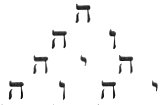
And we learn that this designation of the Ineffable Name was,
among the Hebrews, a symbol of Creation. The mysterious union of God with His
creatures was in the letter ה, which they considered to be the Agent of
Almighty Power; and to enable the possessor of the Name to work miracles.
The Personal Pronoun הוא [HUA], HE, is often used by
itself, to express the
Deity. Lee says that in such cases, IHUH, IH, or ALHIM, or some other name of
God, is understood; but there is no necessity for that. It means in such
cases the Male, Generative, or Creative Principle or Power.
It was a common practice with the Talmudists to conceal
secret meanings and sounds of words by transposing the letters.
The reversal of the letters of words was, indeed, anciently
common everywhere. Thus from Neitha, the name of an Egyptian Goddess, the
Greeks, writing backward, formed Athenè, the name of Minerva. In Arabic
we have Nahid, a name of the planet Venus, which, reversed, gives
Dihan, Greek, in Persian, Nihad, Nature; which Sir William Jones
writes also Nahid. Strabo informs us that the Armenian name of Venus was
Anaitis.
Tien, Heaven, in Chinese, reversed, is Neit, or
Neith, worshipped at Sais in Egypt. Reverse Neitha, drop the i,
and add an e, and we, as before said, Athenè. Mitra was the
name of Venus among the ancient Persians. Herodotus, who tells us this, also
informs us that her name, among the Scythians, was Artim pasa. Artim
is Mitra, reversed. So, by reversing it, the Greeks formed Artemis,
Diana.
One of the meanings of Rama, in Sanscrit, is Kama,
the Deity of Love. Reverse this, and we have Amar, and by changing
a into o, Amor, the Latin word for Love. Probably,
as the verb is Amare, the oldest reading was Amar and not Amor.
So Dipaka, in Sanscrit, one of the meanings whereof is love, is
often written Dipuc. Reverse this, and we have, adding o, the
Latin word Cupido.
In Arabic, the radical letters rhm, pronounced rahm,
signify the trunk, compassion, mercy; this reversed, we
have mhr, in Persic, love and the Sun. In Hebrew we have
Lab, the heart; and in Chaldee, Bal, the heart; the
radical letters of both being b and l.
The Persic word for head is Sar. Reversed, this
becomes Ras in Arabic and Hebrew, Raish in Chaldee, Rash in Samaritan,
and Ryas in Ethiopic; all meaning head, chief, etc. In Arabic we
have Kid, in the sense of rule, regulation, article of agreement,
obligation; which, reversed, becomes, adding e, the Greek dikè
justice. In Coptic we have Chlom, a crown. Reversed, we have in Hebrew,
Moloch or Malec, a King, or he who wears a crown.
In the Kou-onen, or oldest Chinese writing, by Hieroglyphics,
 Ge [Hi or Khi, with the initial
letter modified], was the Sun: in Persic, Gwar and in Turkish Giun.
Yue [ Ge [Hi or Khi, with the initial
letter modified], was the Sun: in Persic, Gwar and in Turkish Giun.
Yue [  ], was the Moon;
in Sanscrit Uh, and in Turkish Ai. It will be
remembered that, in Egypt and elsewhere, the Sun was originally feminine, and
the Moon masculine. In Egypt, Ioh was the moon: and in the feasts of
Bacchus they cried incessantly, Euoï Sabvi! Euoï Bakhè! Io
Bakhe! Io Bakhe! ], was the Moon;
in Sanscrit Uh, and in Turkish Ai. It will be
remembered that, in Egypt and elsewhere, the Sun was originally feminine, and
the Moon masculine. In Egypt, Ioh was the moon: and in the feasts of
Bacchus they cried incessantly, Euoï Sabvi! Euoï Bakhè! Io
Bakhe! Io Bakhe!
Bunsen gives the following personal pronouns for he and she:
|
|
He |
She |
|
Christian Aramiac |
Hû |
Hî |
|
Jewish Aramaic |
Hû |
Hî |
|
Hebrew |
Hû’ |
Hî’ |
|
Arabic |
Huwa |
Hiya |
Thus the Ineffable Name not only embodies the Great
Philosophical Idea, that the Deity is the ENS, the TO ON, the Absolute
Existence, that of which the Essence is To Exist, the only Substance of Spinoza,
the BEING, that never could not have existed, as contradistinguished from
that which only becomes, not Nature or the Soul of Nature, but that which
created Nature; but also the idea of the Male and Female Principles, in its
highest and most profound sense; to wit, that God originally comprehended in
Himself all that is: that matter was not co-existent with Him, or independent of
Him; that He did not merely fashion and shape a pre-existing chaos into a
Universe; but that His Thought manifested itself outwardly in that Universe,
which so became, and before was not, except as comprehended in
Him: that the Generative Power or Spirit, and Productive Matter, ever among the
ancients deemed the Female, originally were in God; and that He Was and Is all
that Was, that Is, and that Shall be: in Whom all else lives, moves, and
has its being.
This was the great Mystery of the Ineffable Name; and this
true arrangement of its letters, and of course its true pronunciation and its
meaning, soon became lost to all except the select few to whom it was confided;
it being concealed from the common people, because the Deity thus metaphysically
named was not that personal and capricious, and as it were tangible God in whom
they believed, and who alone was within the reach of their rude capacities.
Diodorus says that the name given by Moses to God was ΙΑΩ.
Theodorus says that the Samaritans termed God IABE, but the Jews ΙΑΩ.
Philo Byblius gives the form ΙΕΥΩ; and Clemens
of Alexandria ΙΑΟΥ. Macrobius says that it was an admitted axiom
among the Heathen, that the triliteral ΙΑΩ was the sacred name of the Supreme
God. And the Clarian oracle said: "Learn thou that ΙΑΩ is the great God Supreme,
that ruleth over all." The letter Ι signified Unity. Α and Ω are the first and
last letters of the Greek Alphabet.
Hence the frequent expression: "I am the First, and I am the
Last; and besides Me there is no other God. I am Α and Ω, the First and the
Last. I am Α and Ω, the Beginning and the Ending, which Is, and Was, and Is to
come: the Omnipotent." For in this we see shadowed forth the same great truth;
that God is all in all--the Cause and the Effect--the beginning, or Impulse, or
Generative Power: and the Ending, or Result, or that which is produced: that He
is in reality all that is, all that ever was, and all that ever will be; in this
sense, that nothing besides Himself has existed eternally, and co-eternally with
Him, independent of Him, and self-existent, or self-originated.
And thus the meaning of the expression, ALOHAYIM, a plural
noun, used, in the account of the Creation with which Genesis commences, with a
singular verb, and of the name or title IHUH-ALHIM, used for the first time in
the 4th verse of the 2d chapter of the same book, becomes clear. The ALHIM is
the aggregate unity of the manifested Creative Forces or Powers of Deity, His
Emanations; and IHUH-ALHIM is the ABSOLUTE Existence, or Essence of these Powers
and Forces, of which they are Active Manifestations and Emanations.
This was the profound truth hidden in the ancient allegory
and covered from the general view with a double veil. This was the esoteric
meaning of the generation and production of the Indian, Chaldæan, and Phœnician
cosmogonies; and the Active and Passive Powers, of the Male and Female
Principles; of Heaven and its Luminaries generating, and the Earth producing;
all hiding from vulgar view, as above its comprehension, the doctrine that
matter is not eternal, but that God was the only original Existence, the
ABSOLUTE, from Whom everything has proceeded, and to Whom all returns: and that
all moral law springs not from the relation of things, but from His Wisdom and
Essential Justice, as the Omnipotent Legislator. And this Taut WORD is with
entire accuracy said to have been lost; because its meaning was
lost, even among the Hebrews, although we still find the name (its real
meaning unsuspected), in the Hu of the Druids and the FO-Hi of
the Chinese.
When we conceive of the Absolute Truth, Beauty, or Good, we
cannot stop short at the abstraction of either. We are forced to refer each to
some living and substantial Being, in which they have their foundations, some
being that is the first and last principle of each.
Moral Truth, like every other universal and necessary truth,
cannot remain a mere abstraction. Abstractions are unrealities. In ourselves,
moral truth is merely conceived of. There must be somewhere a Being that
not only conceives of, but constitutes it. It has this
characteristic; that it is not only, to the eyes of our intelligence, an
universal and necessary truth, but one obligatory on our will. It is A LAW.
We do not establish that law ourselves. It is imposed on us
despite ourselves: its principle must be without us. It supposes a
legislator. He cannot be the being to whom the law applies; but must be one
that possesses in the highest degree all the characteristics of moral truth. The
moral law, universal and necessary, necessarily has as its author a necessary
being;--composed of justice and charity, its author most be a being possessing
the plenitude of both.
As all beautiful and all true things refer
themselves, these to a Unity which is absolute TRUTH, and those to a
Unity which is absolute BEAUTY, so all the moral principles centre in a
single principle, which is THE GOOD. Thus we arrive at the conception of GOOD
in itself, the ABSOLUTE Good, superior to all particular duties, and
determinate in those duties. This Absolute Good must necessarily be an
attribute of the Absolute BEING. There cannot be several Absolute Beings;
the one in whom are realized Absolute Truth and Absolute Beauty being different
from the one in whom is realized Absolute Good. The Absolute necessarily implies
absolute Unity. The True, the Beautiful, and the Good are not three distinct
essences: but they are one and the same essence, considered in its fundamental
attributes: the different phases which, in our eyes, the Absolute and Infinite
Perfection assumes. Manifested in the World of the Finite and Relative, these
three attributes separate from each other, and are distinguished by our minds,
which can comprehend nothing except by division. But in the Being from Whom they
emanate, they are indivisibly united; and this Being, at once triple and one,
Who sums up in Himself
perfect Beauty, perfect Truth, and the perfect Good, is GOD.
God is necessarily the principle of Moral Truth, and of
personal morality. Man is a moral person, that is to say, one endowed with
reason and liberty. He is capable of Virtue: and Virtue has with him two
principal forms, respect for others and love of others, justice and
charity.
The creature can possess no real and essential
attribute which the Creator does not possess. The effect can draw
its reality and existence only from its cause. The cause contains
in itself, at least, what is essential in the effect. The characteristic
of the effect is inferiority, short-coming, imperfection. Dependent and
derivate, it bears in itself the marks and conditions of dependence; and its
imperfection proves the perfection of the cause; or else there would be in the
effect something immanent, without a cause.
God is not a logical Being, whose Nature may be explained by
deduction, and by means of algebraic equations. When, setting out with a primary
attribute, the attributes of God are deduced one from the other, after the
manner of the Geometricians and Scholastics, we have nothing but abstractions.
We must emerge from this empty dialectic, to arrive at a true and living God.
The first notion which we have of God, that of an Infinite Being, is not
given us à priori, independently of all experience. It is our
consciousness of ourself, as at once a Being and a limited Being, that
immediately raises us to the conception of a Being, the principle of our
being, and Himself without limits. If the existence that we possess forces us to
recur to a cause possessing the same existence in an infinite degree, all the
substantial attributes of existence that we possess equally require each an
infinite cause. God, then, is no longer the Infinite, Abstract, Indeterminate
Being, of which reason and the heart cannot lay hold, but a real Being,
determinate like ourselves, a moral person like ourself; and the study of our
own souls will conduct us, without resort to hypothesis, to a conception of God,
both sublime and having a connection with ourselves.
If man be free, God must be so. It would be strange if, while
the creature has that marvellous power of disposing of himself, of choosing and
willing freely, the Being that has made him should be subject to a necessary
development, the cause of which, though
in Himself, is a sort of abstract, mechanical, or metaphysical power,
inferior to the personal, voluntary cause which we are, and of which we have the
clearest consciousness. God is free because we are: but he is not free
as we are. He is at once everything that we are, and nothing
that we are. He possesses the same attributes as we, but extended to infinity.
He possesses, then, an infinite liberty, united to an infinite intelligence; and
as His intelligence is infallible, exempt from the uncertainty of deliberation,
and perceiving at a glance where the Good is, so His liberty accomplishes it
spontaneously and without effort.
As we assign to God that liberty which is the basis of our
existence, so also we transfer to His character, from our own, justice and
charity. In man they are virtues: in God, His attributes. What is in us the
laborious conquest of liberty, is in Him His very nature. The idea of the right,
and the respect paid to the right, are signs of the dignity of our existence. If
respect of rights is the very essence of justice, the Perfect Being must know
and respect the rights of the lowest of His creatures; for He assigned them
those rights. In God resides a sovereign justice, that renders to every one what
is due him, not according to deceitful appearances, but according to the truth
of things. And if man, a limited being, has the power to go out of himself, to
forget his own person, to love another like himself, and devote himself to his
happiness, dignity, and perfection, the Perfect Being must have, in an infinite
degree, that disinterested tenderness, that Charity, the Supreme Virtue of the
human person. There is in God an infinite tenderness for His creatures,
manifested in His giving us existence, which He might have withheld; and every
day it appears in innumerable marks of His Divine Providence.
Plato well understood that love of God, and expresses it in
these great words: "Let us speak of the cause which led the Supreme Arranger of
the Universe to produce and regulate that Universe. He was good; and he who is
good has no kind of ill-will. Exempt from that, He willed that created things
should be, as far as possible, like Himself." And Christianity in its turn said,
"God has so loved men that He has given them His only Son."
It is not correct to affirm, as is often done, that
Christianity has in some sort discovered this noble sentiment. We must
not lower human nature, to raise Christianity. Antiquity knew, described, and
practised charity; the first feature of which, so touching, and
thank God! so common, is goodness, as its loftiest one is heroism.
Charity is devotion to another; and it is ridiculously senseless to pretend that
there ever was an age of the world, when the human soul was deprived of that
part of its heritage, the power of devotion. But it is certain that Christianity
has diffused and popularized this virtue, and that, before Christ, these words
were never spoken: "LOVE ONE ANOTHER; FOR THAT IS THE WHOLE LAW." Charity
presupposes Justice. He who truly loves his brother respects the rights
of his brother; but he does more, he forgets his own. Egoism sells or
takes. Love delights in giving. In God, love is what it is in us; but
in an infinite degree. God is inexhaustible in His charity, as He is
inexhaustible in His essence. That Infinite Omnipotence and Infinite Charity,
which, by an admirable good-will, draws from the bosom of its immense love the
favors which it incessantly bestows on the world and on humanity, teaches us
that the more we give, the more we possess.
God being all just and all good, He can will nothing but what
is good and just. Being Omnipotent, whatever He wills He can do, and
consequently does. The world is the work of God: it is therefore perfectly made.
Yet there is disorder in the world, that seems to impugn the
justice and goodness of God.
A principle indissolubly connected with the very idea of
good, tells us that every moral agent deserves reward when he does well, and
punishment when he does ill. This principle is universal and necessary. It is
absolute. If it does not apply in this world, it is false, or the world is badly
ordered.
But good actions are not always followed by happiness, nor
evil ones by misery. Though often this fact is more apparent than real; though
virtue, a war against the passions, full of dignity but full of sorrow and pain,
has the latter as its condition, yet the pains that follow vice are greater; and
virtue conduces most to health, strength, and long life;--though the peaceful
conscience that accompanies virtue creates internal happiness; though public
opinion generally decides correctly on men's characters, and rewards virtue with
esteem and consideration, and vice with con-tempt and infamy; and though, after
all, justice reigns in the world, and the surest road to happiness is still that
of virtue, yet there are exceptions. Virtue is not always rewarded, nor vice
punished, in this life.
The data of this problem are these: 1st. The principle of
merit and demerit within us is absolute: every good action ought to be
rewarded, every bad one punished: 2d. God is just as He is all-powerful: 3d.
There are in this world particular cases, contradicting the necessary and
universal law of merit and demerit. What is the result?
To reject the two principles, that God is just, and the law
of merit and demerit absolute, is to raze to the foundations the whole edifice
of human faith.
To maintain them, is to admit that the present life is to be
terminated or continued elsewhere. The moral person who acts well or ill, and
awaits reward or punishment, is connected with a body, lives with it, makes use
of it, depends upon it in a measure, but is not it. The body is
composed of parts. It diminishes or increases, it is divisible even to infinity.
But this something which has a consciousness of itself, and says "I, ME";
that feels itself free and responsible, feels too that it is incapable of
division, that it is a being one and simple; that the ME cannot be
halved, that if a limb is cut off and thrown away, no part of the ME goes with
it: that it remains identical with itself under the variety of phenomena which
successively manifest it. This identity, indivisibility, and absolute unity of
the person, are its spirituality, the very essence of the person. It is
not in the least an hypothesis to affirm that the soul differs essentially from
the body. By the soul we mean the person, not separated from the
consciousness of the attributes which constitute it,--thought and will.
The Existence without consciousness is an abstract being, and not a person. It
is the person, that is identical, one, simple. Its
attributes, developing it, do not divide it. Indivisible, it is indissoluble,
and may be immortal. If absolute justice requires this immortality, it does not
require what is impossible. The spirituality of the soul is the condition and
necessary foundation of immortality: the law of merit and demerit the direct
demonstration of it. The first is the metaphysical, the second the moral proof.
Add to these the tendency of all the powers of the soul toward the Infinite, and
the principle of final causes, and the proof of the immortality of the soul is
complete.
God, therefore, in the Masonic creed, is INFINITE TRUTH,
INFINITE BEAUTY, INFINITE GOODNESS. He is the Holy of Holies, as Author of the
Moral Law, as the PRINCIPLE of Liberty, of Justice, and of Charity, Dispenser of
Reward and Punishment. Such a God is not an abstract God; but an intelligent and
free person, Who has made us in His image, from Whom we receive the law
that presides over our destiny, and Whose judgment we await. It is His love that
inspires us in our acts of charity: it is His justice that governs our
justice, and that of society and the laws. We continually remind ourselves that
He is infinite; because otherwise we should degrade His nature: but He would be
for us as if He were not, if His infinite nature had not forms inherent in
ourselves, the forms of our own reason and soul.
When we love Truth, Justice, and Nobility of Soul, we should
know that it is God we love underneath these special forms, and should unite
them all into one great act of total piety. We should feel that we go in and out
continually in the midst of the vast forces of the Universe, which are only the
Forces of God; that in our studies, when we attain a truth, we confront the
thought of God; when we learn the right, we learn the will of God laid down as a
rule of conduct for the Universe; and when we feel disinterested love, we should
know that we partake the feeling of the Infinite God. Then, when we reverence
the mighty cosmic force, it will not be a blind Fate in an Atheistic or
Pantheistic world, but the Infinite God, that we shall confront and feel and
know. Then we shall be mindful of the mind of God, conscious of God's
conscience, sensible of His sentiments, and our own existence will be in the
infinite being of God.
The world is a whole, which has its harmony; for a God who is
One, could make none but a complete and harmonious work. The harmony of the
Universe responds to the unity of God, as the indefinite quantity is the
defective sign of the infinitude of God. To say that the Universe is God, is to
admit the world only, and deny God. Give it what name you please, it is atheism
at bottom. On the other hand, to suppose that the Universe is void of God, and
that He is wholly apart from it, is an insupportable and al-most impossible
abstraction. To distinguish is not to separate. I distinguish, but do not
separate myself from my qualities and effects. So God is not the Universe,
although He is everywhere present in spirit and in truth.
To us, as to Plato, absolute truth is in God. It is God
Himself under one of His phases. In God, as their original, are the immutable
principles of reality and cognizance. In Him things receive
at once their existence and their intelligibility. It is by
participating in the Divine reason that our own reason possesses something of
the Absolute. Every judgment of reason envelopes a necessary truth, and every
necessary truth supposes the necessary Existence.
Thus, from every direction,--from metaphysics, æsthetics, and
morality above all, we rise to the same Principle, the common centre, and
ultimate foundation of all truth, all beauty, all good. The True, the Beautiful,
the Good, are but diverse revelations of one and the same Being. Thus we reach
the threshold of religion, and are in communion with the great philosophies
which all proclaim a God; and at the same time with the religions which cover
the earth, and all repose on the sacred foundation of natural religion; of that
religion which reveals to us the natural light given to all men, without the aid
of a particular revelation. So long as philosophy does not arrive at religion,
it is below all worships, even the most imperfect; for they at least give man a
Father, a Witness, a Consoler, a Judge. By religion, philosophy connects itself
with humanity, which, from one end of the world to the other, aspires to God,
believes in God, hopes in God. Philosophy contains in itself the common basis of
all religious beliefs; it, as it were, borrows from them their principle, and
returns it to them surrounded with light, elevated above uncertainty, secure
against all attack.
From the necessity of His Nature, the Infinite Being must
create and preserve the Finite, and to the Finite must, in its forms, give and
communicate of His own kind. We cannot conceive of any finite thing existing
without God, the Infinite basis and ground thereof; nor of God existing without
something. God is the necessary logical condition of a world, its necessitating
cause; a world, the necessary logical condition of God, His necessitated
consequence. It is according to His Infinite Perfection to create, and then to
preserve and bless whatever He creates. That is the conclusion of modern
metaphysical science. The stream of philosophy runs down from Aristotle to
Hegel, and breaks off with this conclusion: and then again recurs the ancient
difficulty. If it be of His nature to create,--if we cannot conceive of His
existing alone, without creating, without having created, then
what He created was co-existent with Himself. If He could exist an instant
without creating, He could as well do so for a
myriad of eternities. And so again comes round to us the old doctrine
of a God, the Soul of the Universe, and co-existent with it. For what He created
had a beginning; and however long since that creation occurred, an
eternity had before elapsed. The difference between a beginning and no
beginning is infinite.
But of some things we can be certain. We are conscious of
ourselves--of ourselves if not as substances, at least as Powers to be, to do,
to suffer. We are conscious of ourselves not as self-originated at all or as
self-sustained alone; but only as dependent, first for existence, ever since for
support.
Among the primary ideas of consciousness, that are
inseparable from it, the atoms of self-consciousness, we find the idea of God.
Carefully examined by the scrutinizing intellect, it is the idea of God as
infinite, perfectly powerful, wise, just, loving, holy; absolute being with no
limitation. This made us, made all, sustains us, sustains all; made our body,
not by a single act, but by a series of acts extending over a vast succession of
years,--for man's body is the resultant of all created things,--made our spirit,
our mind, conscience, affections, soul, will, appointed for each its natural
mode of action, set each at its several aim. Thus self-consciousness leads us to
consciousness of God, and at last to consciousness of an infinite God. That is
the highest evidence of our own existence, and it is the highest evidence of
His.
If there is a God at all, He must be omnipresent in space.
Beyond the last Stars He must be, as He is here. There can be no mote that
peoples the sunbeams, no little cell of life that the microscope discovers in
the seed-sporule of a moss, but He is there.
He must also be omnipresent in time. There was no second of
time before the Stars began to burn, but God was in that second. In the most
distant nebulous spot in Orion's belt, and in every one of the millions that
people a square inch of limestone, God is alike present. He is in the smallest
imaginable or even unimaginable portion of time, and in every second of its most
vast and unimaginable volume; His Here conterminous with the All of Space, His
Now coeval with the All of Time.
Through all this Space, in all this Time, His Being extends,
spreads undivided, operates unspent; God in all His infinity, perfectly
powerful, wise, just, loving, and holy. His being is an infinite activity, a
creating, and so a giving of Himself to the World. The World's being is a
becoming, a being created and continued. It is so now, and was so,
incalculable and unimaginable millions of ages ago.
All this is philosophy, the unavoidable conclusion of the
human mind. It is not the opinion of Coleridge and Kant, but their
science; not what they guess, but what they know.
In virtue of this in-dwelling of God in matter, we say that
the world is a revelation of Him, its existence a show of His. He is in His
work. The manifold action of the Universe is only His mode of operation, and all
material things are in communion with Him. All grow and move and live in Him,
and by means of Him, and only so. Let Him withdraw from the space occupied by
anything, and it ceases to be. Let Him withdraw any quality of His nature from
anything, and it ceases to be. All must partake of Him, He dwelling in each, and
yet transcending all.
The failure of fanciful religion to become philosophy, does
not preclude philosophy from coinciding with true religion. Philosophy, or
rather its object, the divine order of the Universe, is the intellectual guide
which the religious sentiment needs; while exploring the real relations of the
finite, it obtains a constantly improving and self-correcting measure of the
perfect law of the Gospel of Love and Liberty, and a means of carrying into
effect the spiritualism of revealed religion. It establishes law, by
ascertaining its terms; it guides the spirit to see its way to the amelioration
of life and the increase of happiness. While religion was stationary, science
could not walk alone; when both are admitted to be progressive, their interests
and aims become identified. Aristotle began to show how religion may be founded
on an intellectual basis; but the basis he laid was too narrow. Bacon, by giving
to philosophy a definite aim and method, gave it at the same time a safer and
self-enlarging basis. Our position is that of intellectual beings surrounded by
limitations; and the latter being constant, have to intelligence the practical
value of laws, in whose investigation and application consists that seemingly
endless career of intellectual and moral progress which the sentiment of
religion inspires and ennobles. The title of Saint has commonly been claimed for
those whose boast it has been to despise philosophy; yet faith will stumble and
sentiment mislead, unless knowledge be present, in amount and quality sufficient
to purify the one and to give beneficial direction to the other.
Science consists of those matured inferences from experience
which all other experience confirms. It is no fixed system superior to revision,
but that progressive mediation between ignorance and wisdom in part conceived by
Plato, whose immediate object is happiness, and its impulse the highest kind of
love. Science realizes and unites all that was truly valuable in both the old
schemes of mediation; the heroic, or system of action and effort; and the
mystical theory of spiritual, contemplative communion. "Listen to me," says
Galen, "as to the voice of the Eleusinian Hierophant, and believe that the study
of nature is a mystery no less important than theirs, nor less adapted to
display the wisdom and power of the Great Creator. Their lessons and
demonstrations were obscure, but ours are clear and unmistakable."
To science we owe it that no man is any longer entitled to
consider himself the central point around which the whole Universe of life and
motion revolves--the immensely important individual for whose convenience and
even luxurious ease and indulgence the whole Universe was made. On one side it
has shown us an infinite Universe of stars and suns and worlds at incalculable
distances from each other, in whose majestic and awful presence we sink and even
our world sinks into insignificance; while, on the other side, the microscope
has placed us in communication with new worlds of organized livings beings,
gifted with senses, nerves, appetites, and instincts, in every tear and in every
drop of putrid water.
Thus science teaches us that we are but an infinitesimal
portion of a great whole, that stretches out on every side of us, and above and
below us, infinite in its complications, and which infinite wisdom alone .can
comprehend. Infinite wisdom has arranged the infinite succession of beings,
involving the necessity of birth, decay, and death, and made the loftiest
virtues possible by providing those conflicts, reverses, trials, and hardships,
without which even their names could never have been invented.
Knowledge is convertible into power, and axioms into rules of
utility and duty. Modern science is social and communicative. It is moral as
well as intellectual; powerful, yet pacific and disinterested; binding man to
man as well as to the Universe; filling up the details of obligation, and
cherishing impulses of virtue, and, by affording clear proof of the consistency
and identity of all
interests, substituting co-operation for rivalry, liberality for jealousy, and
tending far more powerfully than any other means to realize the spirit of
religion, by healing those inveterate disorders which, traced to their real
origin, will be found rooted in an ignorant assumption as to the penurious
severity of Providence, and the consequent greed of selfish men to confine what
seemed as if extorted from it to themselves, or to steal from each other rather
than quietly to enjoy their own.
We shall probably never reach those higher forms containing
the true differences of things, involving the full discovery and correct
expression of their very self or essence. We shall ever fall short of the most
general and most simple nature, the ultimate or most comprehensive law. Our
widest axioms explain many phenomena, but so too in a degree did the principles
or elements of the old philosophers, and the cycles and epicycles of ancient
astronomy. We cannot in any case of causation assign the whole of the
conditions, nor though we may reproduce them in practice, can we mentally
distinguish them all, without knowing the essences of the things including them;
and we therefore must not unconsciously ascribe that absolute certainty to
axioms, which the ancient religionists did to creeds, nor allow the mind, which
ever strives to insulate itself and its acquisitions, to forget the nature of
the process by which it substituted scientific for common notions, and so with
one as with the other lay the basis of self-deception by a pedantic and
superstitious employment of them.
Doubt, the essential preliminary of all improvement and
discovery, must accompany all the stages of man's onward progress. His
intellectual life is a perpetual beginning, a preparation for a birth. The
faculty of doubting and questioning, without which those of comparison and
judgment would be useless, is itself a divine prerogative of the reason.
Knowledge is always imperfect, or complete only in a prospectively boundless
career, in which discovery multiplies doubt, and doubt leads on to new
discovery. The boast of science is not so much its manifested results, as its
admitted imperfection and capacity of unlimited progress. The true religious
philosophy of an imperfect being is not a system of creed, but, as Socrates
thought, an infinite search or approximation. Finality is but another name for
bewilderment or defeat. Science gratifies the religious feeling without
arresting it, and opens out
the unfathomable mystery of the One Supreme into more explicit and manageable
Forms, which express not indeed His Essence, which is wholly beyond our reach
and higher than our faculties can climb, but His Will, and so feeds an endless
enthusiasm by accumulating forever new objects of pursuit. We have long
experienced that knowledge is profitable, we are beginning to find out that it
is moral, and we shall at last discover it to be religious.
God and truth are inseparable; a knowledge of God is
possession of the saving oracles of truth. In proportion as the thought and
purpose of the individual are trained to conformity with the rule of right
prescribed by Supreme Intelligence, so far is his happiness promoted, and the
purpose of his existence fulfilled. In this way a new life arises in him; he is
no longer isolated, but is a part of the eternal harmonies around him. His
erring will is directed by the influence of a higher will, informing and
moulding it in the path of his true happiness.
Man's power of apprehending outward truth is a qualified
privilege; the mental like the physical inspiration passing through a diluted
medium; and yet, even when truth, imparted, as it were, by intuition, has been
specious, or at least imperfect, the intoxication of sudden discovery has ever
claimed it as full, infallible, and divine. And while human weakness needed ever
to recur to the pure and perfect source, the revelations once popularly accepted
and valued assumed an independent substantiality, perpetuating not themselves
only, but the whole mass of derivative forms accidentally connected with them,
and legalized in their names. The mists of error thickened under the shadows of
prescription, until the free light again broke in upon the night of ages,
redeeming the genuine treasure from the superstition which obstinately doted on
its accessories.
Even to the Barbarian, Nature reveals a mighty power and a
wondrous wisdom, and continually points to God. It is no wonder that men
worshipped the several things of the world. The world of matter is a revelation
of fear to the savage in Northern climes; he trembles at his deity throned in
ice and snow. The lightning, the storm, the earthquake startle the rude man, and
he sees the divine in the extraordinary.
The grand objects of Nature perpetually constrain men to
think of their Author. The Alps are the great altar of Europe; the nocturnal
sky has been to mankind the dome of a temple, starred all over with
admonitions to reverence, trust, and love. The Scriptures for the human race are
writ in earth and Heaven. No organ or miserere touches the heart like the
sonorous swell of the sea or the ocean-wave's immeasurable laugh. Every year the
old world puts on new bridal beauty, and celebrates its Whit-Sunday, when in the
sweet Spring each bush and tree dons reverently its new glories. Autumn is a
long All-Saints' day; and the harvest is Hallowmass to Mankind. Before the human
race marched down from the slopes of the Himalayas to take possession of Asia,
Chaldea, and Egypt, men marked each annual crisis, the solstices and the
equinoxes, and celebrated religious festivals therein; and even then, and ever
since, the material was and has been the element of communion between man and
God.
Nature is full of religious lessons to a thoughtful man. He
dissolves the matter of the Universe, leaving only its forces; he dissolves away
the phenomena of human history, leaving only immortal spirit; he studies the
law, the mode of action of these forces and this spirit, which make up the
material and the human world, and cannot fail to be filled with reverence, with
trust, with boundless love of the Infinite God, who devised these laws of matter
and of mind, and thereby bears up this marvellous Universe of things and men.
Science has its New Testament; and the beatitudes of Philosophy are profoundly
touching. An undevout astronomer is mad. Familiarity with the grass and the
trees teaches us deeper lessons of love and trust than we can glean from the
writings of Fénélon and Augustine. The great Bible of God is ever open before
mankind. The eternal flowers of Heaven seem to shed sweet influence on the
perishable blossoms of the earth. The great sermon of Jesus was preached on a
mountain, which preached to Him as He did to the people, and His figures of
speech were first natural figures of fact.
If to-morrow I am to perish utterly, then I shall only take
counsel for to-day, and ask for qualities which last no longer. My fathers will
be to me only as the ground out of which my bread-corn is grown; dead, they are
but the rotten mould of earth, their memory of small concern to me.
Posterity!--I shall care nothing for the future generations of mankind! I am one
atom in the trunk of a tree, and care nothing for the roots below, or the branch
above. I shall sow such seed only as will bear harvest
to-day. Passion may enact my statutes to-day, and ambition repeal
them to-morrow. I will know no other legislators. Morality will vanish, and
expediency take its place. Heroism will be gone; and instead of it there will be
the savage ferocity of the he-wolf, the brute cunning of the she-fox, the
rapacity of the vulture, and the headlong daring of the wild bull; but no longer
the cool, calm courage that, for truth's sake, and for love's sake, looks death
firmly in the face, and then wheels into line ready to be slain. Affection,
friendship, philanthropy, will be but the wild fancies of the monomaniac, fit
subjects for smiles or laughter or for pity.
But knowing that we shall live forever, and that the Infinite
God loves all of us, we can look on all the evils of the world, and see that it
is only the hour before sunrise, and that the light is coming; and so we also,
even we, may light a little taper, to illuminate the darkness while it lasts,
and help until the day-spring come. Eternal morning follows the night: a rainbow
scarfs the shoulders of every cloud that weeps its rain away to be flowers on
land and pearls at sea: Life rises out of the grave, the soul cannot be held by
fettering flesh. No dawn is hopeless; and disaster is only the threshold of
delight.
Beautifully, above the great wide chaos of human errors,
shines the calm, clear light of natural human religion, revealing to us God as
the Infinite Parent of all, perfectly powerful, wise, just, loving, and
perfectly holy too. Beautiful around stretches off every way the Universe, the
Great Bible of God. Material nature is its Old Testament, millions of years old,
thick with eternal truths under our feet, glittering with everlasting glories
over our heads; and Human Nature is the New Testament from the Infinite God,
every day revealing a new page as Time turns over the leaves. Immortality stands
waiting to give a recompense for every virtue not rewarded, for every tear not
wiped away, for every sorrow undeserved, for every prayer, for every pure
intention and emotion of the heart. And over the whole, over Nature, Material
and Human, over this Mortal Life and over the eternal Past and Future, the
infinite Loving-kindness of God the Father comes enfolding all and blessing
everything that ever was, that is, that ever shall be.
Everything is a thought of the Infinite God. Nature is His
prose, and man His Poetry. There is no Chance, no Fate; but God's Great
Providence, enfolding the whole Universe in its
bosom, and feeding it with everlasting life. In times past there has
been evil which we cannot understand; now there are evils which we cannot solve,
nor make square with God's perfect goodness by any theory our feeble intellect
enables us to frame. There are sufferings, follies, and sins for all mankind,
for every nation, for every man and every woman. They were all foreseen by the
infinite wisdom of God, all provided for by His infinite power and justice, and
all are consistent with His infinite love. To believe otherwise would be to
believe that He made the world, to amuse His idle hours with the follies and
agonies of mankind, as Domitian was wont to do with the wrigglings and
contortions of insect agonies. Then indeed we might despairingly unite in that
horrible utterance of Heine: "Alas, God's Satire weighs heavily on me! The Great
Author of the Universe, the Aristophanes of Heaven, is bent on demonstrating,
with crushing force, to me, the little, earthly, German Aristophanes, how my
wittiest sarcasms are only pitiful attempts at jesting, in comparison with His,
and how miserably I am beneath Him, in humor, in colossal mockery."
No, no! God is not thus amused with and prodigal of human
suffering. The world is neither a Here without a Hereafter, a body without a
soul, a chaos with no God; nor a body blasted by a soul, a Here with a worse
Hereafter, a world with a God that hates more than half the creatures He has
made. There is no Savage, Revengeful, and Evil God: but there is an Infinite
God, seen everywhere as Perfect Cause, everywhere as Perfect Providence,
transcending all, yet in-dwelling everywhere, with perfect power, wisdom,
justice, holiness, and love, providing for the future welfare of each and all,
foreseeing and forecaring for every bubble that breaks on the great stream of
human life and human history.
The end of man and the object of existence in this world,
being not only happiness, but happiness in virtue and through virtue, virtue in
this world is the condition of happiness in another life, and the condition of
virtue in this world is suffering, more or less frequent, briefer or longer
continued, more or less intense. Take away suffering, and there is no longer any
resignation or humanity, no more self-sacrifice, no more devotedness, no more
heroic virtues, no more sublime morality. We are subjected to suffering, both
because we are sensible, and because we ought to be virtuous. If there were no
physical evil, there would be no possible virtue, and the world would be badly
adapted to the destiny of man. The apparent disorders of the physical world, and
the evils that result from them, are not disorders and evils that occur despite
the power and goodness of God. God not only allows, but wills them. It is His
will that there shall be in the physical world causes enough of pain for man, to
afford him occasions for resignation and courage.
Whatever is favorable to virtue, whatever gives the moral
liberty more energy, whatever can serve the greater moral development of the
human race, is good. Suffering is not the worst condition of man on earth. The
worst condition is the moral brutalization which the absence of physical evil
would engender.
External or internal physical evil connects itself with the
object of existence, which is to accomplish the moral law here below, whatever
the consequences, with the firm hope that virtue unfortunate will not fail to be
rewarded in another life. The moral law has its sanction and its reason in
itself. It owes nothing to that law of merit and demerit that accompanies it,
but is not its basis. But, though the principle of merit and demerit ought not
to be the determining principle of virtuous action, it powerfully concurs with
the moral law, because it offers virtue a legitimate ground of consolation and
hope.
Morality is the recognition of duty, as duty, and its
accomplishment, whatever the consequences.
Religion is the recognition of duty in its necessary harmony
with goodness; a harmony that must have its realization in another life, through
the justice and omnipotence of God.
Religion is as true as morality; for once morality is
admitted, its consequences must be admitted.
The whole moral existence is included in these two words,
harmonious with each other: DUTY and HOPE.
Masonry teaches that God is infinitely good. What motive,
what reason, and, morally speaking, what possibility can there be to Infinite
Power and Infinite Wisdom, to be anything but good? Our very sorrows,
proclaiming the loss of objects inexpressibly dear to us, demonstrate His
Goodness. The Being that made us intelligent cannot Himself be without
intelligence; and He Who has made us so to love and to sorrow for what we love,
must number love for the creatures He has made, among His infinite attributes.
Amid all our sorrows, we take refuge in the assurance that He loves us; that He
does not capriciously, or through indifference,
and still less in mere anger, grieve and afflict us; that He chastens
us, in order that by His chastisements, which are by His universal law only the
consequences of our acts, we may be profited; and that He could not show so much
love for His creatures, by leaving them unchastened, untried, undisciplined. We
have faith in the Infinite; faith in God's Infinite Love; and it is that faith
that must save us.
No dispensations of God's Providence, no suffering or
bereavement is a messenger of wrath: none of its circumstances are indications
of God's Anger. He is incapable of Anger; higher above any such feelings than
the distant stars are above the earth. Bad men do not die because God hates
them. They die because it is best for them that they should do so; and, bad as
they are, it is better for them to be in the hands of the infinitely good God,
than anywhere else.
Darkness and gloom lie upon the paths of men. They stumble at
difficulties, are ensnared by temptations, and perplexed by trouble. They are
anxious, and troubled, and fearful. Pain and affliction and sorrow often gather
around the steps of their earthly pilgrimage. All this is written indelibly upon
the tablets of the human heart. It is not to be erased; but Masonry sees and
reads it in a new light. It does not expect these ills and trials and sufferings
to be removed from life; but that the great truth will at some time be believed
by all men, that they are the means, selected by infinite wisdom, to purify the
heart, and to invigorate the soul whose inheritance is immortality, and the
world its school.
Masonry propagates no creed except its own most simple and
Sublime One; that universal religion, taught by Nature and by Reason. Its Lodges
are neither Jewish, Moslem, nor Christian Temples. It reiterates the precepts of
morality of all religions. It venerates the character and commends the teachings
of the great and good of all ages and of all countries. It extracts the good and
not the evil, the truth, and not the error, from all creeds; and acknowledges
that there is much which is good and true in all.
Above all the other great teachers of morality and virtue, it
reveres the character of the Great Master Who, submissive to the will of His and
our Father, died upon the Cross. All must admit, that if the world were filled
with beings like Him, the great ills of society would be at once relieved. For
all coercion, injury, selfishness, and revenge, and all the wrongs and the
greatest sufferings of life,
would disappear at once. These human years would be happy; and the eternal ages
would roll on in brightness and beauty; and the still, sad music of Humanity,
that sounds through the world, now in the accents of grief, and now in pensive
melancholy, would change to anthems, sounding to the March of Time, and bursting
out from the heart of the world.
If every man were a perfect imitator of that Great, Wise,
Good Teacher, clothed with all His faith and all His virtues, how the circle of
Life's ills and trials would be narrowed! The sensual passions would assail the
heart in vain. Want would no longer successfully tempt men to act wrongly, nor
curiosity to do rashly. Ambition, spreading before men its Kingdoms and its
Thrones, and offices and honors, would cause none to swerve from their great
allegiance. Injury and insult would be shamed by forgiveness. "Father," men
would say, "forgive them; for they know not what they do." None would seek to be
enriched at another's loss or expense. Every man would feel that the whole human
race were his brothers. All sorrow and pain and anguish would be soothed by a
perfect faith and an entire trust in the Infinite Goodness of God. The world
around us would be new, and the Heavens above us; for here, and there, and
everywhere, through all the ample glories and splendors of the Universe, all men
would recognize and feel the presence and the beneficent care of a loving
Father.
However the Mason may believe as to creeds, and churches, and
miracles, and missions from Heaven, he must admit that the Life and character of
Him who taught in Galilee, and fragments of Whose teachings have come down to
us, are worthy of all imitation. That Life is an undenied and undeniable Gospel.
Its teachings cannot be passed by and discarded. All must admit that it would be
happiness to follow and perfection to imitate Him. None ever felt for Him a
sincere emotion of contempt, nor in anger accused Him of sophistry, nor saw
immorality lurking in His doctrines; however they may judge of those who
succeeded Him, and claimed to be His apostles. Divine or human, inspired or only
a reforming Essene, it must be agreed that His teachings are far nobler, far
purer, far less alloyed with error and imperfection, far less of the earth
earthly, than those of Socrates, Plato, Seneca, or Mahomet, or any other of the
great moralists and Reformers of the world.
If our aims went as completely as His beyond personal care
and selfish gratification; if our thoughts and words and actions were as
entirely employed upon the great work of benefiting our kind--the true work
which we have been placed here to do--as His were; if our nature were as gentle
and as tender as His; and if society, country, kindred, friendship, and home
were as dear to us as they were to Him, we should be at once relieved of more
than half the difficulties and the diseased and painful affections of our lives.
Simple obedience to rectitude, instead of self-interest; simple self-culture and
self-improvement, instead of constant cultivation of the good opinion of others;
single-hearted aims and purposes, instead of improper objects, sought and
approached by devious and crooked ways, would free our meditations of many
disturbing and irritating questions.
Not to renounce the nobler and better affections of our
natures, nor happiness, nor our just dues of love and honor from men; not to
vilify ourselves, nor to renounce our self-respect, nor a just and reasonable
sense of our merits and deserts, nor our own righteousness of virtue, does
Masonry require, nor would our imitation of Him require; but to renounce our
vices, our faults, our passions, our self-flattering delusions; to forego all
outward advantages, which are to be gained only through a sacrifice of our
inward integrity, or by anxious and petty contrivances and appliances; to choose
and keep the better part; to secure that, and let the worst take care of itself;
to keep a good conscience, and let opinion come and go as it will; to retain a
lofty self-respect, and let low self-indulgence go; to keep inward happiness,
and let outward advantages hold a subordinate place; to renounce our
selfishness, and that eternal anxiety as to what we are to have, and what men
think of us; and be content with the plenitude of God's great mercies, and so to
be happy. For it is the inordinate devotion to self, and consideration of self,
that is ever a stumbling-block in the way; that spreads questions, snares, and
difficulties around us, darkens the way of Providence, and makes the world a far
less happy one to us than it might be.
As He taught, so Masonry teaches, affection to our kindred,
tenderness to our friends, gentleness and forbearance toward our inferiors, pity
for the suffering, forgiveness of our enemies; and to wear an affectionate
nature and gentle disposition as the garment of our life, investing pain, and
toil, and agony, and even death,
with a serene and holy beauty. It does not teach us to wrap ourselves in the
garments of reserve and pride, to care nothing for the world because it cares
nothing for us, to withdraw our thoughts from society because it does us not
justice, and see how patiently we can live within the confines of our own
bosoms, or in quiet communion, through books, with the mighty dead. No man ever
found peace or light in that way. Every relation, of hate, scorn, or neglect, to
mankind, is full of vexation and torment. There is nothing to do with men but to
love them, to admire their virtues, pity and bear with their faults, and forgive
their injuries. To hate your adversary will not help you; to kill him will help
you still less: nothing within the compass of the Universe will help you, but to
pity, forgive, and love him.
If we possessed His gentle and affectionate disposition, His
love and compassion for all that err and all that offend, how many difficulties,
both within and without us, would they relieve! How many depressed minds should
we console! How many troubles in society should we compose! How many enmities
soften! How many a knot of mystery and misunderstanding would be untied by a
single word, spoken in simple and confiding truth! How many a rough path would
be made smooth, and how many a crooked path be made straight! Very many places,
now solitary, would be made glad; very many dark places be filled with light.
Morality has its axioms, like the other sciences; and these
axioms are, in all languages, justly termed moral truths. Moral truths,
considered in themselves, are equally as certain as mathematical truths. Given
the idea of a deposit, the idea of keeping it faithfully is attached to it as
necessarily, as to the idea of q, triangle is attached the idea that its three
angles are equal to two right angles. You may violate a deposit; but in doing
so, do not imagine that you change the nature of things, or make what is in
itself a deposit become your own property. The two ideas exclude each other. You
have but a false semblance of property: and all the efforts of the passions, all
the sophisms of interest, will not overturn essential differences. Therefore it
is that a moral truth is so imperious; because, like all truth, it is what it
is, and shapes itself to please no caprice. Always the same, and always present,
little as we may like it, it inexorably condemns, with a voice always heard, but
not always regarded, the insensate and guilty
will which thinks to prevent its existing, by denying, or rather by
pretending to deny, its existence.
The moral truths are distinguished from other truths by this
singular characteristic: so soon as we perceive them, they appear to us as the
rule of our conduct. If it is true that a deposit is made in order to be
returned to its legitimate possessor, it must be returned. To the
necessity of believing the truth, the necessity of practising it
is added.
The necessity of practising the moral truths is obligation.
The moral truths, necessary to the eye of reason, are obligatory on the will.
The moral obligation, like the moral truth which is its basis, is absolute. As
necessary truths are not more or less necessary, so obligation is
not more or less obligatory. There are degrees of importance among
different obligations; but there are no degrees in the obligation itself.
One is not nearly obliged, almost obliged; but wholly so,
or not at all. If there be any place of refuge against the obligation, it
ceases to exist.
If the obligation is absolute, it is immutable
and universal. For if what is obligation to-day may not be so
to-morrow, if what is obligatory for me may not be so for you,
the obligation differing from itself, it would be relative and contingent. This
fact of absolute, immutable, universal obligation is certain and manifest.
The good is the foundation of obligation. If it be not, obligation has no
foundation; and that is impossible. If one act ought to be done, and another
ought not, it must be because evidently there is an essential difference between
the two acts. If one be not good and the other bad, the obligation imposed on us
is arbitrary.
To make the Good a consequence, of anything whatever,
is to annihilate it. It is the first, or it is nothing. When we ask an honest
man why, despite his urgent necessities, he has respected the sanctity of a
deposit, he answers, because it was his duty. Asked why it was his duty,
he answers, because it was right, was just, was good.
Beyond that there is no answer to be made, but there is also no question to be
asked. No one permits a duty to be imposed on him without giving himself a
reason for it: but when it is admitted that the duty is commanded by justice,
the mind is satisfied; for it has arrived at a principle beyond which there is
nothing to seek, justice being its own principle. The primary truths include
their own reason: and justice, the essential distinction between good and evil,
is the first truth of morality.
Justice is not a consequence; because we cannot ascend
to any principle above it. Moral truth forces itself on man, and does not
emanate from him. It no more becomes subjective, by appearing to us
obligatory, than truth does by appearing to us necessary. It is in the very
nature of the true and the good that we must seek for the reason of necessity
and obligation. Obligation is founded on the necessary distinction between the
good and the evil; and it is itself the foundation of liberty. If man has his
duties to perform, he must have the faculty of accomplishing them, of resisting
desire, passion, and interest, in order to obey the law. He must be free;
therefore he is so, or human nature is in contradiction with itself. The
certainty of the obligation involves the corresponding certainty of
free will.
It is the will that is free: though sometimes that
will may be ineffectual. The power to do must not be confounded with the
power to will. The former may be limited: the latter is
sovereign. The external effects may be prevented: the resolution
itself cannot. Of this sovereign power of the will we are conscious. We feel in
ourselves, before it becomes determinate, the force which can determine itself
in one way or another. At the same time when I will this or that, I am equally
conscious that I can will the contrary. I am conscious that I am the
master of my resolution: that I may check it, continue it, retake it. When
the act has ceased, the consciousness of the power which produced if
has not. That consciousness and the power remain, superior to all the
manifestations of the power. Wherefore free-will is the essential and
ever-subsisting attribute of the will itself.
At the same time that we judge that a free agent has done a
good or a bad act, we form another judgment, as necessary as the first; that if
he has done well, he deserves compensation; if ill, punishment. That judgment
may be expressed in a manner more or less vivid, according as it is mingled with
sentiments more or less ardent. Sometimes it will be a merely kind feeling
toward a virtuous agent, and moderately hostile to a guilty one; sometimes
enthusiasm or indignation. The judgment of merit and demerit is intimately
connected with the judgment of good and evil. Merit is the natural right which
we have to be rewarded; demerit the natural right which others have to punish
us. But whether the reward is received, or the punishment undergone, or not, the
merit or demerit equally subsists. Punishment and reward are
the satisfaction of merit and demerit, but do not constitute them.
Take away the former, and the latter continue. Take away the latter, and there
are no longer real rewards or punishments. When a base man encompasses our
merited honors, he has obtained but the mere appearance of a reward; a mere
material advantage. The reward is essentially moral; and its value is
independent of its form. One of those simple crowns of oak with which the early
Romans rewarded heroism, was of more real value than all the wealth of the
world, when it was the sign of the gratitude and admiration of a people. Reward
accorded to merit is a debt; without merit it is an alms or a theft.
The Good is good in itself, and to be accomplished, whatever
the consequences. The results of the Good cannot but be fortunate. Happiness,
separated from the Good, is but a fact to which no moral idea is attached. As an
effect of the Good, it enters into the moral order, completes and crowns it.
Virtue without happiness, and crime without misery, is a
contradiction and disorder. If virtue suppose sacrifice (that is, suffering),
eternal justice requires that sacrifice generously accepted and courageously
borne, shall have for its reward the same happiness that was sacrificed: and it
also requires that crime shall be punished with unhappiness, for the guilty
happiness which it attempted to procure.
This law that attaches pleasure and sorrow to the good and
the evil, is, in general, accomplished even here below. For order rules in the
world; because the world lasts. Is that order sometimes disturbed? Are happiness
and sorrow not always distributed in legitimate proportion to crime and virtue?
The absolute judgment of the Good, the absolute judgment of obligation, the
absolute judgment of merit and demerit, continue to subsist, inviolable and
imprescriptible; and we cannot help but believe that He Who has implanted in us
the sentiment and idea of order, cannot therein Himself be wanting; and that He
will, sooner or later, re-establish the holy harmony of virtue and happiness, by
means belonging to Himself.
The Judgment of the Good, the decision that such a thing is
goad, and that such another is not,--this is the primitive fact, and reposes on
itself. By its intimate resemblances to the judgment of the true and the
beautiful, it shows us the secret affinities of morality, metaphysics, and
esthetics. The good, so especially
united to the true, is distinguished from it, only because it is
truth put in practice. The good is obligatory. These are two indivisible but not
identical ideas. The idea of obligation reposes on the idea of the Good. In this
intimate alliance, the former borrows from the latter its universal and absolute
character.
The obligatory good is the moral law. That is the foundation
of all morality. By it we separate ourselves from the morality of interest and
the morality of sentiment. We admit the existence of those facts, and their
influence; but we do not assign them the same rank.
To the moral law, in the reason of man, corresponds liberty
in action. Liberty is deduced from obligation, and is a fact irresistibly
evident. Man, as free, and subject to obligation, is a moral person; and that
involves the idea of rights. To these ideas is added that of merit and demerit;
which supposes the distinction between good and evil, obligation and liberty;
and creates the idea of reward and punishment.
The sentiments play no unimportant part in morality. All the
moral judgments are accompanied by sentiments that respond to them. From the
secret sources of enthusiasm the human will draws the mysterious virtue that
makes heroes. Truth enlightens and illumines. Sentiment warms and inclines to
action. Interest also bears its part; and the hope of happiness is the work of
God, and one of the motive powers of human action.
Such is the admirable economy of the moral constitution of
man. His Supreme Object, the Good: his law, Virtue, which often imposes upon him
suffering, thus making him to excel all other created beings known to us. But
this law is harsh, and in contradiction with the instinctive desire for
happiness. Wherefore the Beneficent Author of his being has placed in his soul,
by the side of the severe law of duty, the sweet, delightful force of sentiment.
Generally he attaches happiness to virtue; and for the exceptions, for such
there are, he has placed Hope at the end of the journey to be travelled.
Thus there is a side on which morality touches religion. It
is a sublime necessity of Humanity to see in God the Legislator supremely wise,
the Witness always present, the infallible judge of virtue. The human mind, ever
climbing up to God, would deem the foundations of morality too unstable, if it
did not place in God the first principle of the moral law. Wishing to give to
the moral law a religious
character, we run the risk of taking from it its moral character. We may refer
it so entirely to God as to make His will an arbitrary degree. But the will of
God, whence we deduce morality, in order to give it authority, itself has no
moral authority, except as it is just. The Good comes from the will of God
alone; but from His will, in so far as it is the expression of His wisdom and
justice. The Eternal Justice of God is the sole foundation of Justice, such as
Humanity perceives and practises it. The Good, duty, merit and demerit, are
referred to God, as everything is referred to him; but they have none the less a
proper evidence and authority. Religion is the crown of Morality, not its base.
The base of Morality is in itself.
The Moral Code of Masonry is still more extensive than that
developed by philosophy. To the requisitions of the law of Nature and the law of
God, it adds the imperative obligation of a con-tract. Upon entering the Order,
the Initiate binds to himself every Mason in the world. Once enrolled among the
children of Light, every Mason on earth becomes his brother, and owes him the
duties, the kindnesses, and the sympathies of a brother. On every one he may
call for assistance in need, protection against danger, sympathy in sorrow,
attention in sickness, and decent burial after death. There is not a Mason in
the world who is not bound to go to his relief, when he is in danger, if there
be a greater probability of saving his life than of losing his own. No Mason can
wrong him to the value of anything, knowingly, himself, nor suffer it to be done
by others, if it be in his power to prevent it. No Mason can speak evil of him,
to his face or behind his back. Every Mason must keep his lawful secrets, and
aid him in his business, defend his character when unjustly assailed, and
protect, counsel, and assist his widow and his orphans. What so many thousands
owe to him, he owes to each of them. He has solemnly bound himself to be ever
ready to discharge this sacred debt. If he fails to do it he is dishonest and
forsworn; and it is an unparalleled meanness in him to obtain good offices by
false pretences, to receive kindness and service, rendered him under the
confident expectation that he will in his turn render the same, and then to
disappoint, without ample reason, that just expectation.
Masonry holds him also, by his solemn promise, to a purer
life, a nobler generosity, a more perfect charity of opinion and action; to be
tolerant, catholic in his love for his race, ardent in his zeal
for the interest of mankind, the advancement and progress of
humanity.
Such are, we think, the Philosophy and the Morality, such the
TRUE WORD of a Master Mason.
The world, the ancients believed, was governed by Seven
Secondary Causes; and these were the universal forces, known to the Hebrews by
the plural name ELOHIM. These forces, analogous and contrary one to the other,
produce equilibrium by their contrasts, and regulate the movements of the
spheres. The Hebrews called them the Seven great Archangels, and gave them
names, each of which, being a combination of another word with AL, the first
Phœnician Nature-God, considered as the Principle of Light, represented them as
His manifestations. Other peoples assigned to these Spirits the government of
the Seven Planets then known, and gave them the names of their great divinities.
So, in the Kabala, the last Seven Sephiroth constituted ATIK
YOMIN, the Ancient of Days; and these, as well as the Seven planets, correspond
with the Seven colors separated by the prism, and the Seven notes of the musical
octave.
Seven is the sacred number in all theogonies and all symbols,
because it is composed of 3 and 4. It represents the magical. power in its full
force. It is the Spirit assisted by all the Elementary Powers, the Soul served
by Nature, the Holy Empire spoken of in the clavicules of Solomon, symbolized by
a warrior, crowned, bearing a triangle on his cuirass, and standing on a cube,
to which are harnessed two Sphinxes, one white and the other black, pulling
contrary ways, and turning the head to look backward.
The vices are Seven, like the virtues; and the latter were
anciently symbolized by the Seven Celestial bodies then known as planets. FAITH,
as the converse of arrogant Confidence, was represented by the Sun; HOPE,
enemy of Avarice, by the Moon; CHARITY, opposed to Luxury, by Venus;
FORCE, stronger than Rage, by Mars; PRUDENCE, the opposite of Indolence,
by Mercury; TEMPERANCE, the antipodes of Gluttony, by Saturn; and
JUSTICE, the opposite of Envy, by Jupiter.
The Kabalistic book of the Apocalypse is represented as
closed with Seven Seals. In it we find the Seven genii of the Ancient
Mythologies; and the doctrine concealed under its emblems is the pure Kabala,
already lost by the Pharisees at the advent of the Saviour. The pictures that
follow in this wondrous epic are somany pantacles, of which the numbers 3, 4, 7,
and 12 are the keys.
The Cherub, or symbolic bull, which Moses places at the gate
of the Edenic world, holding a blazing sword, is a Sphinx, with the body of a
bull and a human head; the old Assyrian Sphinx whereof the combat and victory of
Mithras were the hieroglyphic analysis. This armed Sphinx represents the law of
the Mystery, which keeps watch at the door of initiation, to repulse the
Profane. It also represents the grand Magical Mystery, all the elements whereof
the number 7 expresses, still without giving its last word. This "unspeakable
word" of the Sages of the school of Alexandria, this word, which the Hebrew
Kabalists wrote; יהוה [IHUH], and translated by אראריתא, [ARARITA,] so
expressing the threefoldness of the Secondary Principle, the dualism of the
middle ones, and the Unity as well of the first Principle as of the end; and
also the junction of the number 3 with the number 4 in a word composed of four
letters, but formed of seven by one triplicate and two repeated,--this word is
pronounced Ararita.
The vowels in the Greek language are also Seven in number,
and were used to designate the Seven planets.
Tsadok or Sydyc was the Supreme God in Phœnicia. His Seven
Sons were probably the Seven Cabiri; and he was the Heptaktis, the God of Seven
Rays.
Kronos, the Greek Saturn, Philo makes Sanchoniathon say, had
six sons, and by Astarte Seven daughters, the Titanides. The Persians adored
Ahura Masda or Ormuzd and the Six Amshaspands, the first three of whom were
Lords of the Empires of Light, Fire, and Splendor; the Babylonians, Bal and the
Gods; the Chinese, Shangti, and the Six Chief Spirits; and the Greeks, Kronos,
and the Six great Male Gods, his progeny, Zeus, Poseidon, Apollo, Arēs,
Hēphaistos, and Hermes; while the female deities were also Seven: Rhea, wife of
Kronos, Hērē, Athēnē, Artemis, Aphroditē, Hestia, and Dēmētēi. In the Orphic
Theogony, Gaia produced the fourteen Titans, Seven male and Seven female, Kronos
being the most potent of the males; and as the number Seven appears in
these, nine by threes, or the triple triangle, is found in the three Mœraê or
Fates, the three Centimanēs, and the three Cyclopēs, offspring of Ouranos and
Gaia, or Heaven and Earth.
The metals, like the colors, were deemed to be Seven in
number, and a metal and color were assigned to each planet. Of
the metals, gold was assigned to the Sun and silver to the Moon.
The palace of Deioces in Ecbatana had Seven circular walls of
different colors, the two innermost having their battlements covered
respectively with silvering and gilding.
And the Seven Spheres of Borsippa were represented by the
Seven Stories, each of a different color, of the tower or truncated pyramid of
Bel at Babylon.
Pharaoh saw in his dream, which Joseph interpreted, Seven
ears of wheat on one stalk, full and good, and after them Seven ears,
withered, thin, and blasted with the East wind; and the Seven thin ears devoured
the Seven good ears; and Joseph interpreted these to mean Seven years of plenty
succeeded by Seven years of famine.
Connected with this Ebn Hesham relates that a flood of rain
laid bare to view a sepulchre in Yemen, in which lay a woman having on her neck
Seven collars of pearls, and on her hands and feet bracelets and
ankle-rings and armlets, Seven on each, with an inscription on a tablet showing
that, after attempting in vain to purchase grain of Joseph, she, Tajah, daughter
of Dzu Shefar, and her people, died of famine.
Hear again the words of an adept, who had profoundly studied
the mysteries of science, and wrote, as the Ancient Oracles spoke, in enigmas;
but who knew that the theory of mechanical forces and of the materiality of the
most potent agents of Divinity, explains nothing, and ought to satisfy no one!
Through the veil of all the hieratic and mystic allegories of
the ancient dogmas, under the seal of all the sacred writings, in the ruins of
Nineveh or Thebes, on the worn stones of the ancient temples, and on the
blackened face of the sphinx of Assyria or Egypt, in the monstrous or marvellous
pictures which the sacred pages of the Vedas translate for the believers of
India, in the strange emblems of our old books of alchemy, in the ceremonies of
reception practised by all the mysterious Societies, we find the traces of a
doctrine, everywhere the same, and everywhere carefully concealed. The occult
philosophy seems to have been the nurse or the godmother of all religions, the
secret lever of all the intellectual forces, the key of all divine obscurities,
and the absolute Queen of Society, in the ages when it was exclusively reserved
for the education of the Priests and Kings.
It had reigned in Persia with the Magi, who perished one day,
as the masters of the world had perished, for having abused their power. It had
endowed India with the most marvellous traditions, and an incredible luxury of
poetry, grace, and terror in its emblems: it had civilized Greece by the sounds
of the lyre of Orpheus: it hid the principles of all the sciences, and of the
whole progression of the human spirit, in the audacious calculations of
Pythagoras: fable teemed with its miracles; and history, when it undertook to
judge of this unknown power, confounded itself with fable: it shook or enfeebled
empires by its oracles; made tyrants turn pale on their thrones, and ruled over
all minds by means of curiosity or fear. To this science, said the crowd,
nothing is impossible; it commands the elements, knows the language of the
planets, and controls the movements of the stars; the moon, at its voice, falls,
reeking with blood, from Heaven; the dead rise upright on their graves, and
shape into fatal words the wind that breathes through their skulls. Controller
of Love or Hate, this science can at pleasure confer on human hearts Paradise or
Hell: it disposes at will of all forms, and distributes beauty or deformity as
it pleases: it changes in turn, with the rod of Circe, men into brutes and
animals into men: it even disposes of Life or of Death, and can bestow on its
adepts riches by the transmutation of metals, and immortality by its
quintessence and elixir, compounded of gold and light.
This is what magic had been, from Zoroaster to Manes, from
Orpheus to Apollonius Thyaneus; when positive Christianity, triumphing over the
splendid dreams and gigantic aspirations of the school of Alexandria, publicly
crushed this philosophy with its anathemas, and compelled it to become more
occult and more mysterious than ever.
At the bottom of magic, nevertheless, was science, as at the
bottom of Christianity there was love; and in the Evangelic Symbols we see the
incarnate WORD adored in its infancy by three magi whom a star guides (the
ternary and the sign of the microcosm), and receiving from them gold
frankincense, and myrrh; another mysterious ternary, under the emblem whereof
are allegorically contained the highest secrets of the Kabala.
Christianity should not have hated magic; but human ignorance
always fears the unknown. Science was obliged to conceal itself, to avoid the
impassioned aggressions of a blind love. It
enveloped itself in new hieroglyphs, concealed its efforts, disguised
its hopes. Then was created the jargon of alchemy, a continual deception for the
vulgar herd, greedy of gold, and a living language for the true disciples of
Hermes alone.
Resorting to Masonry, the alchemists there invented Degrees,
and partly unveiled their doctrine to their Initiates; not by the language of
their receptions, but by oral instruction afterward; for their rituals, to one
who has not the key, are but incomprehensible and absurd jargon.
Among the sacred books of the Christians are two works which
the infallible church does not pretend to understand, and never attempts to
explain,--the prophecy of Ezekiel and the Apocalypse; two cabalistic clavicules,
reserved, no doubt, in Heaven, for the exposition of the Magian kings; closed
with Seven seals for all faithful believers; and perfectly clear to the
unbeliever initiated in the occult sciences.
For Christians, and in their opinion, the scientific and
magical clavicules of Solomon are lost. Nevertheless, it is certain that, in the
domain of intelligence governed by the WORD, nothing that is written is lost.
Only those things which men cease to understand no longer exist for them, at
least as WORD; then they enter into the domain of enigmas and mystery.
The mysterious founder of the Christian Church was saluted in
His cradle by the three Magi, that is to say by the hieratic ambassadors from
the three parts of the known world, and from the three analogical worlds of the
occult philosophy.
In the school of Alexandria, Magic and Christianity almost
take each other by the hand under the auspices of Ammonius Saccos and Plato. The
dogma of Hermes is found almost entire in the writings attributed to Dionysius
the Areopagite. Synesius traces the plan of a treatise on dreams, which was
subsequently to be commented on by Cardan, and composes hymns which might serve
for the liturgy of the Church of Swedenborg, if a church of illuminati could
have a liturgy.
To this epoch of ardent abstractions and impassioned
logomachies belongs the philosophical reign of Julian, an illuminatus and
Initiate of the first order, who believed in the unity of God and the universal
Dogma of the Trinity, and regretted the loss of nothing of the old world but its
magnificent symbols and too graceful images. He was no Pagan, but a Gnostic,
infected with the allegories
of Grecian polytheism, and whose misfortune it was to find the name of Jesus
Christ less sonorous than that of Orpheus.
We may be sure that so soon as Religion and Philosophy become
distinct departments, the mental activity of the age is in advance of its Faith;
and that, though habit may sustain the latter for a time, its vitality is gone.
The dunces who led primitive Christianity astray, by
substituting faith for science, reverie for experience, the fantastic for the
reality; and the inquisitors who for so many ages waged against Magism a war of
extermination, have succeeded in shrouding in darkness the ancient discoveries
of the human mind; so that we now grope in the dark to find again the key of the
phenomena of nature. But all natural phenomena depend on a single and immutable
law, represented by the philosophal stone and its symbolic form, which is that
of a cube. This law, expressed in the Kabala by the number 4, furnished the
Hebrews with all the mysteries of their divine Tetragram.
Everything is contained in that word of four letters. It is
the Azot of the Alchemists, the Thot of the Bohemians, the Taro
of the Kabalists. It supplies to the Adept the last word of the human Sciences,
and the Key of the Divine Power: but he alone understands how to avail himself
of it who comprehends the necessity of never revealing it. If Œdipus, in place
of slaying the Sphynx, had conquered it, and driven it into Thebes
harnessed to his chariot, he would have been King, without incest, calamities,
or exile. If Psyche, by submission and caresses, had persuaded Love to reveal
himself, she would never have lost him. Love is one of the mythological images
of the grand secret and the grand agent, because it expresses at once an action
and a passion, a void and a plenitude, an arrow and a wound. The Initiates ought
to understand this, and, lest the profane should overhear, Masonry never says
too much.
When Science had been overcome in Alexandria by the
fanaticism of the murderers of Hypatia, it became Christian, or, rather, it
concealed itself under Christian disguises, with Ammonius, Synosius, and the
author of the books of Dionysius the Areopagite. Then it was necessary to win
the pardon of miracles by the appearances of superstition, and of science by a
language unintelligible. Hieroglyphic writing was revived, and pantacles and
characters were invented, that summed up a whole doctrine in a sign,
a whole series of tendencies and revelations in a word. What was the object of
the aspirants to knowledge? They sought for the secret of the great work, or the
Philosophal Stone, or the perpetual motion, or the squaring of the circle, or
the universal medicine; formulas which often saved them from persecution and
general ill-will, by exposing them to the charge of folly; and each of which
expressed one of the forces of the grand magical secret. This lasted until the
time of the Roman de la Rose, which also expresses the mysterious and magical
meaning of the poem of Dante, borrowed from the High Kabalah, that immense and
concealed source of the universal philosophy.
It is not strange that man knows but little of the powers of
the human will, and imperfectly appreciates them; since he knows nothing as to
the nature of the will and its mode of operation. That his own will can move his
arm, or compel another to obey him; that his thoughts, symbolically expressed by
the signs of writing, can influence and lead other men, are mysteries as
incomprehensible to him, as that the will of Deity could effect the creation of
a Universe.
The powers of the will are as yet chiefly indefinite and
unknown. Whether a multitude of well-established phenomena are to be ascribed to
the power of the will alone, or to magnetism or some other natural agent, is a
point as yet unsettled; but it is agreed by all that a concentrated effort of
the will is in every case necessary to success.
That the phenomena are real is not to be doubted, unless
credit is no longer to be given to human testimony; and if they are real, there
is no reason for doubting the exercise heretofore, by many adepts, of the powers
that were then termed magical. Nothing is better vouched for than the
extraordinary performances of the Brahmins. No religion is supported by stronger
testimony; nor has any one ever even attempted to explain what may well be
termed their miracles.
How far, in this life, the mind and soul can act without and
in-dependently of the body, no one as yet knows. That the will can act at all
without bodily contact, and the phenomena of dreams, are mysteries that confound
the wisest and most learned, whose explanations are but a Babel of words.
Man as yet knows little of the forces of nature. Surrounded,
controlled, and governed by them, while he vainly thinks himself
independent, not only of his race, but the universal nature and her infinite
manifold forces, he is the slave of these forces, unless he becomes their
master. He can neither ignore their existence nor be simply their neighbor.
There is in nature one most potent force, by means whereof a
single man, who could possess himself of it, and should know how to direct it,
could revolutionize and change the face of the world.
This force was known to the ancients. It is a universal
agent, whose Supreme law is equilibrium; and whereby, if science can but learn
how to control it, it will be possible to change the order of the Seasons, to
produce in night the phenomena of day, to send a thought in an instant round the
world, to heal or slay at a distance, to give our words universal success, and
make them reverberate everywhere.
This agent, partially revealed by the blind guesses of the
disciples of Mesmer, is precisely what the Adepts of the middle ages called the
elementary matter of the great work. The Gnostics held that it composed the
igneous body of the Holy Spirit; and it was adored in the secret rites of the
Sabbat or the Temple, under the hieroglyphic figure of Baphomet or the
hermaphroditic goat of Mendes.
There is a Life-Principle of the world, a universal agent,
wherein are two natures and a double current, of love and wrath. This ambient
fluid penetrates everything. It is a ray detached from the glory of the Sun, and
fixed by the weight of the atmosphere and the central attraction. It is the body
of the Holy Spirit, the universal Agent, the Serpent devouring his own tail.
With this electro-magnetic ether, this vital and luminous caloric, the ancients
and the alchemists were familiar. Of this agent, that phase of modern ignorance
termed physical science talks incoherently, knowing naught of it save its
effects; and theology might apply to it all its pretended definitions of spirit.
Quiescent, it is appreciable by no human sense; disturbed or in movement, none
can explain its mode of action; and to term it a "fluid," and speak of its
"currents," is but to veil a profound ignorance under a cloud of words.
Force attracts force, life attracts life, health attracts
health. It is a law of nature.
If two children live together, and still more if they sleep
together, and one is feeble and the other strong, the strong will absorb the
feeble, and the latter will perish.
In schools, some pupils absorb the intellect of the others,
and in every circle of men some one individual is soon found, who possesses
himself of the wills of the others.
Enthralments by currents is very common; and one is carried
away by the crowd, in morals as in physics. The human will has an almost
absolute power in determining one's acts; and every external demonstration of a
will has an influence on external things.
Tissot ascribed most maladies to disorders of the will, or
the perverse influences of the wills of others. We become subject to the wills
of others by the analogies of our inclinations, and still more by those of our
defects. To caress the weaknesses of an individual, is to possess ourself of
him, and make of him an instrument in the order of the same errors or
depravations. But when two natures, analogical in defects, are subordinated one
to the other, there is effected a kind of substitution of the stronger instead
of the weaker, and a genuine imprisonment of one mind by the other. Often the
weaker struggles, and would fain revolt; and then falls lower than ever in
servitude.
We each have some dominant defect, by which the enemy can
grasp us. In some it is vanity, in others indolence, in most egotism. Let a
cunning and evil spirit possess himself of this, and you are lost. Then you
become, not foolish, nor an idiot, but positively a lunatic, the slave of an
impulse from without. You have an instinctive horror for everything that could
restore you to reason, and will not even listen to representations that
contravene your insanity.
Miracles are the natural effects of exceptional causes.
The immediate action of the human will on bodies, or at least
this action exercised without visible means, constitutes a miracle in the
physical order.
The influence exercised on wills or intellects, suddenly or
within a given time, and capable of taking captive the thoughts, changing the
firmest resolutions, paralyzing the most violent passions, constitutes a miracle
in the moral order.
The common error in relation to miracles is, to regard them
as effects without causes; as contradictions of nature; as sudden fictions of
the Divine imagination; and men do not reflect that a
single miracle of this sort would break the universal harmony and
re-plunge the Universe into Chaos.
There are miracles impossible to God Himself: absurd miracles
are so. If God could be absurd for a single instant, neither He nor the Universe
would exist an instant afterward. To expect of the Divine Free-Will an effect
whose cause is unacknowledged or does not exist, is what is termed tempting God.
It is to precipitate one's self into the void.
God acts by His works: in Heaven, by angels; on earth, by
men.
In the heaven of human conceptions, it is humanity that
creates God; and men think that God has made them in His image, because they
make Him in theirs.
The domain of man is all corporeal nature, visible on earth;
and if he does not rule the planets or the stars, he can at least calculate
their movement, measure their distances, and identify his will with their
influence: he can modify the atmosphere, act to a certain point on the seasons,
cure and afflict with sickness other men, preserve life and cause death.
The absolute in reason and will is the greatest power which
it is given to men to attain; and it is by means of this power that what the
multitude admires under the name of miracles, are effected.
POWER is the wise use of the will, which makes Fatality
itself serve to accomplish the purposes of Sages.
Omnipotence is the most absolute Liberty; and absolute
Liberty cannot exist without a perfect equilibrium; and the columns JACHIN and
BOAZ are also the unlimited POWER and SPLENDOR OF PERFECTION of the Deity, the
seventh and eighth SEPHIROTH of the Kabalah, from whose equilibrium result the
eternal permanence and Stability of His plans and works, and of that perfect
Success and undivided, unlimited Dominion, which are the ninth and tenth
SEPHIROTH, and of which the Temple of Solomon, in its stately symmetry, erected
without the sound of any tool of metal being heard, is to us a symbol. "For
Thine," says the Most Perfect of Prayers, "is the DOMINION, the POWER, and the
GLORY, during all the ages! Amen!"
The ABSOLUTE is the very necessity of BEING, the
immutable law of Reason and of Truth. It is THAT WHICH IS. BUT THAT WHICH IS is
in some sort before HE WHO IS. God Himself is not without a reason of
existence. He does not exist accidentally. He could not not have
been. His Existence, then, is necessitated,
is necessary. He can exist only in virtue of a Supreme
and inevitable REASON. That REASON, then, is THE ABSOLUTE; for it is in IT we
must believe, if we would that our faith should have a reasonable and solid
basis. It has been said in our times, that God is a Hypothesis; but Absolute
Reason is not one: it is essential to Existence.
Saint Thomas said, "A thing is not just because God wills
it, BUT GOD WILLS IT BECAUSE IT IS JUST." If he had deduced all the
consequences of this fine thought, he would have discovered the true
Philosopher's Stone; the magical elixir, to convert all the trials of the world
into golden mercies. Precisely as it is a necessity for God to BE, so it is a
necessity for Him to be just, loving, and merciful. He cannot be unjust, cruel,
merciless. He cannot repeal the law of right and wrong, of merit and demerit;
for the moral laws are as absolute as the physical laws. There are impossible
things. As it is impossible to make two and two be five and not four; as it is
impossible to make a thing be and not be at the same time; so it is impossible
for the Deity to make crime a merit, and love and gratitude crimes. So, too, it
was impossible to make Man perfect, with his bodily senses and appetites, as it
was to make his nerves susceptible of pleasure and not also of pain.
Therefore, according to the idea of Saint Thomas, the moral
laws are the enactments of the Divine WILL, only because they are the
decisions of the Absolute WISDOM and REASON, and the Revelations of
the Divine NATURE. In this alone consists the right of Deity to enact
them; and thus only do we attain the certainty in Faith that the Universe is one
Harmony.
To believe in the Reason of God, and in the God of Reason, is
to make Atheism impossible. It is the Idolaters who have made the Atheists.
Analogy gives the Sage all the forces of Nature. It is the
key of the Grand Arcanum, the root of the Tree of Life, the science of Good and
Evil.
The Absolute, is REASON. Reason IS, by means of Itself. It IS
BECAUSE IT IS, and not because we suppose it. IT IS, where nothing exists;
but nothing could possibly exist without IT. Reason is Necessity, Law, the Rule
of all Liberty, and the direction of every Initiative. If God IS, HE IS by
Reason. The conception of an Absolute Deity, outside of, or independent of,
Reason, is the IDOL of Black Magic, the PHANTOM of the Dæmon.
The Supreme Intelligence is necessarily rational. God,
in philosophy, can be no more than a Hypothesis; but a Hypothesis imposed by
good sense on Human Reason. To personify the Absolute Reason, is to determine
the Divine Ideal.
NECESSITY, LIBERTY, and REASON! Behold the great and Supreme
Triangle of the Kabalists!
FATALITY, WILL, and POWER! Such is the magical ternary which,
in human things, corresponds with the Divine Triangle.
FATALITY is the inevitable linking together, in succession,
of effects and causes, in a given order.
WILL is the faculty that directs the forces of the Intellect,
so as to reconcile the liberty of persons with the necessity of things.
The argument from these premises must be made by yourself.
Each one of us does that. "Seek," say the Holy Writings, "and ye shall find."
Yet discussion is not forbidden; and without doubt the subject will be fully
treated of in your hearing hereafter. Affirmation, negation, discussion,--it is
by these the truth is attained.
To explore the great Mysteries of the Universe and seek to
solve its manifold enigmas, is the chief use of Thought, and constitutes the
principal distinction between Man and the animals. Accordingly, in all ages the
Intellect has labored to understand and explain to itself the Nature of the
Supreme Deity.
That one Reason and one Will created and governed the
Universe was too evident not to be at once admitted by the philosophers
of all ages. It was the ancient religions that sought to multiply gods.
The Nature of the One Deity, and the mode in which the Universe had its
beginning, are questions that have always been the racks in which the human
intellect has been tortured: and it is chiefly with these that the Kabalists
have dealt.
It is true that, in one sense, we can have no actual
knowledge of the Absolute Itself, the very Deity. Our means of obtaining
what is commonly termed actual knowledge, are our senses only. If to
see and feel be knowledge, we have none of our own Soul, of
electricity, of magnetism. We see and feel and taste an acid or an alkali, and
know something of the qualities of each; but it is only when we use them
in combination with other substances, and learn their effects, that we
really begin to know their nature. It is the combination and experiments
of Chemistry that give as a
knowledge of the nature and powers of most animal and vegetable substances. As
these are cognizable by inspection by our senses, we may partially know them by
that alone: but the Soul, either of ourself or of another, being beyond that
cognizance, can only be known by the acts and words which are its effects.
Magnetism and electricity, when at rest, are equally beyond the jurisdiction of
the senses; and when they are in action, we see, feel, hear, taste, and smell
only their effects. We do not know what they are, but only what they
do. We can know the attributes of Deity only through His manifestations. To
ask anything more, is to ask, not knowledge, but something else, for
which we have no name. God is a Power; and we know nothing of any Power
itself, but only its effects, results, and action, and what Reason teaches
us by analogy;
In these later days, in laboring to escape from all
material ideas in regard to Deity, we have so refined away our notions of
GOD, as to have no idea of Him at all. In struggling to regard Him as a pure
immaterial Spirit, we have made the word Spirit synonymous with
nothing, and can only say that He is a Somewhat, with certain
attributes, such as Power, Wisdom, and Intelligence. To compare Him to LIGHT,
would now be deemed not only unphilosophical, but the equivalent of Atheism; and
we find it necessary to excuse and pity the ancients for their inadequate and
gross ideas of Deity, expressed in considering Him as the Light-Principle, the
invisible essence or substance from which visible Light flows.
Yet our own holy writings continually speak of Him as Light;
and therefore the Tsabeans and the Kabala may well be pardoned for doing the
same; especially since they did not regard Him as the visible Light known
to us, but as the Primordial Ether-Ocean from which light flows.
Before the creation, did the Deity dwell alone in the
Darkness, or in the Light? Did the Light co-exist with Him, or was it created,
after an eternity of darkness? and if it co-existed, was it an effluence from
Him, filling all space as He also filled it, He and the Light at the same time
filling the same place and every place?
MILTON says, expressing the Hebraic doctrine:
"Hail, Holy Light, offspring of Heaven first-born,
Or of th’ Eternal, co-eternal beam!
May I express thee unblamed, since God is Light.
And never but in unapproached Light
Dwelt from Eternity; dwelt then in Thee,
Bright effluence of bright Essence uncreate."
"The LIGHT," says the Book Omschim, or Introduction to
the Kabala, "Supremest of all things, and most Lofty, and Limitless, and styled
INFINITE, can be attained unto by no cogitation or speculation; and its VERY
SELF is evidently withdrawn and removed beyond all intellection. It WAS, before
all things whatever, produced, created, formed, and made by Emanation; and in it
was neither Time, Head, or Beginning; since it always existed, and remains
forever, without commencement or end."
"Before the Emanations flowed forth, and created things were
created, the Supreme Light was infinitely extended, and filled the whole WHERE;
so that with reference to Light no vacuum could be affirmed, nor any unoccupied
space; but the ALL was filled with that Light of the Infinite, thus extended,
whereto in every regard was no end, inasmuch as nothing was, except that
extended Light, which, with a certain single and simple equality, was everywhere
like unto itself."
AINSOPH is called Light, says the Introduction to the
Sohar, because it is impossible to express it by any other word.
To conceive of God as an actuality, and not as a mere
non-substance or name, which involved non-existence, the Kabala, like the
Egyptians, imagined Him to be "a most occult Light," AUR; not our material and
visible Light, but the Substance out of which Light flows, the fire, as
relative to its heat and flame. Of this Light or Ether, the Sun was to the
Tsabeans the only manifestation or out-shining, and as such it was worshipped,
and not as the type of dominion and power. God was the Phōs Noēton, the
Light cognizable only by the Intellect, the Light-Principle, the Light-Ether,
from which souls emanate, and to which they return.
Light, Fire, and Flame, with the Phœnicians, were the sons of
Kronos. They are the Trinity in the Chaldæan Oracles, the AOR of the Deity,
manifested in flame, that issues out of the invisible Fire.
In the first three Persian Amshaspands, Lords of LIGHT, FIRE,
and SPLENDOR, we recognize the AOR, ZOHAR, and ZAYO, Light, Splendor,
and Brightness, of the Kabalah. The first of these is termed AOR MUPALA,
Wonderful or Hidden Light, unrevealed, undisplayed--which is KETHER, the
first Emanation or Sephirah,
the Will of Deity: the second is NESTAR, Concealed--which
is HAKEMAH, the second Sephirah, or the Intellectual Potence of the
Deity: and the third is METANOTSATS, coruscating--which is BINAH, the
third Sephirah, or the intellectual producing capacity. In other
words, they are THE VERY SUBSTANCE of light, in the Deity: Fire,
which is that light, limited and furnished with attributes, so that it can
be revealed, but yet remains unrevealed, and its splendor or out-shining,
or the light that goes out from the fire.
Masonry is a search after Light. That search leads us
directly back, as you see, to the Kabalah. In that ancient and little understood
medley of absurdity and philosophy, the Initiate will find the source of many
doctrines; and may in time come to understand the Hermetic philosophers, the
Alchemists, all the Anti-papal Thinkers of the Middle Ages, and Emanuel
Swedenborg.
The Hansavati Rich, a celebrated Sanscrit Stanza, says: "He
is Hansa (the Sun), dwelling in light; Vasu, the atmosphere dwelling in the
firmament; the invoker of the gods (Agni), dwelling on the altar (i.e.,
the altar fire); the guest (of the worshipper), dwelling in the house (the
domestic fire); the dweller amongst men (as consciousness); the dweller in the
most excellent orb, (the Sun); the dweller in truth; the dweller in the sky (the
air); born in the waters, in the rays of light, in the verity (of
manifestation), in the Eastern mountains; the Truth (itself)."
"In the beginning," says a Sanscrit hymn, "arose the Source
of golden light. He was the only born Lord of all that is. He established
the earth and the sky. Who is the God to Whom we shall offer our sacrifice?"
"He who gives life, He who gives strength; Whose blessing all
the bright gods desire; Whose shadow is immortality; Whose shadow is death;
Who is the God, etc?"
"He through Whom the sky is bright and the earth for us; He
through Whom the Heaven was established, nay, the highest Heaven; He who
measured out the light in the air; Who is the God, etc?"
"He to Whom the Heaven and earth, standing firm by His will,
look up trembling inwardly; He over Whom the rising sun shines forth; Who is the
God, etc?"
"Wherever the mighty water-clouds went, where they placed
the seed and lit the fire, thence arose He Who is the only life of
the bright gods; Who is the God, etc?"
The WORD of God, said the Indian philosophy, is the universal
'and invisible Light, cognizable by the senses, that emits its blaze in the Sun,
Moon, Planets, and other Stars. Philo calls it the "Universal Light," which
loses a portion of its purity and splendor in descending from the intellectual
to the sensible world, manifesting itself outwardly from the Deity; and the
Kabalah represents that only so much of the Infinite Light flowed into the
circular void prepared for creation within the Infinite Light and Wisdom, as
could pass by a canal like a line or thread. The Sephiroth, emanating from the
Deity, were the rays of His splendor.
The Chaldæan Oracles said: "The intellect of the Generator,
stirred to action, out-spoke, forming within itself, by intellection, universals
of every possible form and fashion, which issued out, flowing forth from the One
Source . . . For Deity, impersonated as Dominion, before fabricating the
manifold Universe, posited an intellected and unchangeable universal, the
impression of the form whereof goes forth through the Universe; and that
Universe, formed and fashioned accordingly, becomes visibly beautified in
infinitely varying types and forms, the Source and fountain whereof is one. . .
. Intellectual conceptions and forms from the Generative source, succeeding each
other, considered in relation to ever-progressing Time, and intimately partaking
of THE PRIMAL ETHER or FIRE; but yet all these Universals and Primal Types and
Ideas flowed forth from, and are part of, the first Source of the Generative
Power, perfect in itself."
The Chaldæans termed the Supreme Deity ARAOR, Father of
Light. From Him was supposed to flow the light above the world, which
illuminates the heavenly regions. This Light or Fire was considered as the
Symbol of the Divine Essence, extending itself to inferior spiritual natures.
Hence the Chaldæan oracles say: "The Father took from Himself, and did not
confine His proper fire within His intellectual potency:" . . "All things are
begotten from one Fire."
The Tsabeans held that all inferior spiritual beings were
emanations from the Supreme Deity; and therefore Proclus says: "The progression
of the gods is one and continuous, proceeding downward from the intelligible and
latent unities, and terminating in the last partition of the Divine cause."
It is impossible to speak clearly of the Divinity. Whoever
attempts to express His attributes by the help of abstractions, confines himself
to negatives, and at once loses sight of his ideas, in wandering through a
wilderness of words. To heap Superlatives on Superlatives, and call Him best,
wisest, greatest, is but to exaggerate qualities which- are found
in man. That there exists one only God, and that He is a Perfect and Beneficent
Being, Reason legitimately teaches us; but of the Divine Nature, of the
Substance of the Deity, of the manner of His Existence, or of the mode of
creation of His Universe, the human mind is inadequate to form any just
conception. We can affix no clear ideas to Omnipotence, Omniscience, Infinity or
Eternity; and we have no more right to attribute intelligence to Him, than any
other mental quality of ourselves, extended indefinitely; or than we have to
attribute our senses to Him, and our bodily organs, as the Hebrew writings do.
We satisfy ourselves with negativing in the Deity everything
that constitutes existence, so far as we are capable of conceiving of existence.
Thus He becomes to us logically nothing, Non-Ens. The Ancients saw no
difference between that and Atheism, and sought to conceive of Him as something
real. It is a necessity of Human Nature. The theological idea, or rather
non-idea, of the Deity, is not shared or appreciated by the unlearned. To them,
God will always be The Father Who is in Heaven, a Monarch on His Throne, a Being
with human feelings and human sympathies, angry at their misdeeds, lenient if
they repent, accessible to their supplications. It is the Humanity, far more
than the Divinity, of Christ, that makes the mass of Christians worship Him, far
more than they do the Father.
"The Light of the Substance of The Infinite," is the
Kabalistic expression. Christ was, according to Saint John, "the Light that
lighteth every man that cometh into the. world"; and "that Light was the life of
men." "The Light shone in the darkness: and the darkness comprehended it not."
The ancient ideas in respect to Light were perhaps quite as
correct as our own. It does not appear that they ascribed to Light any of the
qualities of matter. But modern Science defines it to be a flood of particles of
matter, flowing or shot out from the Sun and Stars, and moving through
space to come to us. On the theories of mechanism and force, what force of
attraction here or repulsion
at the Sun or at the most distant Star could draw or drive these impalpable,
weightless, infinitely minute particles, appreciably by the Sense of Sight
alone, so far through space? What has become of the immense aggregate of
particles that have reached the earth since the creation? Have they increased
its bulk? Why cannot chemistry detect and analyze them? If matter, why can they
travel only in right lines?
No characteristic of matter belongs to Light, or Heat, or
flame, or to Galvanism, Electricity, and Magnetism. The electric spark is light,
and so is that produced by the flint, when it cuts off particles of steel. Iron,
melted or heated, radiates light; and insects, infusoria, and decayed wood emit
it. Heat is produced by friction and by pressure; to explain which, Science
tells us of latent Caloric, thus representing it to us as existing
without its only known distinctive quality. What quality of matter enables
lightning, blazing from the Heavens, to rend the oak? What quality of matter
enables it to make the circuit of the earth in a score of seconds?
Profoundly ignorant of the nature of these mighty agents of
Divine Power, we conceal our ignorance by words that have no meaning; and we
might well be asked why Light may not be an effluence from the Deity, as
has been agreed by all the religions of all the Ages of the World.
All truly dogmatic religions have issued from the Kabalah and
return to it: everything scientific and grand in the religious dreams of all the
illuminati, Jacob Bœhme, Swedenborg, Saint-Martin, and others, is borrowed from
the Kabalah; all the Masonic associations owe to it their Secrets and their
Symbols.
The Kabalah alone consecrates the alliance of the Universal
Reason and the Divine Word; it establishes, by the counterpoises of two forces
apparently opposite, the eternal balance of being; it alone reconciles Reason
with Faith, Power with Liberty, Science with Mystery; it has the keys of the
Present, the Past, and the Future.
The Bible, with all the allegories it contains, expresses, in
an incomplete and veiled manner only, the religious science of the Hebrews. The
doctrine of Moses and the Prophets, identical at bottom with that of the ancient
Egyptians, also had its outward meaning and its veils. The Hebrew books were
written only to recall to memory the traditions; and they were written in
Symbols unintelligible to
the Profane. The Pentateuch and the prophetic poems were merely elementary books
of doctrine, morals, or liturgy; and the hue secret and traditional philosophy
was only written afterward, under veils still less transparent. Thus was a
second Bible born, unknown to, or rather uncomprehended by, the Christians; a
collection, they say, of monstrous absurdities; a monument, the adept
says, wherein is everything that the genius of philosophy and that of religion
have ever formed or imagined of the sublime; a treasure surrounded by thorns; a
diamond concealed in a rough dark stone.
One is filled with admiration, on penetrating into the
Sanctuary of the Kabalah, at seeing a doctrine so logical, so simple, and at the
same time so absolute. The necessary union of ideas and signs, the consecration
of the most fundamental realities by the primitive characters; the Trinity of
Words, Letters, and Numbers; a philosophy simple as the alphabet, profound and
infinite as the Word; theorems more complete and luminous than those of
Pythagoras; a theology summed up by counting on one's fingers; an Infinite which
can be held in the hollow of an infant's hand; ten ciphers, and twenty-two
letters, a triangle, a square, and a circle,--these are all the elements of the
Kabalah. These are the elementary principles of the written Word, reflection of
that spoken Word that created the world!
This is the doctrine of the Kabalah, with which you will no
doubt seek to make yourself acquainted, as to the Creation.
The Absolute Deity, with the Kabalists, has no name. The
terms applied to Him are אור פּשוט, AOR PASOT, the Most Simple [or Pure] Light,
"called, אין סוף, AYEN SOPH, or INFINITE, before any Emanation. For then there
was no space or vacant place, but all was infinite Light."
Before the Deity created any Ideal, any limited and
intelligible Nature, or any form whatever, He was alone, and without form or
similitude, and there could be no cognition or comprehension of Him in any wise.
He was without Idea or Figure, and it is forbidden to form any Idea or Figure of
Him, neither by the letter He (ה), nor by the letter Yōd (י), though these are
contained in the Holy Name; nor by any other letter or point in the world.
But after He created this Idea [this limited and
existing-in-intellection Nature, which the ten Numerations, SEPHIROTH or Rays
are], of the Medium, the First Man ADAM KADMON, He descended therein, that, by
means of this Idea, He might be called by the name TETRAGRAMMATON; that created
things might have cognition of Him, in His own likeness.
When the Infinite God willed to emit what were to flow forth,
He contracted Himself in the centre of His light, in such manner that that most
intense light should recede to a certain circumference, and on all sides upon
itself. And this is the first contraction, and termed צמצם Tsemsum.
אדם קדמון, ADAM KADMON, the Primal or First Man, is the first
Aziluthic emanant from the Infinite Light, immitted into the evacuated Space,
and from which, afterward, all the other degrees and systems had their
beginnings. It is. called the Adam prior to all the first. In it are imparted
ten spherical numerations; and thereafter issued forth the rectilinear figure of
a man in his sephirothic decade, as it were the diameter of the said circles; as
it were the axis of these spheres, reaching from their highest point to their
lowest; and from it depend all the systems.
But now, as the Infinite Light would be too excellent and
great to be borne and endured, except through the medium of this Adam Kadmon,
its most Secret Nature preventing this, its illuminating light had again to
emanate in streams out of itself, by certain apertures, as it were, like
windows, and which are termed the ears, eyes, nostrils, and mouth.
The light proceeding from this Adam Kadmon is indeed but one;
but in proportion to its remoteness from the place of out-flowing, and to the
grades of its descent, it is more dense.
From the word אצל, ATSIL, to emanate or flow forth, comes the
word אצילות, ATSILOTH or Aziluth, Emanation, or the System of Emanants. When the
primal space was evacuated, the surrounding Light of the Infinite, and the Light
immitted into the void, did not touch each other; but the Light of the Infinite
flowed into that void through a line or certain slender canal; and that Light is
the Emanative and emitting Principle, or the out-flow and origin of Emanation:
but the Light within the void is the emanant subordinate; and the two cohere
only by means of the aforesaid line.
Aziluth means specifically and principally the first system
of the four Olamoth [עלמות], worlds or systems; which is thence called the
Aziluthic World.
The ten Sephiroth of the general Aziluthic system are ten
Nekudoth or Points.
אינזף AINSOPH, AENSOPH, or AYENSOPH, is the title of the
Cause of Causes, its meaning being "endless," because there is no limit
to Its loftiness, and nothing can comprehend it. Sometimes, also, the name is
applied to KETHER, or the CROWN, the first emanation, because that is the Throne
of the Infinite, that is, its first and highest Seat, than which none is higher,
and because Ainsoph resides and is concealed therein: hence it rejoices in the
same name.
Before that anything was, says the Emech Hammelech,
He, of His mere will, proposed to Himself to make worlds . . . but at that time
there was no vacant space for worlds; but all space was filled with the light of
His Substance, which He had with fixed limits placed in the centre of Himself,
and of the parts whereof, and wherein, He was thereafter to effect a folding
together.
What then did the Lord of the Will, that most perfectly free
Agent, do? By His own estimation, He measured off within His own Substance the
width and length of a circular space to be made vacant, and wherein might be
posited the worlds aforesaid; and of that Light which was included within the
circle so measured, He compressed and folded over a certain portion . . . and
that Light He lifted higher up, and so a place was left unoccupied by the Primal
Light.
But yet was not this space left altogether empty of that
Light; for the vestiges of the Primal Light still remained in the place where
Itself had been; and they did not recede therefrom.
Before the Emanations out-flowed, and created things were
created, the Supreme Light was infinitely extended, and filled the whole
Where: nothing was, except that extended light, called AOR H’ AINSOPH,
the Light of the non-finite.
When it came into the mind of the Extended to will to make
worlds, and by forth-flowing to utter Emanations, and to emit as Light the
perfection of His active powers, and of His aspects and attributes, which was
the impelling cause of the creation of worlds; then that Light, in some measure
compressed, receded in every direction from a particular central point, and on
all sides of it drew back, and so a certain vacuum was left, called void space,
its circumference everywhere equidistant from that point which was exactly in
the centre of the space . . . a certain void place and
space left in Mid-Infinite: a certain Where was thereby
constituted wherein Emanations might BE, and the Created, the Fashioned and the
Fabricated.
This world of the garmenting,--this circular vacant
space, with the vestiges of the withdrawn light of the Infinite yet remaining,
is the inmost garment, nearest to His substance; and to it belongs the name AOR
PENAI-AL, Light of the Countenance of God.
An interspace surrounds this great circle, established
between the light of the very substance, surrounding the circle on
its outside, and the substance contained within the circle. This is
called SPLENDOR EXCELSUS, in contradistinction to Simple Splendor.
This light "of the vestige of the garment," is said to be,
relatively to that of the vestige of the substance, like a point in the centre
of a circle. This light, a point in the centre of the Great Light, is called
Auir, Ether, or Space.
This Ether is somewhat more gross than the Light--not so
Subtle--though not perceptible by the Senses--is termed the Primal
Ether--extends everywhere; Philosophers call it the Soul of the World.
The Light so forth-shown from the Deity, cannot be
said to be severed or diverse from Him. "It is flashed forth from
Him, and yet all continues to be perfect unity . . . The Sephiroth, sometimes
called the Persons of the Deity, are His rays, by which He is
enabled most perfectly to manifest Himself.
The Introduction to the Book SONAR says:
The first compression was effected, in order that the Primal
Light might be upraised, and a space become vacant. The second compression
occurred when the vestiges of the removed Light remaining were compressed into
points; and that compression was effected by means of the emotion of joy; the
Deity rejoicing, it had already been said, on account of His Holy People,
thereafter to come into being; and that joy being vehement, and a commotion and
exhilaration in the Deity being caused by it, so that He flowed forth in His
delight; and of this commotion an abstract power of judgment being generated,
which is a collection of the letters generated by the points of the vestiges of
Light left within the circle. For He writes the finite expressions, or
limited manifestations of Himself upon the Book, in single letters.
Like as when water or fire, it had been said, is blown upon
by the wind, it is wont to be greatly moved, and with flashes like
lightning to smite the eyes, and gleam and coruscate hither and
thither, even so The Infinite was moved within Himself, and shone and coruscated
in that circle, from the centre outward and again to the centre: and that
commotion we term exhilaration; and from that exhilaration, variously divided
within Himself, was generated the potency of determining the fashioning of the
letters.
Of that exhilaration, it had also been said, was generated
the determination of forms, by which determination the Infinite
determined them within Himself, as if by saying: "Let this Sphere be the
appointed place, wherein let all worlds be created!"
He, by radiating and coruscating, effected the points, so
that their sparkling should smite the eyes like lightning. Then He combined
diversely the single points, until letters were fashioned thereof, in the
similitude and image of those wherewith THE BLESSED had set forth the decrees of
His Wisdom.
It is not possible to attain to an understanding of the
creation of man, except by the mystery of letters; and in these worlds of The
Infinite is nothing, except the letters of the Alphabet and their combinations.
All the worlds are Letters and Names; but He Who is the Author of all, has no
name.
This world of the covering [or garment--vestimenti],
[that is, the circular vacant space, with the vestiges of the removed Light of
The Infinite still remaining after the first contraction and compression], is
the inmost covering, nearest to His substance; and to this
covering belongs the general name AUR PENIAL, Light of the Countenance of God:
by which we are to understand the Light of The Substance.
And after this covering was effected, He contracted it, so as
to lift up the lower moiety; . . . and this is the third contraction; and
in this manner He made vacant a space for the worlds, which had not the capacity
to use the great Light of the covering, the end whereof was lucid and excellent
as its beginning. And so [by drawing up the lower half and half the letters],
are made the Male and Female, that is, the anterior and posterior
adhering mutually to one another.
The vacant space effected by this retraction is called AUIR
KADMON, the PRIMAL SPACE: for it was the first of all Spaces; nor was it
allowable to call it covering, which is AUR PENI-BAL, the Light of the
Countenance of God.
The vestiges of the Light of the Garment still remained
there. And this world of the garment has a name that includes all things,
which is the name IHUH. Before the world of the vacant space was created, HE
was, and His Name, and they alone; that is, AINSOPH and His garmenting.
The EMECH HAMMELECH says again:
The lower half of the garment [by the third retraction], was
left empty of the light of the garment. But the vestiges of that light remained
in the place so vacated . . . and this garment is called SHEKINAH, God
in-dwelling; that is, the place where יה Yōd He, of the anterior [or male], and
וה Vav He, of the posterior [or female], combinations of letters dwelt.
This vacant space was square, and is called the Primal
Space; and in Kabalah it is called Auira Kadmah, or Rasimu Ailah,
The Primal Space, or The Sublime Vestige. It is the vestige of the Light of the
Garment, with which is intermingled somewhat of the vestige of the Very
Substance. It is called Primal Ether, but not void Space. . . The Light
of the Vestige still remains in the place it occupied, and adheres there, like
somewhat spiritual, of extreme tenuity.
In this Ether are two Lights; that is, the Light of the
SUBSTANCE, which was taken away, and that of the Garment. There is a vast
difference between the two; for that of the Vestige of the Garment is,
relatively to that of the Vestige of the Substance, like a point in the
centre of a circle. And as the only appropriate name for the Light of the
Vestige of Ainsoph is AUR, Light, therefore the Light of the Vestige of
the Garment could not be called by that name; and so we term it a
point, that is, Yōd [’ or י], which is that point in the centre of Light . .
. and this Light, a point in the centre of the Great Light, is called
Auir, Ether, or Space.
This Ether is somewhat more gross than The Light . . . . not
so subtle, though not perceptible by the senses . . . is termed the Primal Ether
. . . extends everywhere; whence the Philosophers call it The Soul of the World
. . . Light is visible, though not perceptible. This Ether is neither
perceptible nor visible.
The Introduction to the Book Sohar continues, in the Section
of the Letter Yōd, etc:
Worlds could not be framed in this Primal Ether, on account
of its extreme tenuity and the excess of Light; and also because
in it remained the vital Spirit of the Vestige of the Light Ainsoph,
and that of the Vestige of the Light of the Garment; whereby such manifestation
was prevented.
Wherefore HE directed the letter Yōd, since it was not so
brilliant as the Primal Ether, to descend, and take to itself the light
remaining in the Primal Ether, and return above, with that Vestige which so
impeded the manifestation; which Yōd did.
It descended below five times, to remove the vital Spirit of
the Vestige of the Light Ainsoph; and the Vestige of the Light and vital Spirit
of the Garment from the Sphere of Splendor, so as to make of it ADAM, called
KADMON. And by its return, manifestation is effected in the space below, and a
Vestige of the Sublime Brilliance yet remains there, existing as a Spherical
Shape, and termed in the Sohar simply Tehiru, that is, Splendor; and it
is styled The First Matter. . . . it being, as it were, vapor, and, as it were,
smoke. And as smoke is formless, not comprehended under any fixed definite form,
so this Sphere is a formless somewhat, since it seems to be somewhat that is
spherical, and yet is not limited.
The letter Yōd, while adhering to the Shekinah, had adhering
to himself the Light of the Shekinah, though his light was not so great as that
of the Shekinah. But when he descended, he left that light of his own below, and
the Splendor consisted of it. After which there was left in Yōd only a vestige
of that light, inasmuch as he could not re-ascend to the Shekinah and adhere to
it. Wherefore The Holy and Blessed directed the letter He [ה, the female
letter], to communicate to Yōd of her Light; and sent him forth, to descend and
share with that light in the Splendor aforesaid . . . and when he
re-descended into the Sphere of Splendor, he diffused abroad in it the Light
communicated to him by the letter He.
And when he again ascended he left behind him the productive
light of the letter He, and thereof was constituted another Sphere, within
the Sphere of Splendor; which lesser Sphere is termed in the Sohar KETHER
AILAH, CORONA SUMMA, The Supreme Crown, and also ATIKA DI ATIKIM,
Antiquus Antiquum, The Ancient of Ancients, and even AILIT H’ AILIT,
Causa Causarum, the Cause of Causes. But the Crown is very far
smaller than the Sphere of Splendor, so that within the latter an immense
unoccupied place and space is still left.
The BETH ALOHIM says:
Before the Infinite God, the Supreme and First Good, formed
objectively within Himself a particular conception, definite, limited, and the
object of intellection, and gave form and shape to an intellectual conception
and image. HE was alone, companionless, without form or similitude, utterly
without Ideal or Figure . . . It is forbidden to make of Him any figure
whatever, by any image in the world, neither by the letter He nor by the letter
Yōd, nor by any other letter or point in the world.
But after He had formed this Idea, the particular conception,
limited and intelligible, which the Ten Numerations are, of the medium of
transmission, Adam Kadmon, the Primal or Supreme Man, He by that medium
descended, and may, through that Idea, be called by the name IHUH, and so
created things have cognizance of Him, by means of His proper likeness.
Woe unto him who makes God to be like unto any mode or
attribute whatever, even were it to one of His own; and still more if he make
Him like unto the Sons of Men, whose elements are earthly, and so are consumed
and perish!
There can be no conception had of Him, except in so far as He
manifests Himself, in exercising dominion by and through some attribute . . .
Abstracted from this, there can be no attribute, conception, or ideal of Him. He
is comparable only to the Sea, filling some great reservoir, its bed in the
earth, for example; wherein it fashions for itself a certain concavity, so that
thereby we may begin to compute the dimensions of the Sea itself.
For example, the Spring and Source of the Ocean is a
somewhat, which is one. If from this Source or Spring there issues forth
a certain fountain, proportioned to the space occupied by the Sea in that
hemispherical reservoir, such as is the letter Yōd, there the Source of Spring
is the first somewhat, and the fountain that flows forth from it is the second.
Then let there be made a great reservoir, as by excavation, and let this be
called the Ocean, and we have the third thing, a vessel [Vas]. Now let
this great reservoir be divided into seven beds of rivers, that is, into seven
oblong reservoirs, so that from this ocean the waters may flow forth in- seven
rivers; and the Source, Fountain, and Ocean thus make ten in all.
The Cause of Causes made ten Numerations, and called the
Source of Spring KETHER, Corona, the Crown, in which the idea
of circularity is involved, for there is no end to the out-flow of
Light; and therefore He called this, like Himself, endless; for this
also, like Him, has no similitude or configuration, nor hath it any vessel or
receptacle wherein it may be contained, or by means whereof any possible
cognizance can be had of it.
After thus forming the Crown, He constituted a certain
smaller receptacle, the letter Yōd, and filled it from that source; and this is
called "The Fountain gushing with Wisdom," and, manifested in this, He called
Himself WISE, and the vessel He called HAKEMAH, Wisdom, Sapientia.
Then He also constituted a great reservoir, which He called
the Ocean; and to it He gave the name of BINAH, Understanding, Intelligentia.
In this He characterized Himself as Intelligent or Conceiver. HE is
indeed the Absolutely Wise and Intelligent, but Hakemah is not Absolute Wisdom
of itself, but is wise by means of Binah, who fills Himself from it, and
if this supply were taken from it, would be dry and unintelligent.
And thereupon seven precious vessels become, to which are
given the following names: GEDULAH, Magnificence or Benignity [or
KHASED, Mercy]; GEBURAH, Austerity, Rigor or Severity;
TEPHARETH, Beauty; NETSAKH, Victory; HŌD, Glory; YESOD,
Foundation or Basis; and MALAKOTH, Rule, Reign,
Royalty, Dominion or Power. And in GEDULAH He took the
character of Great and Benignant; in GEBURAH, of Severe; in
TEPHARETH, of Beautiful; in NETSAKH, of Overcoming; in HŌD, of OUR
GLORIOUS AUTHOR; in YESOD, of Just, by Yesod all vessels and worlds being
upheld; and in MALAKOTH He applied to Himself the title of King.
These numerations or Sephiroths are held in the Kabala to
have been originally contained in each other; that is, Kether contained the nine
others, Hakemah contained Binah, and Binah contained the last seven.
For all things, says the commentary of Rabbi Jizchak Lorja,
in a certain most abstruse manner, consist or reside and are contained in Binah,
and it projects them, and sends them downward, species by species, into the
several worlds of Emanation, Creation, Formation, and Fabrication; all whereof
are derived from what are above them, and are termed their out-flowings; for,
from the potency which was their state there, they descend into actuality.
The INTRODUCTION says:
It is said in many places in the Sohar, that all things that
emanate or are created have their root above. Hence also the Ten Sephiroth have
their root above, in the world of the garment, with the very Substance of HIM.
And AINSOPH had full consciousness and appreciation, prior to their actual
existence, of all the Grades and Impersonations contained unmanifested within
Himself, with regard to the essence of each, and its domination then in potency
. . . When He came to the Sephirah of the Impersonation Malakoth, which He then
contained hidden within Himself, He concluded within Himself that therein worlds
should be framed; since the scale of the first nine Sephiroths was so
constituted, that it was neither fit nor necessary for worlds to be framed from
them; for all the attributes of these nine Superior Sephiroth could be
assigned to Himself, even if He should never operate outwardly; but Malakoth,
which is Empire or Dominion, could not be attributed to Him, unless He ruled
over other Existences; whence from the point Malakoth He produced all the worlds
into actuality.
These circles are ten in number. Originated by points, they
expanded in circular shape. Ten Circles, under the mystery of the ten Sephiroth,
and between them ten Spaces; whence it appears that the sphere of Splendor is in
the centre of the space Malakoth of the First Occult Adam.
The First Adam, in the ten circles above the Splendor,
is called the First occult Adam; and in each of these spaces are formed
many thousand worlds. The first Adam is involved in the Primal Ether, and
is the analogue of the world Binah.
Again the Introduction repeats the first and second descent
of Yōd into the vacated space, to make the light there less great and subtile;
the constitution of the Tehiru, Splendor, from the light left behind
there by him; the communication of Light to him by the female letter He; the
emission by him of that Light, within the sphere of Splendor, and the formation
thereof, within the sphere, "of a certain sphere called the Supreme Crown,"
Corona Summa, KETHER, "wherein were contained, in potence, all the remaining
Numerations, so that they were not distinguishable from it. Precisely as in man
exist the four elements, in potence specifically undistinguishable, so in this
Corona were in potence all the ten Numerations, specifically undistinguishable."
This Crown, it is added, was
called, after the restoration, The Cause of Causes, and the Ancient of the
Ancients.
The point, Kether, adds the Introduction, was the aggregate
of all the Ten . . . when it first emanated, it consisted of all the Ten; and
the Light which extended from the Emanative Principle simultaneously flowed into
it; and beheld the two Universals [that is, the Unities out of
which manifoldness flows; as, for example, the idea, within the Deity, of
Humanity as a Unit, out of which the individuals were to flow], the Vessel or
Receptacle containing this immitted Light, and the Light Itself within it. And
this Light is the Substance of the point Kether; for the WILL of God is the
Soul of all things that are.
The Ainsophic Light, it had said, was infinite in every
direction, and without end or limit. To prevent it from flowing into and
re-filling the quasi-vacant space, occupied by an infinitely less Splendor, a
partition between the greater and lesser Splendor was necessary; and this
partition, the boundary of the sphere of Splendor, and a like one bounding the
sphere Kether, were called Vessels or Receptacles, containing,
including, and enclosing within themselves the light of the sphere. Imagine a
sea of pellucid water, and in the centre of it a spherical mass of denser and
darker water. The outer surface of this sphere, or its limits every way, is the
vessel containing it. The Kabalah regards the vessels "as by their nature
somewhat opaque, and not so splendid as the light they enclose."
The contained Light is the Soul of the vessels, and is
active in them, like the Human Soul in the human body. The Light of the
Emanative Principle [Ainsoph] inheres in the vessels, as their Life,
internal Light, and Soul. . . Kether emanated, with its Very
Substance, at the same time as Substance and Vessel, in like manner as the flame
is annexed to the live coal, and as the Soul pervades, and is within, the body.
All the Numerations were potentially contained in it.
And this potentiality is thus explained: When a woman
conceives, a Soul is immediately sent into the embryo which is to become the
infant, in which Soul are then, potentially, all the members and veins of the
body, which afterward, from that potency of the Soul, become in the human
body of the child to be born.
Then the wisdom of God commanded that these Numerations
potentially in Kether, should be produced from potentiality into
actuality, in order that worlds might consist; and HE directed Yōd again to
descend, and to enter into and shine within Kether, and then to re-ascend: which
was so done. From which illumination and re-ascension, all the other
numerations, potentially in Kether, were manifested and disclosed; but they
continued still compacted together, remaining within Kether in a circle.
When God willed to produce the other emanations or
numerations from Kether, it is added, HE sent Yōd down again, to the upper part
of Kether, one-half of him to remain without and one-half to penetrate within
the sphere of Kether. Then HE sent the letter Vav into the Splendor, to pour out
its light on Yōd: and thus,--
Yōd received light from Vav, and thereby so directed his
countenance that it should illuminate and confer exceeding great energy on
Hakemah, which yet remained in Kether; so giving it the faculty to proceed forth
therefrom; and that it might collect and contain within itself, and there
reveal, all the other eight numerations, until that time in Kether.
The sphere of Kether opened, and thereout issued Hakemah, to
remain below Kether, containing in itself all the other numerations.
By a similar process, Binah, illuminated within Hakemah by a
second Yōd, "issued forth out of Hakemah, having within itself the Seven lower
Numerations."
And since the vessel of Binah was excellent, and coruscated
with rays of the color of sapphire, and was so nearly of the same color as the
vessel of Hakemah that there was scarcely any difference between them, hence it
would not quietly remain below Hakemah, but rose, and placed itself on his left
side.
And because the light from above profusely flowed into and
accumulated in the vessel of Hakemah, to so great an extent that it overflowed,
and escaped, coruscating, outside of that vessel, and, flowing off to the left,
communicated potency and increase to the vessel of Binah . . . . For Binah is
female . . . .
Binah, therefore, by means of this energy that flowed into it
from the left side of Hakemah, by virtue of the second Yōd, came to possess such
virtue and potency, as to project beyond itself the Seven remaining vessels
contained within itself, and so emitted them all, continuously, one after the
other . . . all connected and linked one with the other, like the links of a
chain.
Three points first emanated, one under the other; Kether,
Hakemah, and Binah; and, so far, there was no copulation. But afterward the
positions of Hakemah and Binah changed, so that they were side by side, Kether
remaining above them; and then conjunction of the Male and Female, ABA and IMMA,
Father and Mother, as points.
He, from Whom all emanated, created Adam Kadmon, consisting
of all the worlds, so that in him should be somewhat from those above, and
somewhat from those below. Hence in Him was NEPHESCH [PSYCHE, anima infima,
the lowest spiritual part of man, Soul], from the world ASIAH, which is one
letter He of the Tetragrammaton; RUACH [ SPIRITUS, anima media,
the next higher spiritual part, or Spirit], from the world YEZIRAH, which
is the Vav of the Tetragrammaton; NESCHAMAH [the highest spiritual part,
mens or anima superior], from the world BRIAH, which is the other
letter He; and NESCHAMAH LENESCHAMAH, from the world ATSILUTH, which is
the YŌD of the Tetragrammaton.
And these letters [the Sephiroth] were changed from the
spherical form into the form of a person, the symbol of which person is the
BALANCE, it being Male and Female . . . Hakemah on one side, Binah
on the other, and Kether over them: and so Gedulah on one side, Geburah on the
other, and Tephareth under them.
The Book Omschim says: Some hold that the ten
Sephiroth succeeded one another in ten degrees, one above the other, in regular
gradation, one connected with the other in a direct line, from the highest to
the lowest. Others hold that they issued forth in three lines, parallel with
each other, one on the right hand, one on the left, and one in the middle; so
that, beginning with the highest and going down to the lowest, Hakemah, Khased
[or Gedulah], and Netsach are one over the other, in a perpendicular line, on
the right hand; Binah, Geburah, and Hōd on the left; and Kether, Tephareth,
Yesod, and Malakoth in the middle: and many hold that all the ten subsist in
circles, one within the other, and all homocentric.
It is also to be noted, that the Sephirothic tables contain
still another numeration, sometimes called also a Sephirah, which is called
Daath, cognition. It is in the middle, below Hakemah and Binah, and is the
result of the conjunction of these two.
To Adam Kadmon, the Idea of the Universe, the Kabalah assigns
a human form. In this, Kether is the cranium, Hakemah and Binah the two lobes of
the brain, Gedulah and Geburah the two arms, Tephareth the trunk, Netsach and
Hōd the thighs, Yesod the male organ, and Malkuth the female organ, of
generation.
Yōd is Hakemah, and He Dinah; Vav is Tephareth, and the last
He, Malkuth.
The whole, say the Books Mysterii or of Occultation,
is thus summed up: The intention of God The Blessed was to form Impersonations,
in order to diminish the Light. Wherefore HE constituted, in Macroprosopos, Adam
Kadmon, or Arik Anpin, three Heads. The first is called, "The Head whereof is no
cognition"; the second, "The Head of that which is non-existent"; and the third,
"The Very Head of Macroprosopos"; and these three are Corona,
Sapientia, and Informatio, Kether, Hakemah, and Binah, existent in
the Corona of the World of Emanation, or in Macroprosopos; and these three are
called in the Sohar ATIKA KADISCHA, Senex Sanctissimus, The Most Holy
Ancient. But the Seven inferior Royalties of the first Adam are called "The
Ancient of Days"; and this Ancient of Days is the internal part, or Soul, of
Macroprosopos.
The human mind has never struggled harder to understand and
explain to itself the process of creation, and of Divine manifestation, and
at the same time to conceal its thoughts from all but the initiated, than in
the Kabalah. Hence, much of it seems at first like jargon. Macroprosopos or Adam
Kadmon is, we have said, the idea or intellectual aggregate of the whole
Universe, included and contained unevolved in the manifested Deity, Himself yet
contained unmanifested in the Absolute. The Head, Kether, "whereof is no
cognition," is the Will of the Deity, or the Deity as Will.
Hakemah, the head "of that which is non-existent," is the Generative Power of
begetting or producing Thought; yet in the Deity, not in action, and
therefore non-existent. Binah, "the very or actual head" of Macroprosopos, is
the productive intellectual capacity, which, impregnated by Hakemah, is to
produce the Thought. This Thought is Daath; or rather, the result is
Intellection, Thinking; the Unity, of which Thoughts are the manifold
outflowings.
This may be illustrated by a comparison. Pain, in the human
being, is a feeling or sensation. It must be produced. To produce it,
there must be, not only the capacity to produce it, in the nerves,
but also the power of generating it by means of that capacity.
This generative Power, the Passive Capacity which produces, and the pain
produced, are like Hakemah, Dinah, and Daath.
The four Worlds or Universals, Aziluth, Briah, Yetzirah, and
Asiah, of Emanation, Creation, Formation, and Fabrication, are another enigma of
the Kabalah. The first three are wholly within the Deity. The first is
the Universe, as it exists potentially in the Deity, determined and imagined,
but as yet wholly formless and undeveloped, except so far as it is contained in
His Emanations. The second is the Universe in idea, distinct within the Deity,
but not invested with forms; a simple unity. The third is the same Universe in
potence in the Deity, unmanifested, but invested with forms,--the idea developed
into manifoldness and individuality, and succession of species and individuals;
and the fourth is the potentiality become the Actuality, the Universe
fabricated, and existing as it exists for us.
The Sephiroth, says the Porta Cælorum, by the virtue
of their Infinite Emanator, who uses them as a workman uses his tools, and who
operates with and through them, are the cause of existence of everything
created, formed, and fashioned, employing in their production certain media.
But these same Sephiroth, Persons and Lights, are not
creatures per se, but ideas, and Rays of THE INFINITE,
which, by different gradations, so descended from the Supreme Source as still
not to be severed from It; but It, through them, is extended to the production
and government of all Entities, and is the Single and Perfect Universal Cause of
All, though becoming determinate for this or the other operation, through this
or that Sephiroth or MODE.
God produced all things by His Intellect and Will and free
Determination. He willed to produce them by the mediation of His Sephiroth, and
Persons . . . . . by which He is enabled most perfectly to manifest Himself; and
that the more perfectly, by producing the causes themselves, and the
Causes of Causes, and not merely the viler effects.
God produced, in the first Originate, all the remaining
causates. For, as He Himself is most simply One, and from One Simple Being One
only can immediately proceed, hence it results that from the First
Supreme Infinite Unity flowed forth at the same time All and One. One, that is,
in so far as flowing from the Most Simple Unity, and being like unto It; but
also All, in so far as, departing from that perfect Singleness which can be
measured by no other
Singleness, it became, to a certain extent, manifold, though still Absolute and
Perfect.
Emanation, says the same, is the Resulting displayed from the
Unresulting, the Finite from the Infinite, the Manifold and Composite from the
Perfect Single and Simple, Potentiality from that which is Infinite Power and
Act, the mobile from that which is perennially permanent; and therefore in a
more imperfect and diminished mode than His Infinite Perfection is. As the First
Cause is all things, in an unresulting and Infinite mode, so the Entities that
flow from Him are the First Causes, in a resulting and finite mode.
THE NECESSARY ENTITY, subsisting of Itself, as It cannot be
dissevered into the manifold, yet becomes, as it were, multiplied in the
Causates, in respect of their Nature, or of the Subsistences, Vessels, and
openings assigned to them; whereby the Single and Infinite Essence, being
inclosed or comprehended in these limits, bounds, or externalnesses, takes on
Itself Definiteness of dimension, and becomes Itself manifold, by the
manifoldness of these envelopes.
As man [the unit of Humanity] is a microcosm, so Adam Kadmon
is a macrocosm, containing all the Causates of the First Cause . . . . . as the
Material Man is the end and completion of all creation, so in the Divine Man is
the beginning thereof. As the inferior Adam receives all things from
all, so the superior Adam supplies all things to all. As the
former is the principle of reflected light, so the latter is of Direct
Light. The former is the terminus of the Light, descending; the latter its
terminus, ascending. As the Inferior man ascends from the lowest matter even to
the First Cause, so the Superior Adam descends from the Simple and Infinite Act,
even to the lowest and most attenuated Potence.
The Ternary is the bringing back of duality to unity.
The Ternary is the Principle of Number, because, bringing
back the binary to unity, it restores to it the same quantity whereby it had
departed from unity. It is the first odd number, containing in itself the first
even number and the unit, which are the Father and Mother of all Numbers; and it
has in itself the beginning, middle, and end.
Now, Adam Kadmon emanated from the Absolute Unity, and so is
himself a unit; but he also descends and flows downward into
his own Nature, and so is duality. Again, he returns to the Unity,
which he hath in himself, and to The Highest, and so is the Ternary and
Quaternary.
And this is why the Essential Name has four letters,--three
different ones, and one of them once repeated; since the first He is the wife of
the Yōd, and the second He is the wife of the Vav.
Those media which manifest the First Cause, in Himself
profoundly hidden, are the Sephiroth, which emanate immediately from that First
Cause, and by Its Nature have produced and do control all the rest.
These Sephiroth were put forth from the One First and Simple,
manifesting His Infinite Goodness. They are the mirrors of His Truth, and the
analogues of His Supremest Essence, the Ideas of His Wisdom, and the
representations of His will; the receptacles of His Potency, and the instruments
with which He operates; the Treasury of His Felicity, the dispensers of His
Benignity, the Judges of His Kingdom, and reveal His Law; and finally, the
Denominations, Attributes, and Names of Him Who is above all and the Cause of
all . . . . . the ten categories, wherein all things are contained; the
universal genera, which in themselves include all things, and utter them
outwardly . . . . the Second Causes, whereby the First Cause effects, preserves,
and governs all things; the rays of the Divinity, whereby all things are
illumined and manifested; the Forms and Ideas and Species, out whereof all
things issue forth; the Souls and Potencies, whereby essence, life, and movement
are given to all things; the Standard of times, whereby all things are measured;
the incorporeal Spaces which, in themselves, hold and inclose the Universe; the
Supernal Monads to which all manifolds are referred, and through them to The One
and Simple; and finally the Formal Perfections, flowing forth from and still
connected with the One Eminent Limitless Perfection, are the Causes of all
dependent Perfections, and so illuminate the elementary Intelligences, not
adjoined to matter, and the intellectual Souls, and the Celestial, Elemental and
Element-produced bodies.
The IDRA SUTA says:
HE, the Most Holy Hidden Eldest, separates Himself, and is
ever more and more separated from all that are; nor yet does HE in very deed
separate Himself; because all things cohere with
Him and HE with All. HE is All that is, the Most Holy Eldest of All,
the Occult by all possible occultations.
When HE takes shape, HE produces nine Lights, which shine
forth from Him, from His outforming. And those Lights out-shine from Him and
emit flames, and go forth and spread out on every side; as from one elevated
Lamp the Rays are poured forth in every direction, and these Rays thus
diverging, are found to be, when one approaching has cognizance of them, but a
single Lamp.
The Space in which to create is fixed by THE MOST HOLY
ANCIENT, and illuminated by His inflowing, which is the Light of Wisdom, and the
Beginning from which manifestation flows.
And HE is conformed in three Heads, which are but one Head;
and these three are extended into Microprosopos, and from them shines out all
that is.
Then this Wisdom instituted investiture with form, whereby
the unmanifested and informous became manifested, putting on form; and produced
a certain outflow.
When this Wisdom is thus expanded by flowing forth, then it
is called "Father of Fathers," the whole Universe of Things being contained and
comprehended in it. This Wisdom is the principle of all things, and in it
beginning and end are found.
The Book of the Abstruse, says the Siphra de Zeniutha,
is that which describes the equilibrium of the Balance. Before the Balance was,
face did not look toward face.
And the Commentary on it says: The Scales of the
Balance are designated as Male and Female. In the Spiritual world Evil and Good
are in equilibrio, and it will be restored, when of the Evil Good
becomes, until all is Good. Also this other world is called the World of the
Balance. For, as in the Balance are two scales, one on either side and the beam
and needle between them, so too in this world of restoration, the Numerations
are arranged as distinct persons. For Hakemah is on the right hand, on the side
of Gedulah, and Binah on the left, on the side of Geburah; and Kether is the
beam of the Balance above them in the middle. So Gedulah or Khased is on one
hand, and Geburah on the other, and under these Tephareth; and Netsach is on one
side, and Hōd on the other, and under these Yesōd.
The Supreme Crown, which is the Ancient Most Holy, the most
Hidden of the Hidden, is fashioned, within the occult Wisdom, of both
sexes, Male and Female.
Hakemah, and Binah, the Mother, whom it impregnates, are
quantitatively equal. Wisdom and the Mother of Intellection go forth at once and
dwell together; for when the Intellectual Power emanates, the productive
Source of intellection is included in Him.
Before Adam Kadmon was fashioned into Male and Female, and
the state of equilibrium introduced, the Father and Mother did not look each
other in the face; for the Father denotes most perfect Love, and the Mother most
perfect Rigor; and she averted her face.
There is no left [female], says the Idra Rabba,
in the Ancient and Hidden One; but His totality is Right [male]. The totality of
things is HUA, HE, and HE is hidden on every side.
Macroprosopos [Adam Kadmon] is not so near unto us as to
speak to us in the first person; but is designated in the third person, HUA, HE.
Of the letters it says:
Yōd is male, He is female, Vav is both.
In Yōd [י] are three Yōds, the upper and the lower apex, and
Vav in the middle. By the upper apex is denoted the Supreme Kether; by Vav in
the middle, Hakemah; and by the lower apex, Binah.
The IDRA SUTA says:
The Universe was out-formed in the form of Male and Female.
Wisdom, pregnant with all that is, when it flowed and shone forth, shone
altogether under the form of male and female. Hakemah is the Father, and Binah
is the Mother; and so the two are in equilibrium as male and female, and for
this reason, all things whatsoever are constituted in the form of male and
female; and if it were not so they would not exist.
This Principle, Hakemah, is the Generator of all things; and
He and Binah conjoin, and she shines within Him. When they thus conjoin, she
conceives, and the out-flow is Truth.
Yōd impregnates the letter He and begets a son; and she, thus
pregnant, brings forth. The Principle called Father [the Male or Generative
Principle] is comprehended in Yōd, which itself flows downward from the energy
of the Absolute Holy One.
Yōd is the beginning and the end of all things that are. The
stream that flows forth is the Universe of things, which always becomes,
having no cessation. And this becoming world is created by Yōd: for Yōd
includes two letters. All things are included in Yōd; wherefore it is called the
Father of all.
All Categories whatever go forth from Hakemah; and in it are
contained all things, unmanifested; and the aggregate of all things, or the
Unity in which the many are, and out of which all flow, is
the Sacred Name IHUH.
In the view of the Kabalists, all individuals are
contained in species, and all species in genera, and all particulars in a
Universal, which is an idea, abstracted from all consideration of individuals;
not an aggregate of individuals; but, as it were, an Ens, Entity
or Being, ideal or intellectual, but none the less real; prior to any
individual, containing them all, and out of which they are all in
succession evolved.
If this discontents you, reflect that, supposing the theory
correct, that all was originally in the Deity, and that the Universe has
proceeded forth from Him, and not been created by Him out of nothing, the
idea of the Universe, existing in the Deity before its out-flow, must
have been as real as the Deity Himself. The whole Human race, or Humanity, for
example, then existed in the Deity, not distinguished into individuals, but as a
Unit, out of which the Manifold was to flow.
Everything actual must also first have been
possible, before having actual existence; and this possibility or
potentiality was to the Kabalists a real Ens. Before the evolvement of the
Universe, it had to exist potentially, the whole of it, with all its
individuals, included in a single Unity. This was the Idea or Plan of the
Universe; and this had to be formed. It had to emanate from the Infinite
Deity, and be of Himself, though not His Very Self.
Geburah, Severity, the Sephirah opposite to and conjoined
sexually with Gedulah, to produce Tephareth, Harmony and Beauty, is also called
in the Kabalah "Judgment," in which term are included the ideas of
limitation and conditioning, which often seems, indeed, to be its
principal sense; while Benignity is as often styled Infinite. Thus it is
obscurely taught that in everything that is, not only the Finite but also
the Infinite is present; and that the rigor of the stern law of
limitation, by which everything below or beside the Infinite Absolute is
limited, bounded, and conditioned, is tempered and modified by the grace,
which so relaxes it that the Infinite, Unlimited, Unconditioned, is also
everywhere present; and that it is thus the Spiritual and Material Natures are
in equilibrio, Good everywhere counterbalancing Evil, Light everywhere in
equilibrium with Darkness: from which again results
the Universal Harmony of things. In the vacant space effected for
creation, there at last remained a faint vestige or trace of Ainsophic Light, of
the Light of the Substance of the Infinite. Man is thus both human and divine:
and the apparent antagonisms in his Nature are a real equilibrium, if
he wills it shall be so; from which results the Harmony, not only of Life
and Action, but of Virtue and Perfection.
To understand the Kabalistic idea of the Sephiroth, it must
be borne in mind that they were assigned, not only to the world of Emanation,
Aziluth, but also to each of the other worlds, Briah, Jezirah, and Asiah. They
were not only attributes of the Unmanifested Deity, not only Himself in
limitation, but His actual manifestations, or His qualities made apparent as
modes; and they were also qualities of the Universal Nature--Spiritual, Mental,
and Material, produced and made existent by the outflow of Himself.
In the view of the Kabalah, God and the Universe were One,
and in the One General, as the type or source, were included and involved, and
from it have been evolved and issued forth, the manifold and all particulars.
Where, indeed, does individuality begin? Is it the Hidden Source and Spring
alone that is the individual, the Unit, or is it the flowing fountain that fills
the ocean, or the ocean itself, or its waves, or the drops, or the vaporous
particles, that are the individuals? The Sea and the River--these are each One;
but the drops of each are many. The tree is one; but its leaves are a multitude:
they drop with the frosts, and fall upon his roots; but the tree still continues
to grow, and new leaves come again in the Spring. Is the Human Race not the
Tree, and are not individual men the leaves? How else explain the force of will
and sympathy, and the dependence of one man at every instant of his life on
others, except by the oneness of the race? The links that bind all created
things together are the links of a single Unity, and the whole Universe is One,
developing itself into the manifold.
Obtuse commentators have said that the Kabalah assigns sexual
characteristics to the very Deity. There is no warrant for such an assertion,
anywhere in the Sohar or in any commentary upon it. On the contrary, the whole
doctrine of the Kabalah is based on the fundamental proposition, that the Very
Deity is Infinite, everywhere extended, without limitation or determination, and
therefore without any conformation whatever. In order to commence
the process of creation, it was necessary for Him, first of all, to
effect a vacant space within Himself. To this end the Deity, whose Nature is
approximately expressed by describing Him as Light filling all space, formless,
limitless, contracts Himself on all sides from a point within Himself, and thus
effects a quasi-vacant space, in which only a vestige of His Light remains; and
into this circular or spherical space He emits His Emanations, portions of His
Light or Nature; and to some of these, sexual characteristics are symbolically
assigned.
The Infinite first limits Himself by flowing forth in the
shape of Will, of determination to act. This Will of the Deity, or
the Deity as will, is Kether, or the Crown, the first Sephirah. In
it are included all other Emanations. This is a philosophical necessity.
The Infinite does not first will, and then, as a sequence to, or
consequence of, that determination, subsequently perform. To will and to
act must be, with Him, not only simultaneous, but in reality the same . .
Nor does He, by His Omniscience, learn that a particular action will be
wise, and then, in consequence of being so convinced, first determine to
do the act, and then do it. His Wisdom and His Will, also, act
simultaneously; and, with Him, to decide that it was wise to create, was
to create. Thus His will contains in itself all the Sephiroth. This will,
determining Him to the exercise of intellection, to thought, to frame the Idea
of the Universe, caused the Power in Him to excite the intellectual Faculty to
exercise, and was that Power. Its SELF, which had flowed forth from
Ainsoph as Will, now flows forth as the Generative Power to beget intellectual
action in the Intellectual Faculty, or Intelligence, Binah. The Act
itself, the Thought, the Intellection, producing the Idea, is Daath; and
as the text of the Siphra de Zeniutha says, The Power and Faculty, the
Generative and Productive, the Active and Passive, the Will and Capacity, which
unite to produce that Act of reflection or Thought or Intellection, are
always in conjunction. As is elsewhere said in the Kabalah, both of them are
contained and essentially involved in the result. And the Will,
as Wisdom or Intellectual Power, and the Capacity or Faculty, are really the
Father and Mother of all that is; for to the creation of anything, it was
absolutely necessary that The Infinite should form for Himself and in
Himself, an idea of what HE willed to produce or create: and, as there is no
Time with Him, to will was to create, to plan was to
will and to create;
and in the Idea, the Universe in potence, the universal succession of things was
included. Thenceforward all was merely evolution and development.
Netsach and Hōd, the Seventh and Eighth Sephiroth, are
usually called in the Kabalah, Victory and Glory. Netsach is the perfect
Success, which, with the Deity, to Whom the Future is present, attends,
and to His creatures is to result, from the plan of Equilibrium
everywhere adopted by Him. It is the reconciliation of Light and Darkness, Good
and Evil, Free-will and Necessity, God's omnipotence and Man's liberty; and the
harmonious issue and result of all, without which the Universe would be a
failure. It is the inherent Perfection of the Deity, manifested in His Idea of
the Universe, and in all the departments or worlds, spiritual, mental, or
material, of that Universe; but it is that Perfection regarded as the successful
result, which it both causes or produces and is; the perfection
of the plan being its success. It is the prevailing of Wisdom over
Accident; and it, in turn, both produces and is the Glory and Laudation of the
Great Infinite Contriver, whose plan is thus Successful and Victorious.
From these two, which are one,--from the excellence and
perfection of the Divine Nature and Wisdom, considered as Success and Glory, as
the opposites of Failure and Mortification, results what the Kabalah, styling it
Yesod, Foundation or Basis, characterizes as the Generative member of the
Symbolical human figure by which the ten Sephiroth are represented, and from
this flows Malakoth, Empire, Dominion, or Rule. Yesod is the Stability and
Permanence, which would, in ordinary language, be said to result from the
perfection of the Idea or Intellectual Universal, out of which all particulars
are evolved; from the success of that scheme, and the consequent Glory
or Self-Satisfaction of the Deity; but which Stability and Permanence that
Perfection, Success, and Glory really Is; since the Deity, infinitely Wise, and
to Whom the Past, Present, and Future were and always will be one Now, and all
space one HERE, had not to await the operation and evolution of His plan, as men
do the result of an experiment, in order to see if it would succeed, and so to
determine whether it should stand, and be stable and permanent, or fall and be
temporary. Its Perfection was its Success; His Glory, its
permanence and stability: and the Attributes of Permanence and
Stability belong, like the
others, to the Universe, material, mental, spiritual, and real, because
and as they belong to the Infinite Himself.
This Stability and Permanence causes continuance and
generates succession. It is Perpetuity, and continuity without solution;
and by this continuous succession, whereby out of Death comes new Life, out of
dissolution and resolution comes reconstruction, Necessity and Fatality result
as a consequence: that is to say, the absolute control and dominion (Malakoth)
of The Infinite Deity over all that He produces, and over chance and accident;
and the absolute non-existence in the Universe, in Time and in Space, of any
other powers or influences than those which, proceeding from Him, are and cannot
not be perfectly submissive to His will. This results, humanly
speaking; but in reality, the Perfection of the plan, which is its success,
His glory, and its stability, is also His Absolute Autocracy, and
the utter absence of Chance, Accident, or Antagonism. And, as the Infinite
Wisdom or Absolute Reason rules in the Divine Nature itself, so also it does in
its Emanations, and in the worlds or systems of Spirit, Soul, and Matter; in
each of which there is as little Chance or Accident or Unreasoning Fate, as in
the Divine Nature unmanifested.
This is the Kabalistic theory as to each of the four
worlds;--1st, of the Divine Nature, or Divinity itself, quantitatively limited
and determined, but not manifested into Entities, which is the world of
Emanation, 2d, of the first Entities, that is, of Spirits and Angels, which
is the world of Creation; 3d, of the first forms, souls, or
psychical natures, which is the world of Formation or Fashioning;
and, 4th, of Matter and Bodies, which is the world of Fabrication, or, as
it were, of manufacture. In each of these the Deity is present, as,
in, and through the Ten Sephiroth. First of these, in each, is
Kether, the Crown, ring, or circlet, the HEAD. Next, in that Head, as the
two Hemispheres of the Brain, are Hakemah and Binah, and their result and
progeny, Daath. These three are found also in the Spiritual world, and are
universals in the psychical and material world, producing the lower Sephiroth.
Then follow, in perfect Equilibrium, Law and Equity, Justice and Mercy, the
Divine Infinite Nature and the Human Finite Nature, Good and Evil, Light and
Darkness, Benignity and Severity, the Male and the Female again, as Hakemah and
Binah are, mutually tempering each other, and by their intimate union producing
the other Sephiroth.
The whole Universe, and all the succession of entities and
events were present to The Infinite, before any act of creation; and His
Benignity and Leniency, tempering and qualifying the law of rigorous Justice and
inflexible Retribution, enabled Him to create: because, but for it, and if He
could not but have administered the strict and stern law of justice, that would
have compelled Him to destroy, immediately after its inception, the Universe He
purposed to create, and so would have prevented its creation. This
Leniency, therefore, was, as it were, the very essence and quintessence of the
Permanence and Stability of the plan of Creation, and part of the Very Nature of
the Deity. The Kabalah, therefore, designates it as Light and
Whiteness, by which the Very Substance of Deity is symbolized. With this
agree Paul's ideas as to Law and Grace; for Paul had studied the Kabalah at the
feet of Gamaliel the Rabbi.
With this Benignity, the Autocracy of the dominion and
control of the Deity is imbued and interpenetrated. The former, poured,
as it were, into the latter, is an integral and essential part of it, and
causes it to give birth to the succession and continuance of the Universe. For
Malakoth, in the Kabalah, is female, and the matrix or womb out of which
all creation is born.
The Sephiroth may be arranged as shown below.
The Kabalah is the primitive tradition, and its entirety
rests on the single dogma of Magism, "the visible is for us the proportional
measure of the invisible." The Ancients, observing that equilibrium is in
physics the universal law, and that it results from the apparent opposition of
two forces, concluded from the physical to the metaphysical equilibrium, and
thought that in God, that is to say, in the first living and active cause, two
properties necessary to each other, should be recognized; stability and
movement, necessity and liberty, order dictated by reason and the self-rule of
Supreme Will, Justice, and Love, and consequently Severity and Grace, Mercy or
Benignity.
The idea of equilibrium among all the impersonations; of the
male on one side, and the female on the other, with the Supreme Will, which
is also the Absolute Reason, above each two, holding the balance, is,
according to the Kabalah, the foundation of all religions and all sciences, the
primary and immutable idea of things. The Sephiroth are a triple triangle and a
circle, the idea of the Ternary explained by the balance and multiplied by
itself in the domain of the Ideal; then the realization of this Idea in forms.
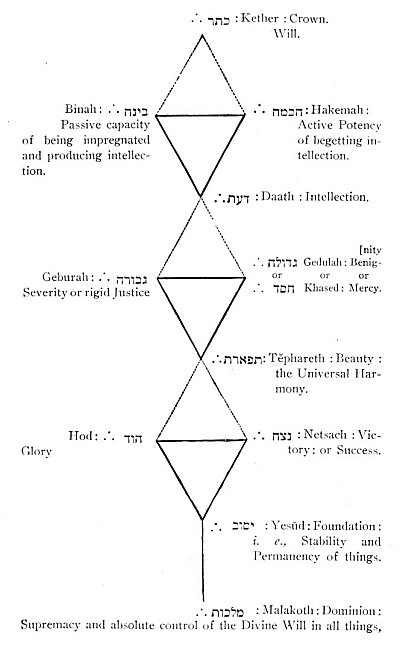
Chart of the Sephiroth
Unity can only be manifested by the Binary. Unity itself and
the idea of Unity are already two.
The human unity is made complete by the right and left. The
primitive man was of both sexes.
The Divinity, one in its essence, has two essential
conditions as fundamental bases of its existence--Necessity and Liberty.
The laws of the Supreme Reason necessitate and regulate
liberty in God, Who is necessarily reasonable and wise.
Knowledge supposes the binary. An object known is
indispensable to the being that knows.
The binary is the generator of Society and the law. It is
also the number of the gnosis, a word adopted in lieu of
Science, and expressing only the idea of cognizance by intuition.
It is Unity, multiplying itself by itself to create; and therefore it is that
the Sacred Symbols make Eve issue from the very chest of Adam.
Adam is the human Tetragram, which is summed up in the
mysterious Yōd of the Kabalah, image of the Kabalistic Phallus. Add to this Yōd
[י] the ternary name of Eve, and you form the name of Jehova, the Divine
Tetragram, the transcendent Kabalistic and magical word:
יהוה
Thus it is that Unity, complete in the fecundity of the
Ternary, forms, with it, the Quaternary, which is the key of all numbers,
movements, and forms.
The Square, turning upon itself, produces the circle equal to
itself, and the circular movement of four equal angles turning around one point,
is the quadrature of the circle.
The Binary serves as a measure for Unity; and the relation of
equality between the Above and the Below, forms with them the Ternary.
To us, Creation is Mechanism: to the Ancients it was
Generation. The world-producing egg figures in all cosmogonies; and modern
science has discovered that all animal production is oviparous. From this idea
of generation came the reverence everywhere paid the image of generative power,
which formed the Stauros of the Gnostics, and the philosophical Cross of the
Masons.
Aleph is the man; Beth is the woman. One is the
Principle; two is the
Word. A∴ is the Active; B∴
is the Passive. Unity is Boaz, and the Binary is Jachin.
The two columns, Boaz and Jachin, explain in the Kabalah all
the mysteries of natural, political, and religious antagonism.
Woman is man's creation; and universal creation is the female
of the First Principle. When the Principle of Existence made Himself Creator, He
produced by emanation an ideal Yōd; and to make room for it in the plenitude of
the uncreated Light, He had to hollow out a pit of shadow, equal to the
dimension determined by His creative desire; and attributed by Him to the ideal
Yōd of radiating Light.
The nature of the Active Principle is to diffuse: of the
Passive Principle, to collect and make fruitful.
Creation is the habitation of the Creator-Word. To create,
the Generative Power and Productive Capacity must unite, the Binary become Unity
again by the conjunction. The WORD is the First-BEGOTTEN, not the first
created Son of God.
SANCTA SANCTIS, we repeat again; the Holy things to the Holy,
and to him who is so, the mysteries of the Kabalah will be holy. Seek and ye
shall find, say the Scriptures: knock and it shall be opened unto you. If you
desire to find and to gain admission to the Sanctuary, we have said enough to
show you the way. If you do not, it is useless for us to say more, as it has
been useless to say so much.
The Hermetic philosophers also drew their doctrines from the
Kabalah; and more particularly from the Treatise Beth Alohim or Domus
Dei, known as the Pneumatica Kabalistica, of Rabbi Abraham Cohen
Irira, and the Treatise De Revolutionibus Animarum of Rabbi Jitz-chak
Lorja.
This philosophy was concealed by the Alchemists under their
Symbols, and in the jargon of a rude Chemistry,--a jargon incomprehensible and
absurd except to the Initiates; but the key to which is within your reach; and
the philosophy, it may be, worth studying. The labors of the human intellect are
always interesting and instructive.
To be always rich, always young, and never to die: such has
been in all times the dream of the Alchemists.
To change into gold, lead, mercury, and all the other metals;
to possess the universal medicine and elixir of life; such is the problem
to be resolved, in order to accomplish this desire and realize this
dream.
Like all the Mysteries of Magism, the Secrets of "the Great
Work" have a threefold signification: they are religious, philosophical, and
natural.
The philosophal gold, in religion, is the Absolute and
Supreme Reason: in philosophy, it is the Truth; in visible nature, the Sun; in
the subterranean and mineral world, the most perfect and pure gold.
It is for this that the pursuit of the Great Work is called
the Search for the Absolute; and the work itself, the work of the Sun.
All the masters of the Science admit that it is impossible to
attain the material results, unless there are found in the two higher Degrees
all the analogies of the universal medicine and of the philosophal stone.
Then, they say, the work is simple, easy, and inexpensive;
otherwise, it consumes fruitlessly the fortune and lives of the seekers.
The universal medicine for the Soul is the Supreme Reason and
Absolute Justice; for the mind, mathematical and practical Truth; for the body,
the Quintessence, a combination of light and gold.
The prima materia of the Great Work, in the Superior World,
is enthusiasm and activity; in the intermediate world, intelligence and
industry; in the lower world, labor: and, in Science, it is the Sulphur,
Mercury, and Salt, which by turns volatilized and fixed, compose the AZOTH of
the Sages.
The Sulphur corresponds with the elementary form of the Fire;
Mercury with the Air and Water; and Salt with the Earth.
The Great Work is, above all things, the creation of man by
himself; that is to say, the fall and entire conquest which he effects of his
faculties and his future. It is, above all, the perfect emancipation of his
will, which assures him the universal empire of Azoth, and the domain of
magnetism, that is, complete power over the universal Magical agent.
This Magical agent, which the Ancient Hermetic philosophers
disguised under the name of "Prima Materia," determines the forms of the
modifiable Substance; and the Alchemists said that by means of it they could
attain the transmutation of metals and the universal medicine.
There are two Hermetic operations, one spiritual, the other
material, dependent the one on the other.
The whole Hermetic Science is contained in the dogma of
Hermes, engraven originally, it is said, on a tablet of emerald. Its sentences
that relate to operating the Great Work are as follows:
"Thou shalt separate the earth from the fire, the subtile
from the gross, gently, with much industry.
"It ascends from earth to Heaven, and again descends to
earth, and receives the force of things above and below.
"Thou shalt by this means possess the glory of the whole
world, and therefore all obscurity shall flee away from thee.
"This is the potent force of all force, for it will overcome
everything subtile, and penetrate everything solid.
"So the world was created."
All the Masters in Alchemy who have written of the Great
Work, have employed symbolic and figurative expressions; being constrained to do
so, as well to repel the profane from a work that would be dangerous for them,
as to be well understood by Adepts, in revealing to them the whole world of
analogies governed by the single and sovereign dogma of Hermes.
So, in their language, gold and silver are the King and
Queen, or the Sun and Moon; Sulphur, the flying Eagle; Mercury, the Man-woman,
winged, bearded, mounted on a cube, and crowned with flames; Matter or Salt, the
winged Dragon; the Metals in ebullition, Lions of different colors; and,
finally, the entire work has for its symbols the Pelican and the Phœnix.
The Hermetic Art is, therefore, at the same time a religion,
a philosophy, and a natural science. As a religion, it is that of the Ancient
Magi and the Initiates of all ages; as a philosophy, we may find its principles
in the school of Alexandria and the theories of Pythagoras; as a science, we
must inquire for its processes of Paracelsus, Nicholas Flamel, and Raymond Lulle.
The Science is a real one only for those who admit and
understand the philosophy and the religion; and its process will succeed only
for the Adept who has attained the sovereignty of will, and so become the King
of the elementary world: for the grand agent of the operation of the Sun, is
that force described in the Symbol of Hermes, of the table of emerald; it is the
universal magical power; the spiritual, fiery, motive power; it is the Od,
according to the Hebrews, and the Astral light, according to others.
Therein is the secret fire, living and philosophical, of
which all the Hermetic philosophers speak with the most mysterious re-serve: the
Universal Seed, the secret whereof they kept, and which they represented only
under the figure of the Caduceus of Hermes.
This is the grand Hermetic arcanum. What the Adepts call dead
matter are bodies as found in nature; living matters are substances assimilated
and magnetized by the science and will of the operator.
So that the Great Work is more than a chemical operation; it
is a real creation of the human word initiated into the power of the Word of
God.
The creation of gold in the Great Work is effected by
transmutation and multiplication.
Raymond Lulle says, that to make gold, one must have gold and
mercury; and to make silver, silver and mercury. And he adds: "I mean by
mercury, that mineral spirit so fine and pure that it gilds even the seed of
gold, and silvers that of silver." He meant by this, either electricity, or Od,
the astral light.
The Salt and Sulphur serve in the work only to prepare the
mercury, and it is to the mercury especially that we must assimilate, and, as it
were, incorporate with it, the magnetic agent. Paracelsus, Lulle, and Flamel
alone seem to have perfectly known this mystery.
The Great Work of Hermes is, therefore, an operation
essentially magical, and the highest of all, for it supposes the Absolute in
Science and in Will. There is light in gold, gold in light, and light in all
things.
The disciples of Hermes, before promising their adepts the
elixir of long life or the powder of projection, advised them to seek for the
Philosophal Stone.
The Ancients adored the Sun, under the form of a black
Stone, called Elagabalus, or Heliogabalus. The faithful are promised, in the
Apocalypse, a white Stone.
This Stone, says the Masters in Alchemy, is the true
Salt of the philosophers, which enters as one-third into the composition
of Azoth. But Azoth is, as we know, the name of the grand Hermetic Agent, and
the true philosophical Agent: wherefore they represent their Salt under the form
of a cubical Stone.
The Philosophal Stone is the foundation of the Absolute
philosophy, the Supreme and unalterable Reason. Before thinking of
the Metallic work, we must be firmly fixed on the Absolute principles
of Wisdom; we must be in possession of this Reason, which is the touchstone of
Truth. A man who is the slave of prejudices will never become the King of Nature
and the Master of transmutations. The Philosophal Stone, therefore, is necessary
above all things. How shall it be found? Hermes tells us, in his "Table of
Emerald," we must separate the subtile from the fixed, with great care and
extreme attention. So we ought to separate our certainties from our beliefs, and
make perfectly distinct the respective domains of science and faith; and to
comprehend that we do not know the things we believe, nor believe anything that
we come to know; and that thus the essence of the things of Faith are the
unknown and indefinite, while it is precisely the contrary with the things of
Science. Whence we shall conclude, that Science rests on reason and experience,
and Faith has for its bases sentiment and reason.
The Sun and Moon of the Alchemists concur in perfecting and
giving stability to the Philosophal Stone. They correspond to the two columns of
the Temple, Jachin and Boaz. The Sun is the hieroglyphical sign of Truth,
because it is the source of Light; and the rough Stone is the symbol of
Stability. Hence the Medieval Alchemists indicated the Philosophal Stone as the
first means of making the philosophical gold, that is to say, of transforming
all the vital powers figured by the six metals into Sun, that is, into Truth and
Light; which is the first and indispensable operation of the Great Work, which
leads to the secondary adaptation, and enables the creators of the spiritual and
living gold, the possessors of the true philosophical Salt, Mercury, and Sulphur,
to discover, by the analogies of Nature, the natural and palpable gold.
To find the Philosophal Stone, is to have discovered the
Absolute, as all the Masters say. But the Absolute is that which admits of no
errors, is the Fixed from the Volatile, is the Law of the Imagination, is the
very necessity of Being, is the immutable Law of Reason and Truth. The Absolute
is that which IS.
To find the Absolute in the Infinite, in the Indefinite, and
in the Finite, this is the Magnum Opus, the Great Work of the Sages, which
Hermes called the Work of the Sun.
To find the immovable bases of true religious Faith, of
Philosophical Truth, and of Metallic transmutation, this is the secret of Hermes
in its entirety, the Philosophal Stone.
This stone is one and manifold; it is decomposed by Analysis,
and re-compounded by Synthesis. In Analysis, it is a powder, the powder of
projection of the Alchemists; before Analysis, and in Synthesis, it is a stone.
The Philosophal Stone, say the Masters, must not be exposed
to the atmosphere, nor to the gaze of the Profane; but it must be kept concealed
and carefully preserved in the most secret place of the laboratory, and the
possessor must always carry on his person the key of the place where it is kept.
He who possesses the Grand Arcanum is a genuine King, and
more than a king, for he is inaccessible to all fear and all empty hopes. In all
maladies of soul and body, a single particle from the precious stone, a single
grain of the divine powder, is more than sufficient to cure him. "Let him hear,
who hath ears to hear!" the Master said.
The Salt, Sulphur, and Mercury are but the accessorial
elements and passive instruments of the Great Work. All depends, as we have
said, on the internal Magnet of Paracelsus. The entire work consists in
projection: and the projection is perfectly accomplished by the effective
and realizable understanding of a single word.
There is but a single important operation in the work; this
consists in Sublimation, which is nothing else, according to Geber than
the elevation of dry matter, by means of fire, with adhesion to its proper
vessel.
He who desires to attain to the understanding of the Grand
Word and the possession of the Great Secret, ought carefully to read the
Hermetic philosophers, and will undoubtedly attain initiation, as others have
done; but he must take, for the key of their allegories, the single dogma of
Hermes, contained in his table of Emerald, and follow, to class his acquisitions
of knowledge and direct the operation, the order indicated in the Kabalistic
alphabet of the Tarot.
Raymond Lulle has said that, to make gold, we must first have
gold. Nothing is made out of nothing; we do not absolutely create wealth; we
increase and multiply it. Let aspirants to science well understand, then, that
neither the juggler's tricks nor miracles are to be asked of the adept. The
Hermetic science, like all the real sciences, is mathematically demonstrable.
Its results, even material, are as rigorous as that of a correct equation.
The Hermetic Gold is not only a true dogma, a light without
Shadow, a Truth without alloy of falsehood; it is also a material gold, real,
pure, the most precious that can be found in the mines of the earth.
But the living gold, the living sulphur, or the true fire of
the philosophers, is to be sought for in the house of Mercury. This fire is fed
by the air: to express its attractive and expansive power, no better comparison
can be used than that of the lightning, which is at first only a dry and earthly
exhalation, united to the moist vapor, but which, by self-exhalation, takes a
fiery nature, acts on the humidity inherent in it, which it attracts to itself
and transmutes in its nature; after which it precipitates itself rapidly toward
the earth, whither it is attracted by a fixed nature like unto its own.
These words, in form enigmatic, but clear at bottom,
distinctly express what the philosophers mean by their Mercury, fecundated by
Sulphur, and which becomes the Master and regenerator of the Salt. It is the
AZOTH, the universal magnetic force, the grand magical agent, the Astral light,
the light of life, fecundated by the mental force, the intellectual energy,
which they compare to sulphur, on account of its affinities with the Divine
fire.
As to the Salt, it is Absolute Matter. Whatever is matter
contains salt; and all salt [nitre] may be converted into pure gold by the
combined action of Sulphur and Mercury, which sometimes act so rapidly, that the
transmutation may be effected in an instant, in an hour, without fatigue to the
operator, and almost without expense. At other times, and according to the more
refractory temper of the atmospheric media, the operation requires
several days, several months, and sometimes even several years.
Two primary laws exist in nature, two essential laws, which
produce, by counterbalancing each other, the universal equilibrium of things.
These are fixedness and movement, analogous, in philosophy, to Truth and
Fiction, and, in Absolute Conception, to Necessity and Liberty, which are the
very essence of Deity. The Hermetic philosophers gave the name fixed to
everything ponder-able, to everything that tends by its natural to central
repose and immobility; they term volatile everything that more naturally
and more readily obeys the law of movement; and they form their stone by
analysis, that is to say, by the volatilization of the Fixed, and then by
synthesis, that is, by fixing the volatile, which they effect
by applying to the fixed, which they call their salt, the sulphurated
Mercury, or the light of life, directed and made omnipotent by a Sovereign Will.
Thus they master entire Nature, and their stone is found wherever there is salt,
which is the reason for saying that no substance is foreign to the Great Work,
and that even the most despicable and apparently vile matters may be changed
into gold, which is true in this sense, that they all contain the original
salt-principle, represented in our emblems by the cubical stone.
To know how to extract from all matter the pure salt
concealed in it, is to have the Secret of the Stone. Wherefore this is a Saline
stone, which the Od or universal astral light decomposes or re-compounds: it is
single and manifold; for it may be dissolved like ordinary salt, and
incorporated with other substances. Obtained by analysis, we might term it
the Universal Sublimate: found by way of synthesis, it is the true
panacea of the ancients, for it cures all maladies of soul and body, and has
been styled, par-excellence, the medicine of all nature. When one, by
absolute initiation, comes to control the forces of the universal agent, he
always has this stone at his disposal, for its extraction is then a simple and
easy operation, very distinct from the metallic projection or realization. This
stone, when in a state of sublimation, must not be exposed to contact with the
atmospheric air, which might partially dissolve it and deprive it of its virtue;
nor could its emanations be inhaled without danger. The Sage prefers to preserve
it in its natural envelopes, assured as he is of extracting it by a single
effort of his will, and a single application of the Universal Agent to the
envelopes, which the Kabalists call cortices, the shells, bark, or
integuments.
Hieroglyphically to express this law of prudence, they gave
their Mercury, personified in Egypt as Hermanubis, a dog's head; and to their
Sulphur, represented by the Baphomet of the Temple, that goat's head which
brought into such disrepute the occult Mediæval associations.
Let us listen for a few moments to the Alchemists themselves,
and endeavor to learn the hidden meaning of their mysterious words.
The RITUAL of the Degree of Scottish Elder MASTER, and Knight
of Saint Andrew, being the fourth Degree of Ramsay, it is said upon the
title-page, or of the Reformed or Rectified Rite of Dresden, has these passages:
"O how great and glorious is the presence of the
Almighty God which gloriously shines from between the Cherubim!
"How adorable and astonishing are the rays of that
glorious Light, that sends forth its bright and brilliant beams from the
Holy Ark of Alliance and Covenant!
"Let us with the deepest veneration and devotion adore the
great Source of Life, that Glorious Spirit who is the Most Merciful and
Beneficent Ruler of the Universe and of all the creatures it contains!
"The secret knowledge of the Grand Scottish Master relates to
the combination and transmutation of different substances; where-of that you may
obtain a clear idea and proper understanding, you are to know that all matter
and all material substances are composed of combinations of three several
substances, extracted from the four elements, which three substances in
combination are,  , Salt, , Salt,  ,
Sulphur, and ,
Sulphur, and 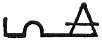 , Spirit. The first of these
produces Solidity, the second Softness, and the third the
Spiritual, vaporous particles. These three compound substances work potently
together; and therein consists the true process for the transmutation of metals. , Spirit. The first of these
produces Solidity, the second Softness, and the third the
Spiritual, vaporous particles. These three compound substances work potently
together; and therein consists the true process for the transmutation of metals.
"To these three substances allude the three golden basins, in
the first of which was engraved the letter M∴, in the second, the letter G∴, and
in the third nothing. The first, M∴, is the initial letter of the Hebrew word
Malakh, which signifies Salt; and the second, G∴, of the Hebrew word
Geparaith, which signifies Sulphur; and as there is no word in
Hebrew to express the vaporous and intangible Spirit, there is no letter
in the third basin.
"With these three principal substances you may effect the
transmutation of metals, which must be done by means of the five points or rules
of the Scottish Mastership.
"The first Master's point shows us the Brazen Sea, wherein
must always be rain-water; and out of this rain-water the Scottish Masters
extract the first substance, which is Salt; which salt must afterward undergo a
seven-fold manipulation and purification, before it will be properly
prepared. This seven-fold purification is symbolized by the Seven Steps of
Solomon's Temple, which symbol is furnished us by the first point or rule of the
Scottish Masters.
"After preparing the first substance, you are to extract the
second, Sulphur, out of the purest gold, to which must then be added
the purified or celestial Salt. They are to be mixed as the Art directs, and
then placed in a vessel in the form of a SHIP, in which it is to remain, as the
Ark of Noah was afloat, one hundred and fifty days, being brought to the first
damp, warm degree of fire, that it may putrefy and produce the mineral
fermentation. This is the second point or rule of the Scottish Masters."
If you reflect, my Brother, that it was impossible for any
one to imagine that either common salt or nitre could be extracted from
rain-water, or sulphur from pure gold, you will no doubt suspect that some
secret meaning was concealed in these words.
The Kabalah considers the immaterial part of man as
threefold, consisting of NEPHESCH, RUACH, and NESCHAMAH, Psyche,
Spiritus, and Mens, or Soul, Spirit, and Intellect.
There are Seven Holy Palaces, Seven Heavens and Seven Thrones; and Souls are
purified by ascending through Seven Spheres. A Ship, in Hebrew, is Ani;
and the same word means I, Me, or Myself.
The RITUAL continues:
"Multiplying the substance thus obtained, is the third
operation, which is done by adding to them the animate, volatile Spirit;
which is done by means of the water of the Celestial Salt, as well as by the
Salt, which must daily be added to it very carefully, and strictly observing to
put neither too much nor too little; inasmuch as, if you add too much, you will
destroy that growing and multiplying substance; and if too little, it will be
self-consumed and destroyed, and shrink away, not having sufficient
substantiality for its preservation. This third point or rule of the Scottish
Masters gives us the emblem of the building of the Tower of Babel, used by our
Scottish Masters, because by irregularity and want of due proportion and harmony
that work was stopped; and the workmen could proceed no further.
"Next comes the fourth operation, represented by the Cubical
Stone, whose faces and angles are all equal. As soon as the work is brought to
the necessary point of multiplication, it is to be submitted to the third Degree
of Fire, wherein it will receive the due proportion of the strength and
substance of the metallic particles of the Cubical Stone; and this is the fourth
point or rule of the Scottish Masters.
"Finally, we come to the fifth and last operation, indicated
to us by the Flaming Star. After the work has become a duly-proportioned
substance, it is to be subjected to the fourth and strongest Degree
of fire, wherein it must remain three times twenty-seven hours; until it is
thoroughly glowing, by which means it becomes a bright and shining tincture,
wherewith the lighter metals may be changed, by the use of one part to a
thousand of the metal. Wherefore this Flaming Star shows us the fifth and last
point of the Scottish Masters.
"You should pass practically through the five points or rules
of the Master, and by the use of one part to a thousand, trans-mute and ennoble
metals. You may then in reality say that your age is a thousand years."
In the oration of the Degree, the following hints are given
as to its true meaning:
"The three divisions of the Temple, the Outer Court,
Sanctuary, and Holy of Holies, signify the three Principles of our Holy Order,
which direct to the knowledge of morality, and teach those most practical
virtues that ought to be practised by mankind. Therefore the Seven Steps which
lead up to the Outer Court of the Temple, are the emblem of the Seven-fold Light
which we need to possess, before we can arrive at the height of knowledge, in
which consist the ultimate limits of our order.
"In the Brazen Sea we are symbolically to purify ourselves
from all pollutions, all faults and wrongful actions, as well those committed
through error of judgment and mistaken opinion, as those intentionally done;
inasmuch as they equally prevent us from arriving at the knowledge of True
Wisdom. We must thoroughly cleanse and purify our hearts to their inmost
recesses, before we can of right contemplate that Flaming Star, which is
the emblem of the Divine and Glorious Shekinah, or presence of God; before we
may dare approach the Throne of Supreme Wisdom."
In the Degree of The True Mason [Le Vrai Maçon],
styled in the title-page of its Ritual the 23d Degree of Masonry, or the 12th of
the 5th class, the Tracing-board displays a luminous Triangle, with a great Yōd
in the centre.
"The Triangle," says the Ritual, "represents one God in three
Persons; and the great Yōd is the initial letter of the last word.
"The Dark Circle represents the Chaos, which in the beginning
God created.
"The Cross within the Circle, the Light by means whereof He
developed the Chaos.
"The Square, the four Elements into which it was resolved.
"The Triangle, again, the three Principles [Salt,
Sulphur, and Mercury], which the intermingling of the elements produced.
"God creates; Nature produces; Art
multiplies. God created Chaos; Nature produced it; God, Nature, and Art,
have perfected it.
"The Altar of Perfumes indicates the Fire that is to
be applied to Nature. The two towers are the two furnaces, moist and dry,
in which it is to be worked. The bowl is the mould of oak that is to inclose the
philosophal egg.
"The two figures surmounted by a Cross are the two vases,
Nature and Art, in which is to be consummated the double marriage of the white
woman with the red Servitor, from which marriage will spring a most Potent King.
"Chaos means universal matter, formless, but susceptible of
all forms. Form is the Light inclosed in the seeds of all species; and its home
is in the Universal Spirit.
"To work on universal matter, use the internal and external
fire: the four elements result, the Principia Principiorum and
Inmediata; Fire, Air, Water, Earth. There are four qualities of these
elements--the warm and dry, the cold and moist. Two appertain to each element:
The dry and cold, to the Earth; the cold and moist, to Water; the moist and
warm, to the Air; and the warm and dry, to Fire: whereby the Fire connects with
the Earth; all the elements, as Hermes said, moving in circles.
"From the mixture of the four Elements and of their four
qualities, result the three Principles,--Mercury, Sulphur, and Salt. These are
the philosophical, not the vulgar.
"The philosophical Mercury is a Water and
SPIRIT, which dissolves and sublimates the Sun; the philosophical Sulphur,
a fire and a SOUL, which mollifies and colors it; the philosophical
Salt, an Earth and a BODY, which coagulates and fixes it; and the whole is
done in the bosom of the Air.
"From these three-Principles result the four Elements
duplicated, or the Grand Elements, Mercury, Sulphur, Salt,
and Glass; two of which are volatile,--the Water [Mercury] and the Air [Sulphur],
which is oil; for all substances liquid in their nature avoid fire, which takes
from the one [water] and burns the other [oil]; but the other two are dry and
solid, to wit, the Salt, wherein Fire is contained, and the pure Earth,
which is the Glass; on
both of which the Fire has no other action than to melt and refine them,
unless one makes use of the liquid alkali; for, just as each element consists of
two qualities, so these great duplicated Elements partake, each of two of the
simple elements, or, more properly speaking, of all the four, according to the
greater or less degree of each,--the Mercury partaking more of the Water, to
which it is assigned; the Oil or Sulphur, more of the Air; the Salt, of the
Fire; and the Glass, of the Earth; which is found, pure and clear, in the centre
of all the elementary composites, and is the last to disengage itself from the
others.
"The four Elements and three Principles reside in all the
Compounds, Animal, Vegetable, and Mineral; but more potently in some than in
others.
"The Fire gives them Movement; the Air, Sensation; the Water,
Nutriment; and the Earth, Subsistence.
"The four duplicated Elements engender THE STONE, if one is
careful enough to supply them with the proper quantity of fire, and to combine
them according to their natural weight. Ten parts of Air make one of Water; ten
of Water, one of Earth; and ten of Earth, one of Fire; the whole by the Active
Symbol of the one, and the Passive Symbol of the other, whereby the conversion
of the Elements is effected."
The Allusion of the Ritual, here, is obviously to the four
Worlds of the Kabalah. The ten Sephiroth of the world Briah proceed from
Malakoth, the last of the ten Emanations of the world Aziluth; the ten Sephiroth
of the world Yezirah, from Malakoth of Brian; and the ten of the world Asiah,
from Malakoth of Yezirah. The Pass-word of the Degree is given as Metralon,
which is a corruption of METATRON, the Cherub, who and Sandalphon are in the
Kabalah the Chief of the Angels. The Active and Passive Symbols are the Male and
Female.
The Ritual continues:
"It is thereby evident that, in the Great Work, we must
employ ten parts of philosophical Mercury to one of Sun or Moon.
"This is attained by Solution and Coagulation.
These words mean that we must dissolve the body and coagulate the spirit; which
operations are effected by the moist and dry bath.
"Of colors, black is the Earth; white, the
Water; blue, the Air; and red, the Fire; wherein also are involved
very great secrets and mysteries.
"The apparatus employed in 'The Great Work' consists of the
Moist bath, the Dry bath, the Vases of Nature and Art, the bowl of oak, lutum
sapientiæ, the Seal of Hermes, the tube, the physical lamp, and the iron
rod.
"The work is perfected in seventeen philosophical months,
according to the mixture of ingredients. The benefits reaped from it are of two
kinds--one affecting the soul, and the other the body. The former consist in
knowing God, Nature, and ourself; and those to the body are wealth and
health.
"The Initiate traverses Heaven and Earth. Heaven is the World
manifest to the Intelligence, subdivided into Paradise and Hell; Earth is the
World manifest to the Senses, also subdivided into the Celestial and that of the
Elements.
"There are Sciences specially connected with each of these.
The one is ordinary and common; the other, mystic and secret. The World
cognizable by the Intellect has the Hermetic Theology and the Kabalah; the
Celestial Astrology; and that of the Elements, Chemistry, which by its
decompositions and separations, effected by fire, reveals all the most hidden
secrets of Nature, in the three kinds of Compound Substances. This last science
is styled 'Hermetic,' or 'The operating of the Great Work.'"
The Ritual of the Degree of Kabalistic and Hermetic Rose ✠,
has these passages:
"The true Philosophy, known and practised by Solomon, is the
basis on which Masonry is founded.
"Our Ancient Masons have concealed from us the most important
point of this Divine Art, under hieroglyphical characters, which are but enigmas
and parables, to all the Senseless, the Wicked, and the Ambitious.
"He will be supremely fortunate, who shall, by arduous labor,
discover this sacred place of deposite, wherein all naked the sublime Truth is
hidden; for he may be assured that he has found the True Light, the True
Felicity, the True Heavenly Good. Then may it truly be said that he is one of
the True Elect; for it is the only real and most Sublime Science of all those
to which a mortal can aspire: his days will be prolonged, and his soul freed
of all vices and corruption; into which" (it is added, to mislead, as if from
fear too much would be disclosed), "the human race is often led by indigence."
As the symbolism of the Hall and the language of the ritual
mutually explain each other, it should be noted here, that in this Degree the
columns of the hall, 12 in number, are white variegated with black and red. The
hangings are black, and over that crimson.
Over the throne is a great Eagle, in gold, on a black ground.
In the centre of the Canopy the Blazing Star in gold, with the letter Yōd in its
centre. On the right and left of the throne are the Sun in gold and the Moon in
silver. The throne is ascended to by three Steps. The hall and ante-room
are each lighted by ten lights, and a single one at the entrance. The
colors, black, white, and crimson appear in the clothing; and the Key and
Balance are among the symbols.
The duty of the Second Grand Prior, says the Ritual, is "to
see if the Chapter is hermetically sealed; whether the materials are ready, and
the elements; whether the Black gives place to the White, and the White to the
Red."
"Be laborious," it says, "like the Star, and procure the
light of the Sages, and hide yourself from the Stupid Profane and the Ambitious,
and be like the Owl, which sees only by night, and hides itself from treacherous
curiosity."
"The Sun, on entering each of his houses, should be received
there by the four elements, which you must be careful to invite to accompany
you, that they may aid you in your undertaking; for without them the House would
be melancholy: wherefore you will give him to feast upon the four elements.
"When he shall have visited his twelve houses, and seen you
attentive there to receive him, you will become one of his chiefest favorites,
and he will allow you to share all his gifts. Matter will then no longer have
power over you; you will, so to say, be no longer a dweller on the earth; but
after certain periods you will give back to it a body which is its own, to take
in its stead one altogether Spiritual. Matter is then deemed to be dead to the
world.
"Therefore it must be re-vivified, and made to be born again
from its ashes, which you will effect by virtue of the vegetation of the Tree of
Life, represented to us by the branch of acacia. Whoever shall learn to
comprehend and execute this great work, will know great things, say the Sages of
the work; but whenever you depart from the centre of the Square and the Compass
you will no longer be able to work with success.
"Another Jewel is necessary for you, and in certain
undertakings cannot be dispensed with. It is what is termed the Kabalistic
pantacle . . . This carries with it the power of commanding the spirits of the
elements. It is necessary for you to know how to use it, and that you will learn
by perseverance if you are a lover of the science of our predecessors the Sages.
"A great Black Eagle, the King of Birds. He alone it is that
can fire the Sun, material in its nature, that has no form, and yet by its form
develops color. The black is a complete harbinger of the work: it changes color
and assumes a natural form, out whereof will emerge a brilliant Sun.
"The birth of the Sun is always announced by its Star,
represented by the Blazing Star, which you will know by its fiery color; and it
is followed in its course by the silvery lustre of the Moon.
"A rough Ashlar is the shapeless stone which is to be
prepared in order to commence the philosophical work; and to be developed, in
order to change its form from triangular to cubic, after the separation from it
of its Salt, Sulphur, and Mercury, by the aid of the Square, Level, Plumb, and
Balance, and all the other Masonic implements which we use symbolically.
"Here me put them to philosophical use, to constitute a
well-proportioned edifice, through which you are to make pass the crude
material, analogous to a candidate commencing his initiation into our Mysteries.
When we build we must observe all the rules and proportions; for otherwise the
Spirit of Life cannot lodge therein. So you will build the great tower, in which
is to burn the fire of the Sages, or, in other words, the fire of Heaven; as
also the Sea of the Sages, in which the Sun and Moon are to bathe. That is the
basin of Purification, in which will be the water of Celestial Grace, water that
doth not soil the hands, but purifies all leprous bodies.
"Let us labor to instruct our Brother, to the end that by his
toils he may succeed in discovering the principle of life contained in the
profundity of matter, and known by the name of Alkahest.
"The most potent of the names of Deity is ADONAI. Its power
is to put the Universe in movement; and the Knights who shall be fortunate
enough to possess it, with weight and measure, shall have at their disposition
all the potences that inhabit it, the Elements,
and the cognizance of all the virtues and sciences that man is
capable of knowing. By its power they would succeed in discovering the primary
metal of the Sun, which holds within itself the Principle of the germ, and
wherewith we can put in alliance and six other metals, each of which contains
the principles and primitive seed of the grand philosophical work.
"The six other metals are Saturn, Jupiter, Mars, Venus,
Mercury, and Luna; vulgarly known as Lead, Tin, Iron, Copper, Quicksilver, and
Silver. Gold is not included; because it is not in its nature a metal. It is all
Spirit and incorruptible; wherefore it is the emblem of the Sun, which presides
over the Light.
"The vivifying Spirit, called Alkahest, has in itself the
generative virtue of producing the triangular Cubical Stone, and contains in
itself all the virtues to render men happy in this world and in that to come. To
arrive at the composition of that Alkahest, we begin by laboring at the science
of the union of the four Elements which are to be educed from the three Kingdoms
of Nature, Mineral, Vegetable, and Animal; the rule, measure, weight, and
equipoise whereof have each their key. We then employ in one work the animals,
vegetables, and minerals, each in his season, which make the space of the Houses
of the Sun, where they have all the virtues required.
"Something from each of the three Kingdoms of Nature is
assigned to each Celestial House, to the end that everything may be done in
accordance with sound philosophical rules; and that everything maybe thoroughly
purified in its proper time and place in order to be presented at the
wedding-table of the Spouse and the six virgins who hold the mystic shovel,
without a common fire, but with an elementary fire, that comes primarily by
attraction, and by digestion in the philosophical bed lighted by the four
elements.
"At the banquet of the Spouses, the viands, being thoroughly,
purified, are served in Salt, Sulphur, Spirit, and Oil; a sufficient quantity
thereof is taken every month, and therewith is compounded, by means of the
Balance of Solomon, the Alkahest, to serve the Spouses, when they are laid on
the nuptial bed, there to engender their embryo, producing for the human race
immense treasures, that will last as long as the world endures.
"Few are capable of engaging in this great work. Only the
true Free-Masons may of right aspire to it; and even of them,
very few are worthy to attain it, because most of them are ignorant
of the Clavicules and their contents, and of the Pantacle of Solomon, which
teaches how to labor at the great work.
"The weight raised by Solomon with his balance was 1, 2, 3,
4, 5; which contains 25 times unity, 2 multiplied by 2; 3 multiplied by 3; 4
multiplied by 4; 5 multiplied by 5, and once 9; these numbers thus involving the
squares of 5 and 2, the cube of 2, the square of the square of 2, and the square
of 3."
Thus far the Ritual, in the numbers mentioned by it, is an
allusion to the 47th problem of Euclid, a symbol of Blue Masonry, entirely out
of place there, and its meaning unknown. The base of the right-angled triangle
being 3, and the perpendicular 4, the hypothenuse is 5, by the rule that the sum
of the squares of the two former equals the square of the latter,--3×3 being 9;
and 4×4, 16; and 9+16 being 25, the square of 5. The triangle contains in its
sides the numbers 1, 2, and 3. The Perpendicular is the Male; the Base, the
Female; the Hypothenuse, the product of the two.
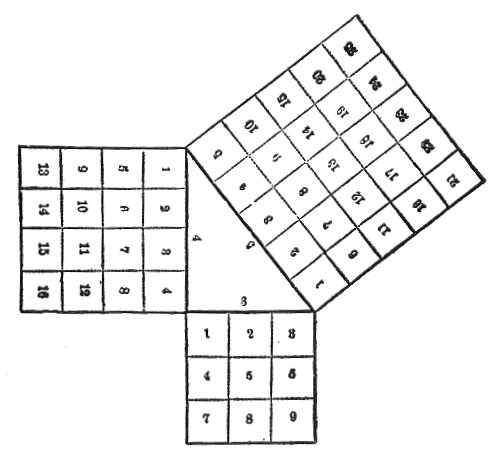
To fix the volatile, in the Hermetic language, means to
materialize the spirit; to volatilize the fixed is to spiritualize matter.
To separate the subtile from the gross, in the first
operation, which is wholly
internal, is to free our soul from all prejudice and all vice. This is effected
by the use of the philosophical SALT, that is to say, of WISDOM; of MERCURY,
that is to say, of personal aptitude and labor; and of SULPHUR, which represents
the vital energy, and the ardor of the will. Thus we succeed in changing into
spiritual gold such things even as are of least value, and even the foul things
of the earth.
It is in this sense we are to understand the parables of the
Hermetic philosophers and the prophets of Alchemy; but in their works, as in the
Great Work, we must skillfully separate the subtile from the gross, the mystic
from the positive, allegory from theory. If you would read them with pleasure
and understandingly, you must first understand them allegorically in their
entirety and then descend from allegories to realities by way of the
correspondences or analogies indicated in the single dogma:
"What is above is like what is below; and what is below is
like what is above."
The treatise "Minerva Mundi," attributed to Hermes
Trismegistus, contains, under the most poetical and profound allegories, the
dogma of the self-creation of beings, or of the law of creation that results
from the accord of two forces, these which the Alchemists called the Fixed and
the Volatile, and which are, in the Absolute, Necessity and Liberty.
When the Masters in Alchemy say that it needs but little time
and expense to accomplish the works of Science. when they affirm, above all,
that but a single vessel is necessary, when they speak of the Great and Single
furnace, which all can use, which is within the reach of all the world, and
which men possess without knowing it, they allude to the philosophical and moral
Alchemy. In fact, a strong and determined will can, in a little while, attain
complete independence; and we all possess that chemical instrument, the great
and single athanor or furnace, which serves to separate the subtile from the
gross, and the fixed from the volatile. This instrument, complete as the world,
and accurate as the mathematics themselves, is designated by the Sages under the
emblem of the Pentagram or Star with five points, the absolute sign of human
intelligence.
The end and perfection of the Great Work is expressed, in
alchemy, by a triangle surmounted by a cross: and the letter Tau, ת, the last of
the Sacred alphabet, has the same meaning.
The "elementary fire," that comes primarily by attraction, is
evidently Electricity or the Electric Force, primarily developed as magnetism,
and in which is perhaps the secret of life or the vital force.
Paracelsus, the great Reformer in medicine, discovered
magnetism long before Mesmer, and pushed to its last consequences this luminous
discovery, or rather this initiation into the magic of the ancients, who
understood the grand magical agent better than we do, and did not regard the
Astral Light, Azoth, the universal magnetism of the Sages, as an animal and
particular fluid, emanating only from certain special beings.
The four Elements, the four symbolic animals, and the
re-duplicated Principles correspond with each other, and are thus arranged by
the Hermetic Masons:
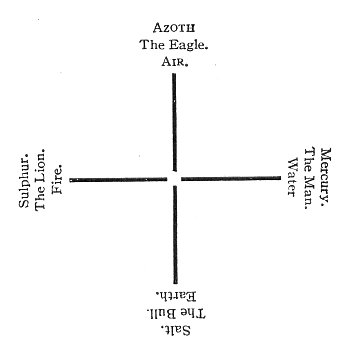
The Air and Earth represent the Male Principle; and
the Fire and Water belong to the Female Principle. To these four forms
correspond the four following philosophical ideas.
Spirit: Matter: Movement: Repose.
Alchemy reduces these four things to three:
The Absolute: the Fixed: the Volatile.
Reason: Necessity; Liberty: are the synonyms of these three
words.
As all the great Mysteries of God and the Universe are thus
hidden in the Ternary, it everywhere appears in Masonry and in the Hermetic
Philosophy under its mask of Alchemy. It even
appears where Masons do not suspect it; to teach the doctrine of the
equilibrium of Contraries, and the resultant Harmony.
The double triangle of Solomon is explained by Saint John in
a remarkable manner: There are, he says, three witnesses in Heaven,--the Father,
the Word, and the Holy Spirit; and three witnesses on earth,--the breath, water,
and blood. He thus agrees with the Masters of the Hermetic Philosophy, who give
to their Sulphur the name of Ether, to their Mercury the name of philosophical
water, to their Salt that of blood of the dragon, or menstruum of the earth. The
blood, or Salt, corresponds by opposition with the Father; the Azothic, or
Mercurial water, with the Word, or Logos; and the breath, with the Holy Spirit.
But the things of High Symbolism can be well understood only by the true
children of Science.
Alchemy has its Symbolic Triad of Salt, Sulphur, and
Mercury,--man consisting, according to the Hermetic philosophers, of Body, Soul,
and Spirit. The Dove, the Raven, and the Phœnix are striking Symbols of Good and
Evil, Light and Darkness, and the Beauty resulting from the equilibrium of the
two.
If you would understand the true secrets of Alchemy, you must
study the works of the Masters with patience and assiduity. Every word is often
an enigma; and to him who reads in haste, the whole will seem absurd. Even when
they seem to teach that the Great Work is the purification of the Soul, and so
to deal only with morals, they most conceal their meaning, and deceive all but
the Initiates.
Yōd [σ or י] is termed in the Kabalah the opifex,
workman of the Deity. It is, says the Porta Cælorum, single and
primal, like one, which is the first among numbers; and like a point,
the first before all bodies. Moved lengthwise, it produces a line, which
is Vau, and this moved sidewise produces a superficies, which is Daleth.
Thus Vau [ו] becomes Daleth [ד]; for movement tends from right to left; and all
communication is from above to below. The plenitude of Yōd, that is, the
name of this letter, spelled, is יוד, Y-O-D. Vau [which represents 6] and
Daleth [4] are 10; like Yōd, their principle.
Yōd, says the Siphra de Zeniutha, is the Symbol of
Wisdom and of the Father.
The Principle called Father, says the Idra Suta, is
comprehended in Yōd, which flows downward from the Holy influence,
wherefore Yōd is the most occult of all the letters; for he is the
beginning and end of all things. The Supernal Wisdom is Yōd; and all things are
included in Yōd, who is therefore called Father of Fathers, or the Generator of
the Universal. The Principle of all things is called the House of all things:
wherefore Yōd is the beginning and end of all things; as it is written: "Thou
halt made all things in Wisdom." For The All is termed Wisdom; and in it The
All is contained; and the summary of all things is the Holy Name.
Yōd, says the Siphra de Zeniutha, signifying the
Father, approaches the letter He, which is the Mother; and by the combination of
these two is denoted that luminous influence wherewith Binah is imbued by the
Supernal Wisdom.
In the name יהו, says the same, are included the Father,
Mother, and Microprosopos, their issue. He, impregnated by Vau, produced
Microprosopos, or Seir Anpin.
Wisdom, Hakemah, is the Principle of all things: it is the
Father of Fathers, and in it are the beginning and end of all things.
Microprosopos, the second Universal, is the issue of Wisdom, the Father, and
Binah, the Mother, and is composed of the six Numerations, Geburah, Gedulah, and
Tephareth, Netsach, Hod, and Yesod; is represented under the form of a man, and
said to have at first occupied the place afterward filled by the world Briah [of
Creation], but afterward to have been raised to the Aziluthic sphere, and
received Wisdom, Intelligence, and Cognition [Daath] from the Supernal Wisdom
and Intellectuality.
Vau, in the tri-literal word, denotes these six members of
Microprosopos. For this latter is. formed after the fashion of Macroprosopos,
but without Kether, the will, which remains in the first prototype or Universal;
though invested with a portion of the Divine Intellectual Power and Capacity.
The first Universal does not use the first person, and is called in the third
person, הוא, HUA, HE: but the second Universal speaks in the first person, using
the word אני ANI, I.
The IDRA RABBA, or Synodus Magna, one of the books of the
Sohar, says:
The Eldest of the Eldest [the Absolute Deity] is in
Microprosopos. All things are one: all was, all is, all will be: there neither
will be, nor is, nor has been, mutation.
But He conformed Himself, by the formings, into a form that
contains all forms, in a form which comprehends all genera.
This form is in the likeness of His form; and is not that
form but its analogue: wherefore the human form is the form of all above and
below, which are included in it: and because it embraces all above and below.
The Most Holy so took form, and so Microprosopos was configured. All things are
equally one, in each of the two Universals; but in the second His ways are
divided, and judgment is on our side, and on the side that looks toward us,
also, they differ.
These Secrets are made known only to the reapers in the Holy
Field.
The Most Holy Ancient is not called ATHAH, Thou, but Hun, He:
but in Microprosopos, where is the beginning of things, He has the name ATHAH,
and also AB, Father. From Him is the beginning, and He is called Thou, and is
the Father of Fathers. He issues from the Non-Ens; and therefore is beyond
cognition.
Wisdom is the Principle of the Universe, and from it
thirty-two ways diverge: and in them the law is contained, in twenty-two letters
and ten words. Wisdom is the Father of Fathers, and in this Wisdom is found the
Beginning and the End: wherefore there is a wisdom in each Universal, one above,
the other below.
The Commentary of Rabbi Chajun Vital, on the Siphra
de Zeniutha, says: At the beginning of emanation, Microprosopos issued from
the Father, and was intermingled with the Mother, under the mysteries of the
letter,ה [He], resolved in דו, that is, Daleth and Vau; by which Vau is denoted
Microprosopos: because Vau is six, and he is constituted of the six parts that
follow Hakemah and Binah. And, according to this conception, the Father is
called Father of Fathers, because from Him these Fathers proceed, Benignity,
Severity, and Beauty. Microprosopos was then like the letter Vau in the letter
He, because He had no head; but when He was now born, three brains were
constituted for Him, by the flow of Divine Light from above.
And as the world of restitution [after the vessels of the
Sephiroth below Binah had been broken, that from the fragments evil might be
created] is instituted after the fashion of the Balance, so also is it formed
throughout in the human form. But Malakoth, Regnum, is a complete and separate
person, behind Microprosopos, and in conjunction with him, and the two are
called man.
The first world [of Inanity] could not continue and did not
subsist, because it had no human conformation nor the system of the Balance, the
Sephiroth being points, one below the other. The first Adam [Microprosopos, as
distinguished from Macroprosopos, the first Occult Adam] was the
beginning, wherein the ten Numerations proceeded forth from potence into act.
Microprosopos is the second garment or interposed medium,
with respect to the Elder Most Holy, who is the name Tetragrammaton; and he is
called Alohim; because the former is Absolute Commiseration; while in
Macroprosopos his lights have the nature of Severities, with respect to the
elder Universal; though they are Commiseration, with respect to the lights of
Malakoth and the three lower worlds.
All the conformations of Macroprosopos come from the first
Adam; who, to interpose a second covering, caused a single spark to issue from
the sphere of Severity, of whose five letters is generated the name Alohim. With
this issued from the brain a most subtle air, which takes its place on the right
hand, while the spark of fire is on the left. Thus the white and red do not
intermix, that is, the Air and Fire, which are Mercy and Judgment.
Microprosopos is the Tree of the Knowledge of Good and Evil,
his Severities being the Evil.
REGNUM, to which is given the name of Word of The Lord,
superinvests Heaven, as the six members of the Degree Tephareth are called, and
these become and are constituted by that superior vestiture. For every
conformation and constitution is effected by means of veiling, because
occultation here is the same as manifestation, the excess of light being veiled,
so that, diminished in intensity and degree, it may be received by those below.
Those six members conceived of as contained in Binah, are said to be in the
World of Creation; as in Tephareth, in that of Formation; and as in Malakoth, in
that of Fabrication.
Before the institution of equilibrium, face was not toward
face: Microprosopos and his wife issuing forth back to back, and yet cohering.
So above; before the prior Adam was conformed into male and female, and the
state of equilibrium established, the Father and Mother were not face to face.
For the Father denotes the most perfect Love; and the Mother the most perfect
Rigor. And the seven supernal sons who proceeded from her, from Binah, who
brought forth seven, were all most perfect rigors, having no
connection with a root in the Most Holy Ancient; that is, they were
all dead, destroyed, shattered; but they were placed in equilibrium, in
the equipoise of the Occult Wisdom, when it was conformed into male and female,
Rigor and Love, and they were then restored, and there was given them a root
above.
The Father is Love and Mercy, and with a pure and subtle Aur
or Benignity impregnates the Mother, who is Rigor and Severity of Judgments; and
the product is the brain of Microprosopos.
It was determined, says the Introduction to the Book
Sohar, by the Deity, to create Good and Evil in the world, according to
what is said in Isaiah, "who makes the bight and creates the Evil." But
the Evil was at first occult, and could not be generated and brought forth,
except by the sinning of the First Adam. Wherefore He determined that the
numerations first emanated, from Benignity downward, should be destroyed and
shattered by the excessive influx of His Light; His intention being to create of
them the worlds of Evils. But the first three were to remain and subsist, that
among the fragments should be neither Will, Intellectual Power, nor the Capacity
of Intellection of the Divinity. The last seven numerations were points,
like the first three, each subsisting independently, unsustained by
companionship; which was the cause of their dying and being shattered.
There was then no Love between them, but only a two-fold
Fear; Wisdom, for example, fearing lest it should ascend again to its Source in
Kether; and also lest it should descend into Binah. Hence there was no union
between any two, except Hakemah and Binah, and this imperfect, with averted
faces. This is the meaning of the saying, that the world was created by
Judgment, which is fear. And so that world could not subsist, and the Seven
Kings were dethroned, until the attribute of Compassion was adjoined to it, and
then restoration took place. Thence came Love and Union, and six of the parts
were united into one person; for Love is the attribute of Compassion or Mercy.
Binah produced the Seven Kings, not successively, but all
together. The Seventh is Regnum, called a stone, the corner-stone, because on it
are builded the palaces of the three lower worlds.
The first six were shattered into fragments; but Regnum was
crushed into a formless mass, lest the malignant demons created from the
fragments of the others should receive bodies from it, since from it came bodies
and vitality [Nephesch].
From the fragments of the vessels came all Evils; judgments,
turbid waters, impurities, the Serpent, and Adam Belial [Baal]. But their
internal light re-ascended to Binah, and then flowed down again into the worlds
Briah and Yezirah, there to form vestiges of the Seven Numerations. The Sparks
of the great Influence of the shattered vases descending into the four spiritual
elements, Fire, Air, Water, and Earth, and thence into the inanimate, vegetable,
living, and speaking kingdoms, became Souls.
Selecting the suitable from the unsuitable lights, and
separating the good from the evil, the Deity first restored the universality of
the Seven Kings of the World Aziluth, and afterward the three other Worlds.
And though in them were both good and evil, still this evil
did not develop itself in act, since the Severities remained, though mitigated;
some portion of them being necessary to prevent the fragments of the integuments
from ascending. These were also left, because connection of two is necessary to
generation. And this necessity for the existence of Severity is the mystery of
the pleasure and warmth of the generative appetite; and thence Love between
husband and wife.
If the Deity, says the Introduction, had not created worlds
and then destroyed them, there could have been no evil in the world, but all
things must have been good. There would have been neither reward nor punishment
in the world. There would have been no merit in righteousness, for the Good is
known by the evil, nor would there have been fruitfulness or multiplication in
the world. If all carnal concupiscence were enchained for three days in the
mouth of the great abyss, the egg of one of the days would be wanting to the
sick man. In time to come it will be called Laban [לבן--white], because
it will be whitened of its impurity, and will return to the realm Israel, and
they will pray the Lord to give them the appetite of carnal concupiscence, for
the begetting of children.
The intention of God was, when He created the world, that His
creatures should recognize His existence. Therefore He created evils, to afflict
them withal when they should sin, and Light and Blessing to reward the just. And
therefore man necessarily has free-will and election, since Good and Evil are in
the World.
And these kings died, says the Commentary, because the
condition of equilibrium did not yet exist, nor was Adam Kadmon
formed male and female. They were not in contact with what was alive:
nor had any root in Adam Kadmon; nor was Wisdom which outflowed from Him, their
root, nor did they connect with it. For all these were pure mercies and most
simple Love; but those were rigorous judgments. Whence face looked not toward
face; nor the Father toward the Mother, because from her proceeded judgments.
Nor Macroprosopos toward Microprosopos. And Regnum, the last numeration, was
empty and inane. It has nothing of itself; and, as it were, was nothing,
receiving nothing from them. Its need was, to receive Love from the Male; for it
is mere rigor and judgment; and the Love and Rigor must temper each other, to
produce creation, and its multitudes above and below. For it was made to be
inhabited; and when rigorous judgments rule in it, it is inane because its
processes cannot be carried on.
Wherefore the Balance must needs be instituted, that there
might be a root above, so that judgments might be restored and tempered, and
live and not again die. And Seven Conformations descend; and all things become
in equilibrium, and the needle of the Balance is the root above.
In the world Yezirah, says the Pneumatica Kabalistica,
י de-notes Kether; יה, Hakemah and Binah; and יהו, Gedulah, Geburah, and
Tephareth; and thus Vau is Beauty and Harmony. The Man is Hakemah; the
Eagle, Binah; the Lion, Gedulah; and the Ox, Geburah. And the
mysterious circle is thus formed by the Sohar and all the Kabalists: Michael and
the face of the Lion are on the South, and the right hand, with the letter י,
Yōd, and Water;
Gabriel and the face of the Ox, on the North, and left hand, with the first ה of
the Tetragrammaton and Fire; Uriel and the face of the Eagle, on the East and
forward, with ו and Air; and Raphael and the face of the Man, on the West, and
backward with the last ה, and Earth. In the same order, the four letters
represent the four worlds.
Rabbi Schimeon Ben Jochai says that the four animals of the
Mysterious Chariot, whose wheels are Netsach and Had, are Gedulah, whose face is
the Lion's; Geburah, with that of the Ox; Tephareth, with that of the Eagle; and
Malakoth, with that of the Man.
The Seven lower Sephiroth, says the Æsch Mezareph,
will represent Seven Metals; Gedulah and Geburah, Silver and Gold; Tephareth,
Iron; Netsach and Hod, Tin and Copper; Yesod, Lead; and Malakoth will be the
metallic Woman and Morn of the Sages, the field wherein are to be sowed the
Seeds of the Secret Minerals, to wit, the Water of Gold; but in these such
mysteries are concealed as no tongue can utter.
The word אמש, Amas, is composed of the initials of the three
Hebrew words that signify Air, Water, and Fire; by which, say the Kabalists, are
denoted Benignity, Judicial Rigor, and Mercy or Compassion mediating between
them.
Malakoth, says the Apparatus, is called Haikal,
Temple or Palace, because it is the Palace of the Degree Tephareth, which is
concealed and contained in it, and Haikal denotes the place in which all things
are contained.
For the better understanding of the Kabalah, remember that
Kether, or the Crown, is treated of as a person, composed of the ten
Numerations, and as such termed Arik Anpin, or Macroprosopos:
That Hakemah is a person, and termed Abba, or
Father:
That Binah is a person, and termed Mother, Imma:
That Tephareth, including all the Numerations from Khased or
Gedulah to Yesod, is a person, called Seir Anpin, or Microprosopos. These
Numerations are six in number, and are represented by the interlaced triangle,
or the Seal of Solomon.
And Malakoth is a person, and called the wife of
Microprosopos. Vau represents the Beauty or Harmony, consisting of the six parts
which constitute Seir Anpin.
The wife, Malakoth, is said to be behind the husband,
Seir, and to have no other cognition of him. And this is thus explained: That
every cognizable object is to be known in two ways: à priori, which is
when it is known by means of its cause, or of itself; or, à posteriori
when it is known by its effects. The most nearly perfect mode of cognition is,
when the intellect knows the thing itself, in itself, and through itself. But if
it knows the thing by its similitude or idea, or species separate from it, or by
its effects and operations, the cognition is much feebler and more imperfect.
And it is thus only that Regnum, the wife of Seir, knows her husband, until face
is turned to face, when they unite, and she has the more nearly perfect
knowledge. For then the Deity, as limited and manifested in Seir and the
Universe are one.
Vau is Tephareth, considered as the Unity in which are
the six members, of which itself is one. Tephareth, Beauty, is the
column which supports the world, symbolized by the column of the junior Warden
in the Blue Lodges. The world was first created by Judgment: and as it could not
so subsist, Mercy was conjoined with Judgment, and the Divine Mercies sustain
the Universe.
God, says the Idra Suta, formed all things in the form
of male and female, since otherwise the continuance of things was impossible.
The All-embracing Wisdom, issuing and shining from the Most Holy Ancient, shines
not otherwise than as male and female. Wisdom as the Father, Intelligence the
Mother, are in equilibrium as male and female, and they are conjoined, and one
shines in the other. Then they generate, and are expanded in the Truth. Then the
two are the Perfection of all things, when they are coupled; and when the Son is
in them, the summary of all things is in one.
These things are intrusted only to the Holy Superiors, who
have entered and gone out and known the ways of the Most Holy God, so as not to
err in them, to the right hand or to the left: For these things are hidden; and
the lofty Holinesses shine in them, as light flows from the splendor of a lamp.
These things are committed only to those who have entered and
not withdrawn; for he who has not done so had better never have been born.
All things are comprehended in the letters Vau and He; and
all are one system; and these are the letters, תבונת. Tabunah, Intelligence.
back to top |