THE PURPOSE
OF RITUAL IN FREEMASONRY
by V. W. Piers A.
Vaughan
A Speech given in Washington Lodge No. 21,
State of New
York, United States of
America on Tuesday, 17th
September, 2002
Nasrudin used
to take his donkey across a frontier every day, loaded with baskets full of
straw. Because he freely confessed
to being a smuggler when he came home every night, the frontier guards would
search him again and again. They
used to strip him, sift the straw, steep it in water, sometimes even burn
it. Meanwhile, Nasrudin was
becoming more and more wealthy.
Then he retired and went to live in another country. Here one of the frontier guards happened
to meet him, years later.
“You can tell me now, Nasrudin,” he said. “What on earth were you smuggling all
that time when we could never catch you out?”
“Donkeys, “ said Nasrudin.
From ‘Perfume of the Desert –
Inspirations from Sufi Wisdom,
ed. A. Harvey & E. Hanut, 1999, pub. Quest Books
Introduction
What is Freemasonry for? By what measure of success are we
judging ourselves? If the
indicators are number of members, sums donated to charity, or speed of
advancement to Master Mason, then indeed we are achieving all our goals. But this can be claimed of almost any
society, club, fraternity or Union who has members and
collects money for charity. Ah, we
say, but ours is a fraternity with rituals and education, and this is what makes
us unique. If this is so, we have a
problem: if our rituals are so
important to us, why do they become a secondary consideration against the desire
to attract large numbers of members?
Some have been concerned with quality, and by this they mean the
quality of candidates being attracted to the Craft. Far fewer seem to be concerned about the
quality of the experience we offer to these candidates. The quality of our education will be a
topic covered in later talks in this series.
In Europe,
every effort is made to ensure that the rituals are special for the candidate,
and only one person – two at the most – is advanced through a particular grade
at one time. The focus on education
is on the meaning of the rituals and their application to daily life. The ritual is everything: it inspires, educates, and binds its
members together in fraternity.Here I have heard reports of
Masters – even of Lodges meeting at Grand Lodge – who say that it would be much
easier to attract new members if only we got rid of “those boring rituals”.
To put this more bluntly,
conversations with a number of new members reveals the following telling
comments: “I joined Freemasonry to
learn”; “I can go to business meetings all day at work – I didn’t join Masonry
to attend yet more business meetings”;
“I have friends and an active social life – why do I need more dinners?”;
“I choose to give to charity, but I didn’t join Freemasonry because of its
charities”. Most tellingly: “My father joined Freemasonry many years
ago in the Caribbean and the whole family saw the
transformation it worked in him. I
see nothing of that process here.”This paper is not an examination
of any particular ritual used in Freemasonry. It will use contemporary anthropological
theory to try to better understand the purpose of ritual. From this understanding it is hoped that
ritual will be seen to be key and central to Freemasonry, and that if the
fraternity is to have any relevance in modern society, it must accept that this
is truly its ‘mission statement’, and that the time spent in organizing mass
rallies, charitable donations and filling the evenings with committee meetings
and dinners, while worthy, is not central to its purpose and function.
Whatever might be going on in the minds of those who wish to remove
rituals from Freemasonry altogether, rituals are far, far more that pretty
little plays to be learned by rote and put on for the satisfaction of a group of
actors, or an annoyance that gets in the way of charitable works and delicious
dinners.
Tom Driver’s Theory
(Summary)
Tom Driver, in his book
“Liberating Rites”, sees ritual as resulting from the tensions arising from two
dimensions. In the first, a
performance must balance the modalities of ritual – where efficaciousness is
paramount; and theater – where entertainment is paramount. This is logical, as seeing a play with
no teaching is simply that, an evening’s entertainment. On the other hand, a ritual which only
serves to promote a particular message or state of mind with no eye to keeping
the attention through beauty, pageantry or spectacle will soon lose our
attention.The second dimension is that of Confession versus Ethical, or the
personal aspect versus the public aspect.
Again, this makes sense, since all ritual is a balance between what we
either do in private or within ourselves, and what we carry of what we have
learned into public life, be it to improve ourselves, to change the world, or to
perform little acts of kindness.
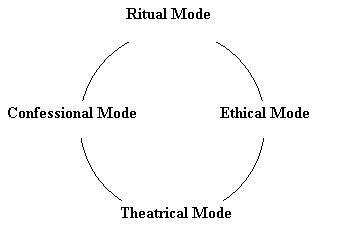
Fig 1 - MODES OF PERFORMANCE (after Tom F.
Driver)
This theory, although developed
for religion, is applicable to Masonry.
No I am not implying that Masonic ritual is religious. I am categorically stating that much of
religion is ritual, in that it uses symbols, repetitive action, separation of
space and time to convey emotional states and teachings.
The Masonic Degrees are an exquisite tension between Ritual, Theatrical,
Confessional and Ethical modes. The
allegory of meaning is concealed within a formalized method of delivery which,
nevertheless is intended to be communicated in a highly absorbing and
entertaining environment. The
wearing of unusual clothing and being divested of anything which might connect
one to the outside world through a careless touch or glance is removed, and the
neophyte enters a new dimension outside of time and space (this should mean no
clocks, no alarms, no cellular phones, and no profane signs of any kind,
including the “Fire Exit” signs sadly imposed upon us by overly intrusive
regulations. In truth, this list
should include “no artificial candles”, for the symbolism of three ‘natural’
luminaries describing a triangle is very profound and worthy of a paper in
itself…). And yet we do not intend
to bore him to death with dry, dull teachings. We present him with a kaleidoscope of
sensations and symbols which he will study with pleasure throughout his Masonic
career. The two opposing modes of
Confession and Ethics are also superbly balanced in our inspired Rites. The ceremony itself balances the things
the Candidate must do for himself, including his first spoken words upon
entering the Lodge, and his Obligation both to conceal and to study the teachings he will receive;
and those actions which this new community – the parts and characters within
this symbolic Temple – will do to and for him.
We will consider three aspects of ritual and relate them to the Masonic
experience: ritual as subversive,
ritual as teaching, and ritual as transcendence.
Ritual as
subversive
History has shown us that kings, presidents and the church alike have
been terrified of the power of ritual, and those of Freemasonry in
particular. From the Morgan Affair
and the Papal proscriptions of the 18th and 19th Century,
through the persecution of Freemasonry under both Fascism and Communism earlier
this century, to the present enforced public declarations of membership by
judges and policemen in England under the Labor Government, Masons have been
singled out for attack. Why is
this? And why should this be a good
thing for Freemasonry?
Ritual takes us away from Society,
even if only for a few hours. It
allows us, for a period, to overcome social alienation – in the famous wearing
of white gloves – and affords us an opportunity to talk with intelligent,
informed people about the state of our nation, without concern that our words
might be carried back to inimical forces by spies – our traditional cowans and
eavesdroppers. This might not seem
a big thing to us in the United
States, but ask a Mason in
Spain in the
1930s or occupied France in the 1940s for his opinion, and he will tell you that
a poorly chosen Candidate meant more than a disrupted Lodge – it probably meant
a firing squad. What we stand for
is contrary to any Society which seeks to control, segregate, repress or
persecute its habitants, and sadly that is the state of affairs in a majority of
the countries of this world. Our
Masonic meetings allow us to rehearse and debate teachings from an earlier time,
and many books have been written about how these deposits of mystical learning
were bought at the price of blood, and are a sacred heritage which it is our
duty and our joy to preserve and, in succession, to pass to the next
generation.This state of existence beyond the
threshold of daily Society has been described as “liminality”, which comes from
the Latin “limen” meaning threshold. Arnold Van Gennep described these rites
being flanked by ‘pre-liminal’ or separation rites, and ‘post-liminal’ or
reincorporation rites. Having been
separated from conventional reality through darkness, enclosure and androgynous
clothing, the candidates or “threshold people” are ambiguous entities which
float passively through the liminal rites which take place outside of time and
space, before being reintegrated by the post-liminal rites to take their place
among the new community. Van Gennep
described liminal ritual as being “frequently linked to death, to being in the
womb, to invisibility, to darkness,…to an eclipse of the sun or moon.” Masons will recognize many of these
allusions.
It is hardly surprising, therefore, as Tom Driver suggests: “As the
powers of nation-states have grown in modern times, so has the desire on their
part to eliminate as much liminality as possible from ritual performance,
because liminality can lead to a weakening of state control over people’s ideas,
emotions, and behavior.”
He continues: “Much goes on in rituals that would not be tolerated at
other times:
hand-clapping,…rhapsodic speech, cross-dressing, speech-song recitations,
direct address to invisible beings…public exchanges of affection, mystical union
with other participants…The liminality of rituals means that they are informed,
on the one hand, by a greater than usual sense of order and, on the other, by a
heightened sense of freedom and possibility.”
So ritual – and especially Masonic ritual – is a process which separates
the man from normal Society, and places him in a position in which to analyze
that Society with the symbolic tools he is given, and, if he finds Society
wanting in its stand on charity, fraternity, rights, God and nature, empowers
him to go out into that Society in order to change it for the better. No wonder Masons are seen as
subversive.
And here lies the paradox. According to Driver: “…Ritual stands in contradiction to
society while at the same time being a part of it.” Our ritual empowers us to live, act and
work within society but empowers us with the mission to change it for the
better. This empowerment given
through the liminal process of ritual internalizes this drive to a far greater
extent than a debating society or business meeting possibly could, for though
internalizing the symbols we become those symbols ourselves, symbols of what man
can achieve by right thinking, right acting and right saying. We have only to look to George
Washington to see those great Masonic symbols in action…
Ritual as
teaching
Our rituals are full of symbolic
teachings. We do not lay out the
secrets of our deposit like pearls before swine. We protect them, even from the ‘casual’
Mason, for only those who are prepared to work at understanding the meaning
behind the parables and allegories is truly worthy of that deposit. Ritual allows the deposit of knowledge
to be passed from generation to generation, unchanged, so that if one generation
fails to understand the true pearls therein contained, the message is
transmitted intact to the next generation, when someone might then discern the
wisdom within. Woe betide the
ignorant Keeper of the Work who decides to ‘modernize’, ‘abbreviate’, or ‘amend’
the ritual: he commits a capital
offense in the eyes of the early members who placed this sacred deposit in the
cure of our Mystery
School!As an aside, I remember a story – I think a Greek myth – being told in my early schooling, of an
old man who appears before a great king, carrying twelve books. When the king asks what he has in those
books the old man says: “Sire, they contain all the wisdom of mankind”. “How much will you sell them to me for?”
asks the king. “For half your
kingdom”, replies the old man. The
king laughs and says this is a ludicrous price. The old man then asks for a
brazier. Intrigued, the king has a
servant fetch a lit brazier. The
old man solemnly places six of the books into the brazier and burns them, to the
horror of the king. Then the old
man asks the king if he would like to buy the remaining six books. Shrewdly (for he is a wise king) the
king asks how much. “Half your
kingdom”, the old man replies. The
king shakes his head. Solemnly, the
old man places another three books in the brazier and they burn to dust…The king
promptly purchases the remaining three for half his kingdom!
Let not our great deposit be squandered in like manner, for if a
generation destroys some of the great symbolism in the name of ‘progress’ or
‘expediency’, the next generation cannot go back to the dead to ask them what it
meant!
There is a second reason we communicate our teachings through the use of
symbols. While allegories and
parables tell a story, it is only through the use of symbols that we truly
become a universal Brotherhood.
Language divides us, but ritual reassembles.
Roy Rappaport wrote: “The distinctions of language cut the
world into bits – into categories, classes, oppositions, and contrasts. It is in the nature of language to
search out all differences and to turn them into distinctions which then provide
bases for boundaries and barriers.”
And further: ”It is…in the
nature of (ritual) to unite, or reunite, the psychic, social, natural and cosmic
orders which language and the exigencies of life pull apart. It is of importance in this regard that
representation in ritual are often multi-modal, employing at one and the same
time words, music, noise, odors, objects and substances.”A ritual can act like a mantra or meditational exercise. It is not to be seen once and
forgotten: it is to be seen again
and again, whereby different messages and nuances are perceived and
understood. In Masonry, this effect
is enhanced considerably through the possibility of seeing the ritual through
the eyes of different participants, as the Brother takes first one then another
part in the mysteries as he progress in the Lodge. This lifetime of learning opens like a
rose to reveal the beauty within, to the intelligent and seeking eye.
Sadly, this value breaks down
when, as Driver writes, people: “do
not see the necessary correspondence between what they signify and the reality
of the …community in the world”.
Religion makes the same complaint.
There is little value in going to pray, then coming back into the world
unchanged, and continuing the same negative behavior as before. To return to Driver’s model, the
confessional mode should drive us towards the ethical mode: charity, right thinking, right acting
and right saying. While these are
not primary concerns of Masonry and its rituals, they are a visible and
confirming sign that the ritual has achieved success in communicating its
lessons; that they have not fallen on stony ground, but indeed have been
internalized and have become an unconscious part of the Brother’s daily
behavior. This is when learning
transforms us.Finally, one point which will be a little vexatious in the current
American Masonic climate, but one which I feel morally obliged to raise, is that
of Mass Initiation. I cannot
believe it is efficacious. It is
critical that the neophyte undergoes the experience of transformation, of liminalization himself. While the side degrees are often run as
theatrical experiences, in which the candidates watch the drama unfold by means
of a proxy, or exemplar, the first three Degrees of the Holy Saints John are too
important to be conferred en masse.
If I might give an extreme example, it is rather like a row of Jewish babies at
a bris watching one of them being
circumcised on their behalf; or a group of Confirmands watching the diocesan
bishop laying his hands on an exemplar for the class. How about those to be initiated into the
Mysteries of Eleusis sitting outside the cave and being given a brief summary of
what is happening to the one allowed into the cave to undergo the Rites? Or one which has been seriously
debated: the efficacy of a papal
blessing when watched on television?
Ludicrous examples, certainly!
But do they apply to Masonic initiation as well? I believe so.
Ritual as
transformational
Ritual can transform us in two ways: internally, in the way we learn to think
and to perceive things in a new way; and externally, in making us part of a new
community.
This external community has been called a number of things. It is not strictly a ‘club’ or even a
‘Fraternity’, for undergoing a transforming ritual is a far more powerful than
going out for a few drinks, or sharing in some community project. In mystical groups the term often
applied is “egregore”, or the collective thoughts and inspiration of previous
generations. If that is a little
too esoteric for some, the term used by Driver is “communitas”, which he defines
as: “a spirit of unity and mutual
belonging not existing outside ritual”.
In other words, charitable giving, a dinner, business meeting or coach
trip do not confer this common bond which transcends Lodge and even continent,
for any well-traveled Mason will tell you that the welcome received from those
who share this sense of “communitas” is as warm and sincere in a Lodge in New
York as in Namibia. Those who hold
out the hand of Brotherhood are not doing so on the strength of a dues card or a
common set of passwords and grips:
they are doing it out of a sense of common experience.
This transformation takes place at a number of levels. There is nothing which can describe the
excitement and joy of making that link between symbol and the external world
which opens up a whole new area of understanding to the perceptive Mason; that momentous instant when the interior
and exterior worlds link, and the Hermetic axiom “as above, so below” is once
more realized. In turn, this
realization or understanding leads the experiencer to enact that part of the
ritual with a greater understanding, with the result that those who also
understand that particular teaching will immediately realize that this Mason,
too, has the key to its interpretation:
while those who still seek its inner meaning will marvel at the depth of
feeling and command that Mason brings to his role.
I like to give the reader a means
in my papers to experience what I say on a practical level, and this is no
exception. One means of opening up
one’s uncritical mind to the power of the symbols which surround us in our
ritual is through using what is called ‘creative visualization’. When the reader next takes part in a
Masonic ritual, I would ask him to spend a few moments before the ritual begins
sitting quietly in his place or station, preferably with his eyes closed, and
imagine himself transported back to the historical time in which the ritual is
set. While any Officer in any body
can do this exercise, let us use the example of the Master in this Blue
Lodge. Let him imagine with all his
power of concentration that he is indeed King Solomon. He should feel the crown upon his head
(the top hat being magically transformed into its prototype!), the rich red and
gold robes enfolding his body, the scepter of power (for us the gavel) lying to
his right, the sensation of the opulent throne pressing against his body. Hear the muffled sound of workmen and
their subdued cries all around this great building site (for remember, no sound
of metal was to be heard). Feel the
heat of the noon day sun beating down;
the acrid, drying sand assaulting the nostrils. Now the eyes are opened and I guarantee
the words uttered by this new King Solomon will thrill the most experienced
ritualist in the room. At the
Obligation he will step down from his throne, leaving the triple dais and
walking across the great flagstones of the
Temple floor, aware of the eyes of
all his courtiers upon him. He
walks between the pylons formed by the Senior and Junior Wardens and enters the
holy place, to administer the vows to the faithful workmen kneeling in awe and
love before him, in the simple white vestments of the Apprentice who has earned
the Great Master’s approbation. See
the members of the ‘living temple’ arrayed on either side in the shadows, huge
and dread as the great statues of the Gods in the Egyptian Temples from which
this Great
Temple took its design. Then the Great King takes his position
before the great altar, and opens his mouth to speak…
Conclusion
In order to survive, Freemasonry
must be a society which offers more than making as many members as possible,
giving more money to charity, and organizing yet more committees, dinners and
events which the same dwindling number of stalwarts doggedly support. To those who say that our society would
attract far more members if we didn’t have Degrees, I would ask: then what do we have left to offer? Where will we find Candidate who do
not seek Light, and who long for long business meetings, relentless
collations and endless calls for charitable donations?We are a mystery school. Our gentle Craft is a place which
imparts important – and relevant – lessons about the nature of our relationship
with God, with each other, and with the earth. As with all mystery schools these
lessons are not poured out at the feet of the new student, but are revealed over
time to the true seeker of meaning in today’s fast and dangerous world. Our
message has never been more relevant.
It is taught through the allegory and symbolism of ritual.
Finally, as I am sure you have realized, in the Sufi parable which began
this paper, the straw which occupied the border guards so completely is all the
chaff and secondary attributes of Freemasonry – the pomp, the titles, the
dinners, the charities, the meetings, the business, the committees; while,
buried under all this superficial activity is the true way to wealth of the
spirit. The donkeys, under the very
noses of the guards, who failed to appreciate their value, represent the ritual!
Bibliography
Driver, Tom F., 1991, 1998. Liberating Rites. Westview Press.
Rappaport, Roy A., 1979. Ecology, meaning, and religion.
Berkeley,
CA: North Atlantic
Books
Van Gennep,
Arnold, 1908, 1960. The Rites of Passage. Trans. Monika B.
Vizedom and Gabrielle L. Caffee.
Chicago, University of
Chicago Press
back to top |