The Masonic Trowel

... to spread the cement of brotherly love and affection, that cement which unites us into one sacred band or society of brothers, among whom no contention should ever exist, but that noble emulation of who can best work or best agree ...


[What is Freemasonry] [Leadership Development] [Education] [Masonic Talks] [Masonic Magazines Online]
[
Articles] [Masonic Books Online] [Library Of All Articles]
[
What is New] [Links] [Feedback]

 Masonic quotes by Brothers


Email This Site To ...


Print This page

Help Me Maintain This Website!!!!!!

Click above graphic to make a fast and secure donation, so I can afford to keep his website going and growing!
List of Contributors

 Traduzca esta página al Español


Add To Favorites


Search Website For

 Traduire Cette Page A Français

 Übersetzen Sie Diese Seite Zu Deutsch


SYMBOLISM OF THE CENSER

by Harold Meij
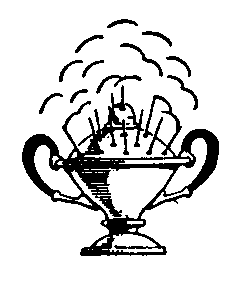


The pot of incense plays an important role in the third degree lecture, where it is explained that it is an emblem of a pure heart - but why is it?

Incense is often used to purify the air. In many religious ceremonies this is taken a step further, whereby incense purifies the people attending the religious ceremony (for example the incensing of the priest and congregation in a Catholic High Mass). When the Israelites wandered the wilderness for forty years, they build a tabernacle, a tent sanctuary used by the Israelites during the Exodus, and which they were able to put together and disassemble quickly as occasion required. Hence the furnishings were simple but deeply symbolic.

On the altar, offerings of fruit and other items were made, put next to a pot of incense, so that the proof of one's gratitude through prayers would rise with the smoke to Him. Hence, the pot of incense is also a central symbol in the 23rd degree (Chief of the Tabernacle) and is also present in the 24th degree (Prince of the Tabernacle).

The idea of smoke rising to Heaven is also extensively used in many religions and cultures, especially with funerals (like India). It is also interesting to note that a lesser known Egyptian God, Dedun (a.k.a. Tatunen) is the Egyptian God of wealth and incense, and is always portrayed with a censer on his head (symbol of purity and pure thought)

back to top


To translate this page to any language, click below and go to the bottom of the page

[What is Freemasonry] [Leadership Development] [Education] [Masonic Talks] [Masonic Magazines Online]
[
Articles] [Masonic Books Online] [Library Of All Articles]
[
What is New] [Links] [Feedback]


Legal Disclaimer

This site is not an official site of any recognized Masonic body in the United States or elsewhere.
It is for informational purposes only and does not necessarily reflect the views or opinion
of Freemasonry, nor webmaster nor those of any
other regular Masonic body other than those stated.

Books published prior to 1923 are online according US Pre-1923 Public Domain Rule.
The papers published are the responsibility of the authors.
Many Articles Taken from Various Sources.
A very sincere effort was made to avoid using any copyrighted material,
without permission, in the creation of this web site.
If you discover something that is yours without giving you due credit,
please let me know and due credit will be given or the item will be replaced.
For any copyright infringement claims please contact me.
Send email with questions or comments about this web site to webmaster.
Site Design Copyright © 2001 Joe M. Sanchez
Last modified: January 15, 2012